SMM News on April 30:
Price Review:
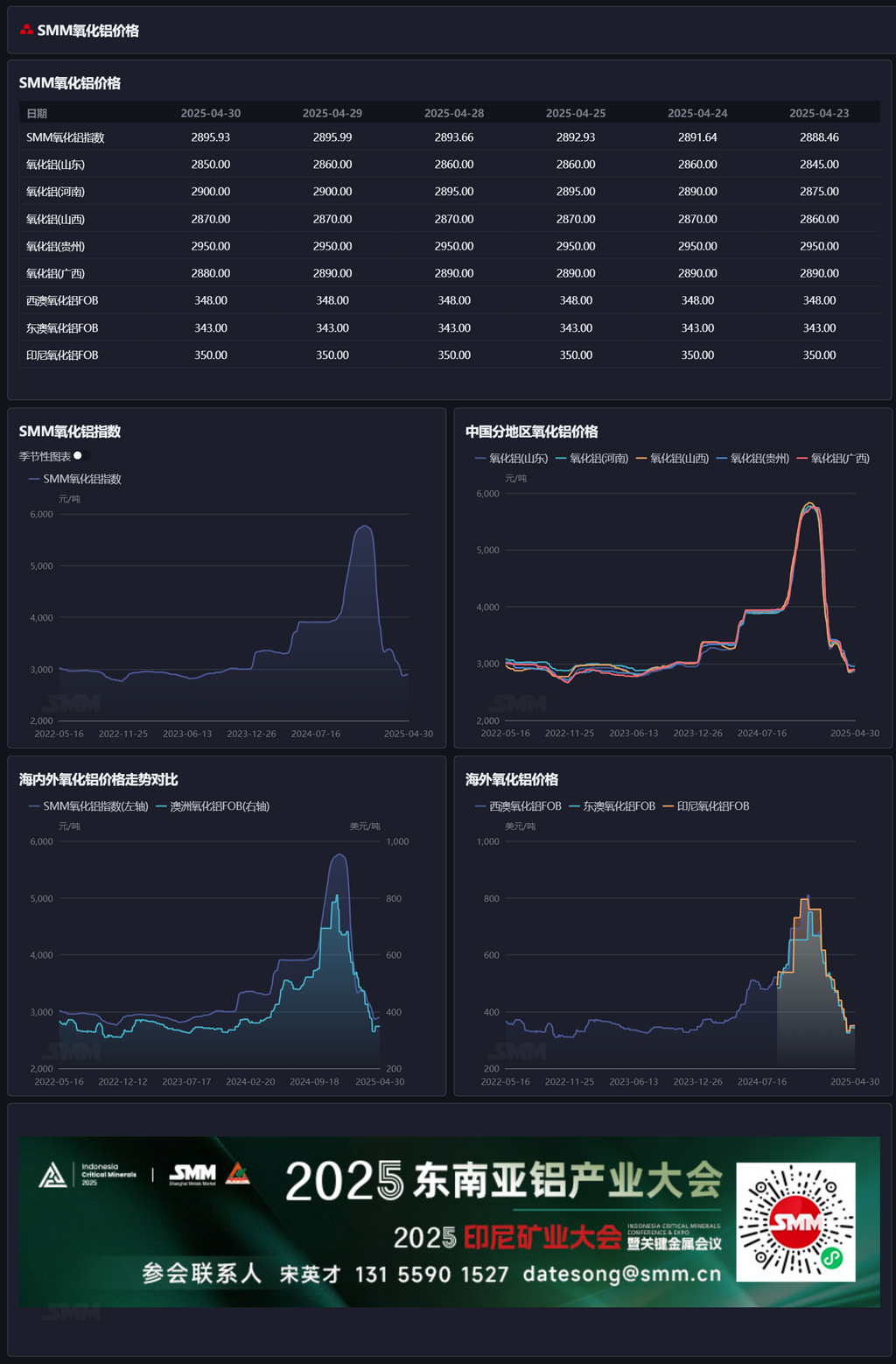
As of Thursday this week, the SMM Alumina Index stood at 2,895.93 yuan/mt, up 4.29 yuan/mt WoW from last Thursday. In Shandong, prices were reported at 2,820-2,880 yuan/mt, down 10 yuan/mt WoW from last Thursday. In Henan, prices were reported at 2,870-2,930 yuan/mt, up 1 yuan/mt WoW from last Thursday. In Shanxi, prices were reported at 2,870-2,930 yuan/mt, up 10 yuan/mt WoW from last Thursday. In Guangxi, prices were reported at 2,840-2,920 yuan/mt, down 10 yuan/mt WoW from last Thursday. In Guizhou, prices were reported at 2,930-2,970 yuan/mt, unchanged WoW from last Thursday. In Bayuquan, prices were reported at 3,110-3,190 yuan/mt.
Overseas Market:
As of April 30, 2025, the FOB Western Australia alumina price was $348/mt, with an ocean freight rate of $20.50/mt. The USD/CNY exchange rate selling price hovered around 7.29. This price translates to approximately 3,114 yuan/mt for the external selling price at major domestic ports, which is 218 yuan/mt higher than the domestic alumina price, keeping the alumina import window closed. This week, one new overseas spot alumina transaction was inquired about, with the transaction price unchanged from the previous one: On April 23, 30,000 mt of alumina was traded overseas at $347.5/mt FOB Bunbury/Kwinana/Gladstone, Australia, with a May shipment.
Domestic Market:
According to SMM data, as of Wednesday this week, the total installed capacity of metallurgical-grade alumina nationwide was 109.22 million mt/year, with a total operating capacity of 87.1 million mt/year. The national weekly alumina operating rate increased by 2.05 percentage points WoW to 79.75%, mainly due to the commissioning and ramp-up of new capacity, as well as the completion of maintenance and production resumption at some maintenance capacities. Specifically, the weekly alumina operating rate in Shandong remained unchanged at 91.74% WoW. In Shanxi, the weekly alumina operating rate increased by 2.8 percentage points WoW to 73.20%. In Henan, the weekly alumina operating rate decreased by 3.33 percentage points WoW to 52.50%. In Guangxi, the weekly alumina operating rate increased by 6.39 percentage points WoW to 95.03%.
During the period, alumina spot market transactions were sluggish. By region: Some alumina was procured through tenders by aluminum plants in Xinjiang, with delivery-to-factory prices around 3,160-3,220 yuan/mt. In Shandong, 2,000 mt of alumina was traded at 2,875 yuan/mt. In Henan, 2,000 mt of alumina was traded at 2,930 yuan/mt. In addition, some warrant cargo transactions were inquired about in Shandong, Xinjiang, and Guangxi this week, with significant discounts against the online prices.
Overall:
With the commissioning of new capacity and the resumption of production at maintenance capacities, the operating capacity of alumina has rebounded significantly, increasing by 3.48 million mt/year WoW. In the short term, some alumina refineries have plans for maintenance and production cuts, but at the same time, new alumina capacities will further ramp up production, and the operating capacity of alumina may show slight fluctuations. Overall, the tightening of alumina spot supply caused by the concentration of maintenance and production cuts in the early stage is expected to ease somewhat, and prices are expected to fluctuate in the short term.
![[SMM Flash News] South32 Revised Q4 '26 CIF MJP Premium Offer at US$265/mt](https://imgqn.smm.cn/usercenter/tkWbz20251217171654.jpg)