On April 23, at the CCIE-2025 SMM (20th) Copper Industry Conference and Copper Industry Expo - Main Forum, hosted by SMM Information & Technology Co., Ltd. (SMM), SMM Metal Trading Center, and Shandong Aisi Information Technology Co., Ltd., with Jiangxi Copper Corporation and Yingtan Inland Port Holding Co., Ltd. as main sponsors, Shandong Humon Smelting Co., Ltd. as a special co-organizer, and New Huang Group and Zhongtiaoshan Nonferrous Metals Group Co., Ltd. as co-organizers, SMM Big Data Director Jianhua Ye shared insights on the theme "Copper: Micro Drivers and Macro Volatility."

Macro - Unpredictable Dynamics
The manufacturing PMI of major global economies mostly remained below 50. Affected by geopolitical conflicts and US tariff policies, the copper/gold ratio declined, reflecting strong market risk aversion sentiment.
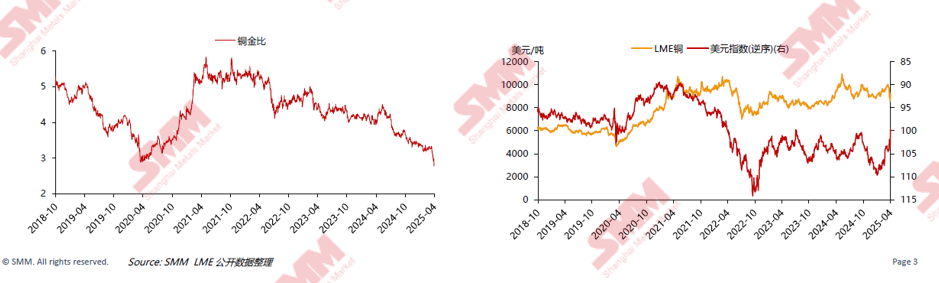
The US economy's "stagnation," "inflation," and "recession" disrupted global asset prices.
He analyzed data changes, including the US long-term and short-term Treasury yields, US non-farm payroll changes (previous values), the University of Michigan Consumer Sentiment Index, the University of Michigan Current Conditions Index, the University of Michigan Expectations Index, the US Markit Manufacturing PMI (final value), and the US Markit Services PMI: Business Activity (final value).
Key economic indicators in Europe began to recover, and a large-scale infrastructure investment fund was established to boost the economy.
He elaborated on the gradual reduction of Eurozone interest rates and the slowdown in the decline of Eurozone construction and retail confidence.
China's domestic consumer market needs further stimulation, while the export market will face greater challenges, and local bond issuance has accelerated.
He discussed the rising inventory area in the real estate sector, the continued negative growth in construction and completion areas, as well as export data and monthly local bond issuance.
The US reciprocal tariffs, anchored on the "trade deficit," aim to address the $36 trillion+ US debt, causing significant market volatility.
At 4:00 AM Beijing time on April 3, reciprocal tariffs were imposed on approximately 60 countries with the largest trade imbalances with the US, with rates far exceeding market expectations. An additional 10% baseline tariff will take effect at 12:01 AM ET on April 5, and reciprocal tariffs will take effect at 12:01 AM ET on April 9.
Canada and Mexico are excluded from this round of tariffs. Previously delayed tariffs will soon be implemented, and goods compliant with the USMCA will continue to be exempt.
Steel, aluminum, automobiles & parts, as well as copper, pharmaceuticals, semiconductors, lumber, and energy products, which are already subject to a 25% tariff under Section 232, are not affected by the reciprocal tariffs.
Supply: Global Copper Supply Tightening
The shortage of copper concentrates has intensified, and the short-term supply-demand structure is unlikely to improve.
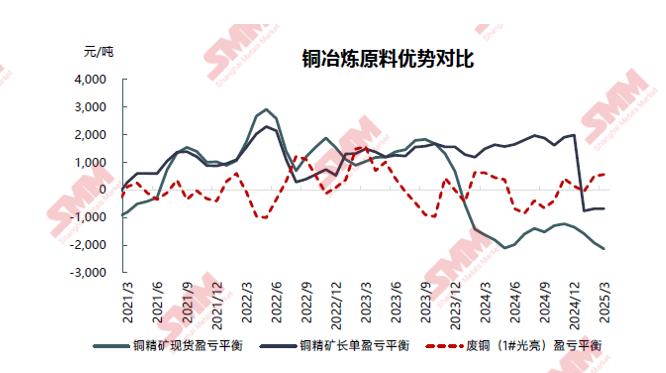
He analyzed the projected global copper concentrate supply-demand balance from 2021 to 2030 (including supply and demand disruption rates), annual long-term contract benchmark TC for copper concentrates, and the comparative advantages of copper smelting raw materials.
In 2024, US exports of secondary copper raw materials are expected to exceed 900,000 mt, equivalent to approximately 700,000 mt of metal content.
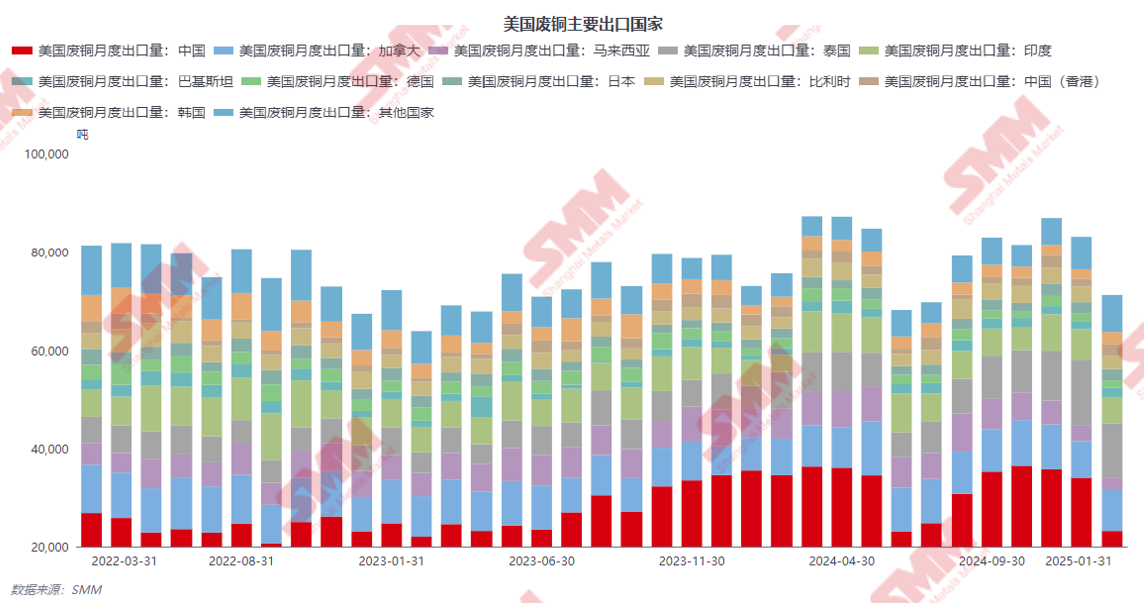
In the long term, China's copper scrap supply will increasingly rely on domestic production growth, with a higher proportion flowing to smelters.
Under tariff expectations, COMEX prices are strongly leading, with the US siphoning off global copper cathode.
He elaborated on the LME-COMEX copper price spread, the ratio of LME registered warrants to cancelled warrants, visible copper cathode inventories at the three major global exchanges, and total COMEX copper cathode inventories.
China's imports of copper cathode from Chile and Peru have significantly decreased, while the proportion from Africa continues to expand.
Based on the share of China's major copper cathode import countries, he reached the above conclusion.
With the decline in imported copper content, domestic copper cathode inventories are expected to decrease rapidly.
He introduced perspectives from SMM China's copper cathode production, spot import profit/loss & Yangshan copper premiums, China's copper cathode imports, and total domestic social inventories.
Demand: Divergence in End-Use Demand Structure
Although dependence on US trade is decreasing, the US remains China's largest single trading partner.
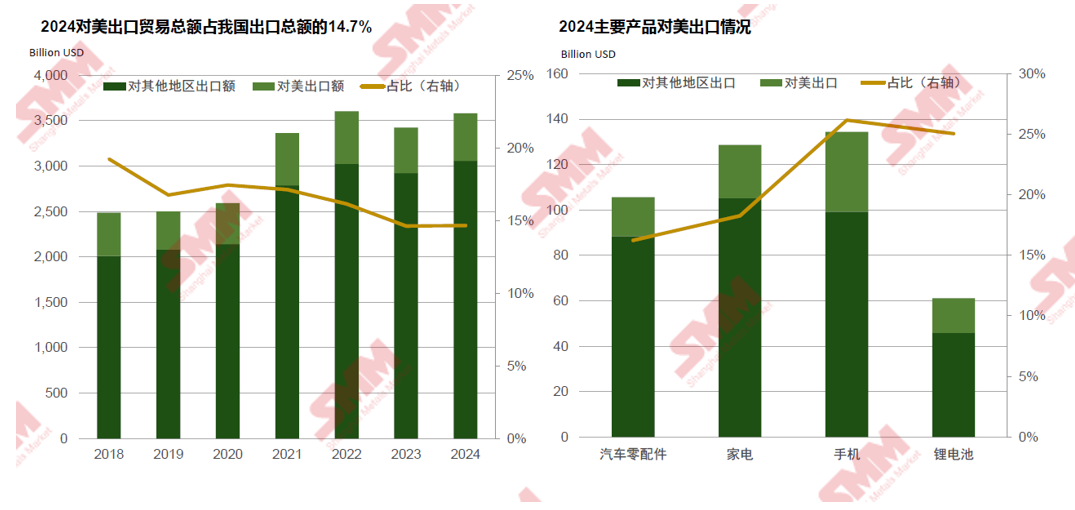
In 2024, exports to the US accounted for 14.7% of China's total export value.
Asia is the main export market for China's copper semis, making it susceptible to US pressure. By 2025, US copper scrap exports to China will decline significantly.
In 2024, exports of copper semis to the North American market reached 60,000 mt, accounting for 7.4% of total exports. Nearly 20% of China's copper scrap imports in 2024 came from the US.
In 2025, the State Grid Corporation of China plans to invest over 650 billion yuan, an increase of more than 7% YoY compared to the actual investment in 2024.
The construction sector remains in a negative growth trend and cannot yet provide positive feedback for copper consumption.
The negative growth in construction and real estate-related data has narrowed. SMM expects copper consumption in the construction sector to decline by nearly 2% YoY in 2025.
"Rush exports" demand persists, with domestic demand growing during the traditional peak season. The operating rate of copper pipe & tube remains high, but concerns about export demand are intensifying.
The operating rate of copper pipe & tube enterprises in April is expected to be 85.81%, up 0.58 percentage points MoM but down 0.72 percentage points YoY. Before the tariff policy takes effect, "rush exports" demand remains strong, with optimistic performance in March exports of air conditioners and copper pipe & tube. Domestic demand will strengthen in April during the traditional peak season. Although tariff disruptions increase, export growth is weaker than domestic growth. Overall, the operating rate of copper pipe & tube in April will stabilize at highs.
In the medium and long term, the new energy sector remains one of the main drivers of global copper consumption growth.
Global Copper Cathode Balance and Price Forecast
► In 2025Q1, before the implementation of Trump's tariffs, market risk sentiment increased, particularly regarding copper tariffs, which temporarily boosted COMEX copper prices, significantly widening the LME-CME price spread and maintaining a high spread. The US siphoned off a large amount of copper. Additionally, since December, US economic data has been relatively strong, inflation expectations have risen, and commodities have generally stabilized and rebounded. Domestically, favorable policies introduced at the beginning of the year boosted macro sentiment, benefiting copper prices. Fundamentally, the expected expansion of ore supply deficits and reduced copper cathode supply in 2025 also supported copper price increases.
► In 2025Q2, with the implementation of US reciprocal tariffs and intensified countermeasures from China, a tariff storm emerged. Coupled with weakening US economic data, the market anticipated economic damage from tariffs, leading to a sharp drop in copper prices, a global economic barometer. Subsequently, China may introduce various favorable policies to stimulate domestic demand. The US-China trade war began with significant measures, and copper prices may gradually rebound, supported by fundamentals (accelerated destocking outside the US, low inventories, and short squeeze expectations under a strong backwardation structure) and domestic favorable policies. However, it will be difficult to return to 80,000 yuan/mt.
► In 2025Q3 and Q4, as the negative sentiment from the trade war subsides, copper prices may stabilize. However, under the economic recession pressure caused by high tariffs, the surplus of copper cathode may increase. In Q3, copper prices may face upward pressure amid the supply-demand weakness caused by smelter production cuts and consumption damage. In Q4, the consumption damage caused by the trade war may weaken, global economic recovery expectations may gradually strengthen, and the effects of earlier relatively loose fiscal policies in the US and China may become evident. With high expectations for shortages in ore and copper cathode, copper prices may shift upward again.