With a growth rate of 2.6%, what happens when China’s aluminium production peaks?

Published: Apr 28, 2025 11:28
For the past two decades, China has dominated the global aluminium landscape with unparalleled force.

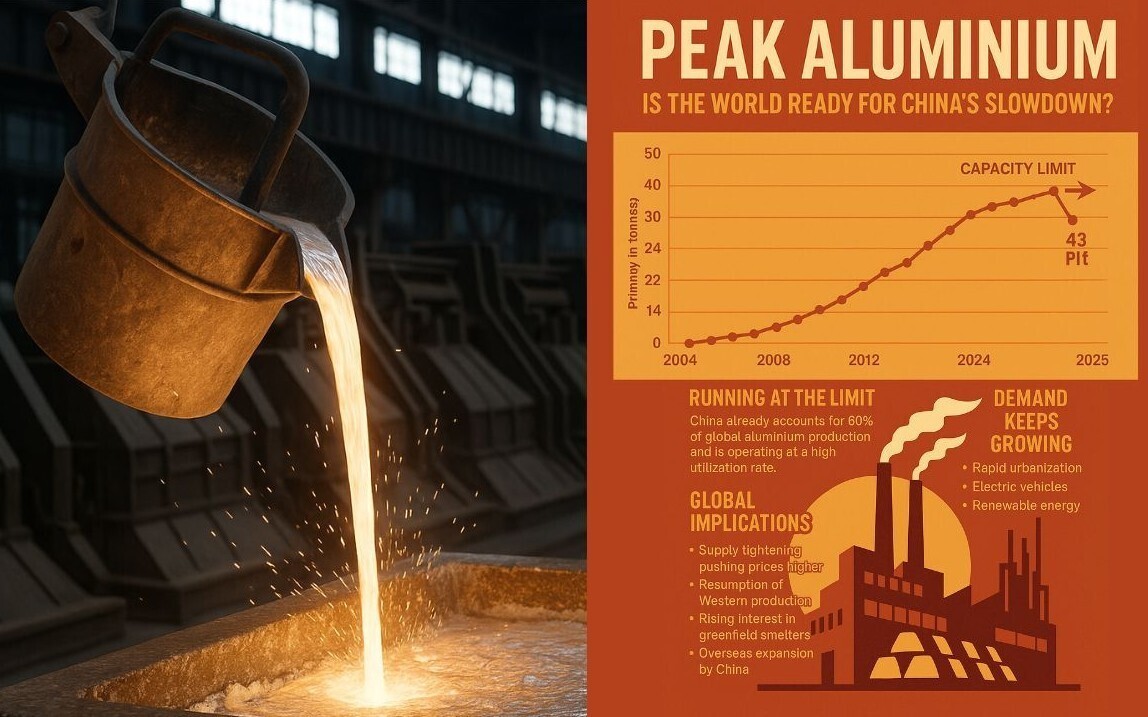
For the past two decades, China has dominated the global aluminium landscape with unparalleled force. From producing just 4 million tonnes in 2004, the country now commands a staggering 43 million tonnes of primary aluminium smelting capacity, accounting for 60 per cent of the world’s total. But now, in 2025, the dragon appears to be nearing its limits. As China approaches its government-imposed production ceiling with a 2.6 per cent growth rate during the first quarter of the calendar year, a monumental shift is on the horizon — one that could recalibrate global supply chains, trade dynamics, and pricing structures.
With a growth rate of 2.6%, what happens when China’s aluminium production peaks?
Image for representational purposes

If China’s aluminium production growth rate progresses in a similar pattern, the national production will reach 44 million tonnes, just one million tonnes away from the set cap. Thus, the aluminium world rightfully asks: What happens when China peaks?

The concept of ‘peak production’ isn’t new. Borrowed from the world of oil economics, it describes the point at which production hits its maximum before an inevitable plateau or decline sets in, not due to lack of demand, but due to constraints like raw material availability, cost pressures, or environmental regulations. For China, all three are now converging.

The country’s bauxite reserves, the cornerstone of aluminium production, are running low. At current rates, domestic resources might only last another 11 years. Compounding this, since 2017, the Chinese government has enforced a hard cap of 45 million tonnes of annual aluminium production to combat overcapacity and reduce the sector’s higher carbon footprint.

Adding to the pressure are rising input costs. Prices for energy and alumina, the key intermediate product, have spiked, with alumina contracts on the Shanghai Stock Exchange recording sharp increases in late 2024. Meanwhile, technological innovation, while ongoing, hasn’t advanced quickly enough to counteract these structural challenges.

Running at the limit

China’s aluminium industry is already operating near full throttle. By February 2025, its smelting capacity had hit 45.81 million tonnes, with operating output at 43.64 million tonnes — a utilisation rate of over 95 per cent. With little room left to grow, analysts now believe the industry is brushing up against its absolute limits.

Log in https://www.alcircle.com/news/with-a-growth-rate-of-2-6-what-happens-when-chinas-aluminium-production-peaks-113915 to read the full story for FREE

Source credit: https://www.alcircle.com/news/with-a-growth-rate-of-2-6-what-happens-when-chinas-aluminium-production-peaks-113915


Data Source Statement: Except for publicly available information, all other data are processed by SMM based on publicly available information, market communication, and relying on SMM's internal database model. They are for reference only and do not constitute decision-making recommendations.

For any inquiries or for more information, please contact: lemonzhao@smm.cn
For more information on how to access our research reports, please contact:service.en@smm.cn
Related News
[SMM Aluminum Flash News] UAE Imposes Four-Month Temporary Export Ban on Certain Aluminum Scrap
5 mins ago
[SMM Aluminum Flash News] UAE Imposes Four-Month Temporary Export Ban on Certain Aluminum Scrap
Read More
[SMM Aluminum Flash News] UAE Imposes Four-Month Temporary Export Ban on Certain Aluminum Scrap
[SMM Aluminum Flash News] UAE Imposes Four-Month Temporary Export Ban on Certain Aluminum Scrap
The UAE Ministry of Foreign Trade has issued Ministerial Decision No.105 of 2026, introducing a four-month temporary export ban on certain industrial wastes and scrap metals, including aluminum scrap under several HS 7602 codes. The measure takes effect seven working days after issuance, while shipments under previously signed international contracts may apply for exemptions. Aluminum scrap was previously subject to an export fee of AED 100/t (US$27/t). The move reflects the UAE's efforts to retain raw materials domestically and promote local value-added processing, with potential implications for Asian scrap markets, particularly India and South Korea.
5 mins ago
SHFE Cast Aluminum Alloy Warrants Drop to 33,243 MT on June 24
20 mins ago
SHFE Cast Aluminum Alloy Warrants Drop to 33,243 MT on June 24
Read More
SHFE Cast Aluminum Alloy Warrants Drop to 33,243 MT on June 24
[SMM Flash] Data from SHFE shows that on June 24, total registered warrants of cast aluminum alloy stood at 33,243 mt, a decrease of 453 mt from the previous trading day. Specifically, the registered volume in Shanghai was 3,558 mt, unchanged; in Guangdong, 5,199 mt, down 242 mt; in Jiangsu, 7,565 mt, down 121 mt; in Zhejiang, 10,730 mt, down 90 mt; in Chongqing, 5,346 mt, unchanged; and in Sichuan, 845 mt, unchanged.
20 mins ago
Data: SHFE, DCE market movement (Jun 24)
1 hour ago
Data: SHFE, DCE market movement (Jun 24)
Read More
Data: SHFE, DCE market movement (Jun 24)
The following table shows the ferrous and nonferrous metals movement on the SHFE and DCE on 24 Jun , 2026
1 hour ago
With a growth rate of 2.6%, what happens when China’s aluminium production peaks? - Shanghai Metals Market (SMM)