The proportion of unregistered copper cathode imports exceeded 70%. What are the reasons for the price increase? [SMM Analysis]

Published: Apr 27, 2025 11:06
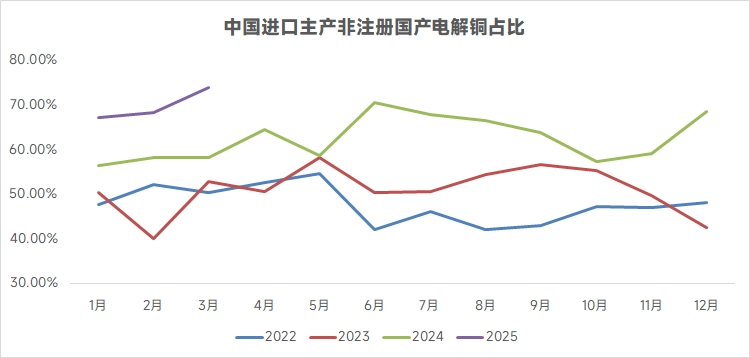
[SMM Analysis] According to customs data, China's copper cathode imports in March 2025 reached 308,800 mt. SMM compiled data showing that China's imports from major non-registered copper cathode producing countries amounted to 228,400 mt, accounting for 73.95% of the total, the highest proportion since 2022.
》View SMM Metal Quotes, Data, and Market Analysis

》Order and View SMM Metal Spot Historical Price Trends              

       According to customs data, China's copper cathode imports in March 2025 reached 308,800 mt. SMM compiled data shows that imports from major non-registered copper cathode producing countries amounted to 228,400 mt, accounting for 73.95% of the total, the highest proportion since 2022.


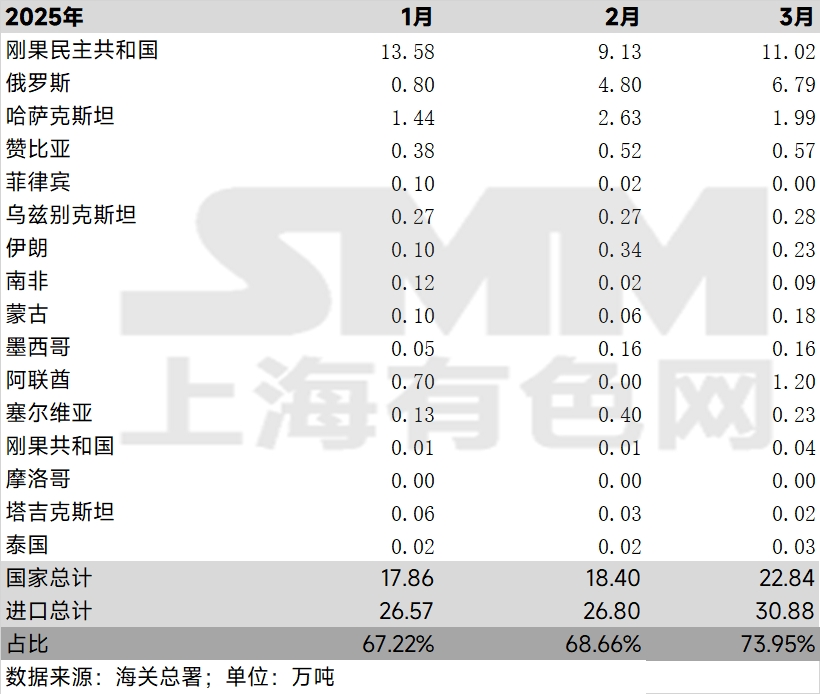
       By country, the highest import proportions in March were from the DRC and Russia, followed by Kazakhstan and the UAE. Notably, Russia's imports exceeded 60,000 mt in March. SMM learned that a significant amount of Russian copper will continue to flow into China, though the volume is not expected to exceed 60,000 mt per month. Future import volumes are not expected to grow, and the proportion of non-registered imports is likely to remain around 70%.
 

       Non-registered imports continue to increase, yet their prices have been rising in the domestic trade market. What is the reason?

       As the US siphons global copper cathode, shipments from Chile, Peru, and other countries to China have decreased, with a notable reduction in registered SX-EW brands arriving in China. Non-registered sources from Africa and Russia have served as substitutes. Meanwhile, secondary copper supply is tight, and as copper prices rise, downstream users favor lower-priced non-registered sources. Continued destocking of non-registered sources has driven their prices higher.


       Observing the ongoing convergence of the price spread between non-registered and SX-EW copper, it has a guiding effect on the price difference between copper cathode and copper scrap. When the price spread between non-registered and SX-EW copper shows a trend of convergence/divergence, the price difference between copper cathode and copper scrap will also tend to converge/diverge; this guidance can be observed one week in advance.



                                                                                                                 》View SMM Metal Industry Chain Database

 

Data Source Statement: Except for publicly available information, all other data are processed by SMM based on publicly available information, market communication, and relying on SMM‘s internal database model. They are for reference only and do not constitute decision-making recommendations.

For any inquiries or to learn more information, please contact: lemonzhao@smm.cn
For more information on how to access our research reports, please contact:service.en@smm.cn
Related News
Shanghai spot copper supply tightens, suppliers hold back sales and hold prices firm [SMM Shanghai spot copper]
1 hour ago
Shanghai spot copper supply tightens, suppliers hold back sales and hold prices firm [SMM Shanghai spot copper]
Read More
Shanghai spot copper supply tightens, suppliers hold back sales and hold prices firm [SMM Shanghai spot copper]
[SMM Shanghai Spot Copper] The Shanghai spot copper market is expected to continue exhibiting a weak supply-demand pattern. The contango spread between nearby months widened slightly, further encouraging suppliers to convert some spot cargo into warrants, limiting further tightening of spot liquidity. Some smelters have opted for stockpiling for delivery, coupled with suppliers' evident reluctance to sell and firm price-holding sentiment, resulting in limited tradable spot cargo in the market, which will support the spot discount structure. As the holiday approaches, downstream enterprises have generally slowed their procurement pace, with most having entered the final stage of pre-holiday stockpiling or production adjustment phases. Actual transaction activity is suppressed, and demand-side factors are unlikely to provide sustained boosts to prices. Amid intertwined factors such as high copper prices, tight supply, firm price-holding by suppliers, and pressure from the futures spread, spot discounts are expected to narrow slightly further tomorrow.
1 hour ago
February Spring Festival Impact Continues to Drive Down Brass Billet Operating Rate
2 hours ago
February Spring Festival Impact Continues to Drive Down Brass Billet Operating Rate
Read More
February Spring Festival Impact Continues to Drive Down Brass Billet Operating Rate
[ SMM Brass Billet Express ] Looking ahead to February, the brass billet industry is expected to face multiple pressures. Supply side, overseas offers are limited before the Chinese New Year, and supply of recycled brass raw materials remains tight. Demand side, orders in traditional sectors show no improvement, with enterprises mainly focusing on delivering existing orders and new orders being limited. Meanwhile, high and fluctuating copper prices, along with the Spring Festival holiday, will further dampen stockpiling willingness and shorten effective production time. The operating rate in February is projected to decline further.
2 hours ago
Poor Price Transmission Across the Supply Chain Keeps Copper Billet Industry Inventories at Low Levels
2 hours ago
Poor Price Transmission Across the Supply Chain Keeps Copper Billet Industry Inventories at Low Levels
Read More
Poor Price Transmission Across the Supply Chain Keeps Copper Billet Industry Inventories at Low Levels
[SMM Brass Billet Express] Copper prices fluctuated at highs in January, putting pressure on raw material procurement, while orders for brass billets contracted in industries such as valves and sanitary hardware due to difficulties in raising prices. Affected by high costs and reduced orders, some small copper billet enterprises began their holidays early from mid-to-late January. Currently, enterprises generally maintain low inventories to mitigate risks, with sample enterprises averaging only 3.95 days of raw material inventory and approximately 6.77 days of finished product inventory, reflecting overall weak stockpiling sentiment.
2 hours ago