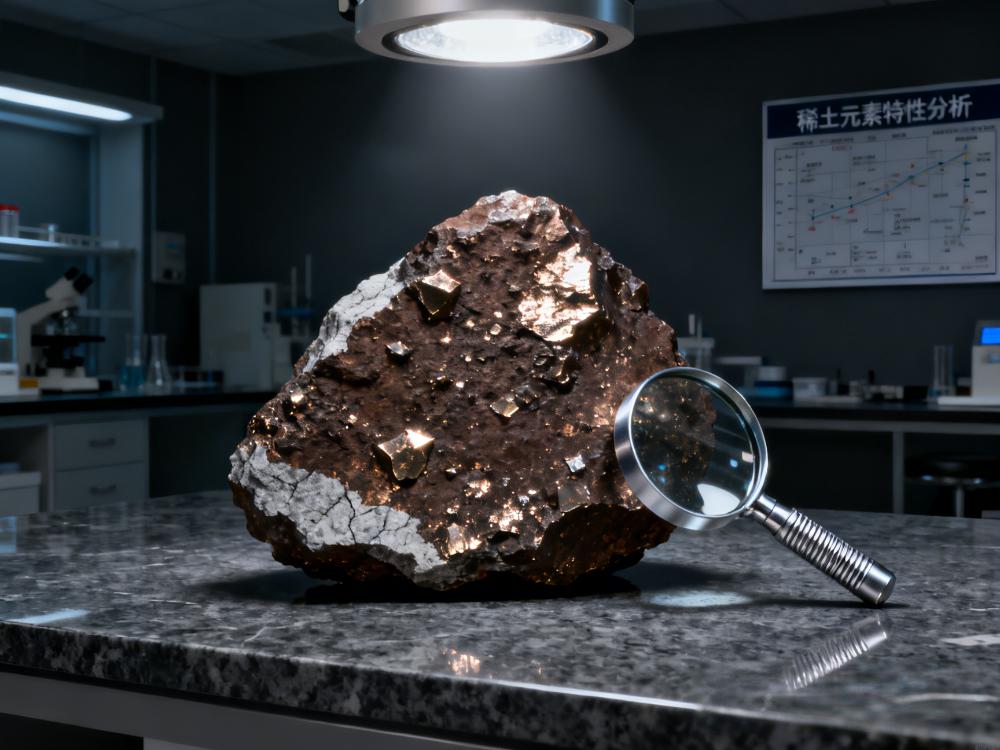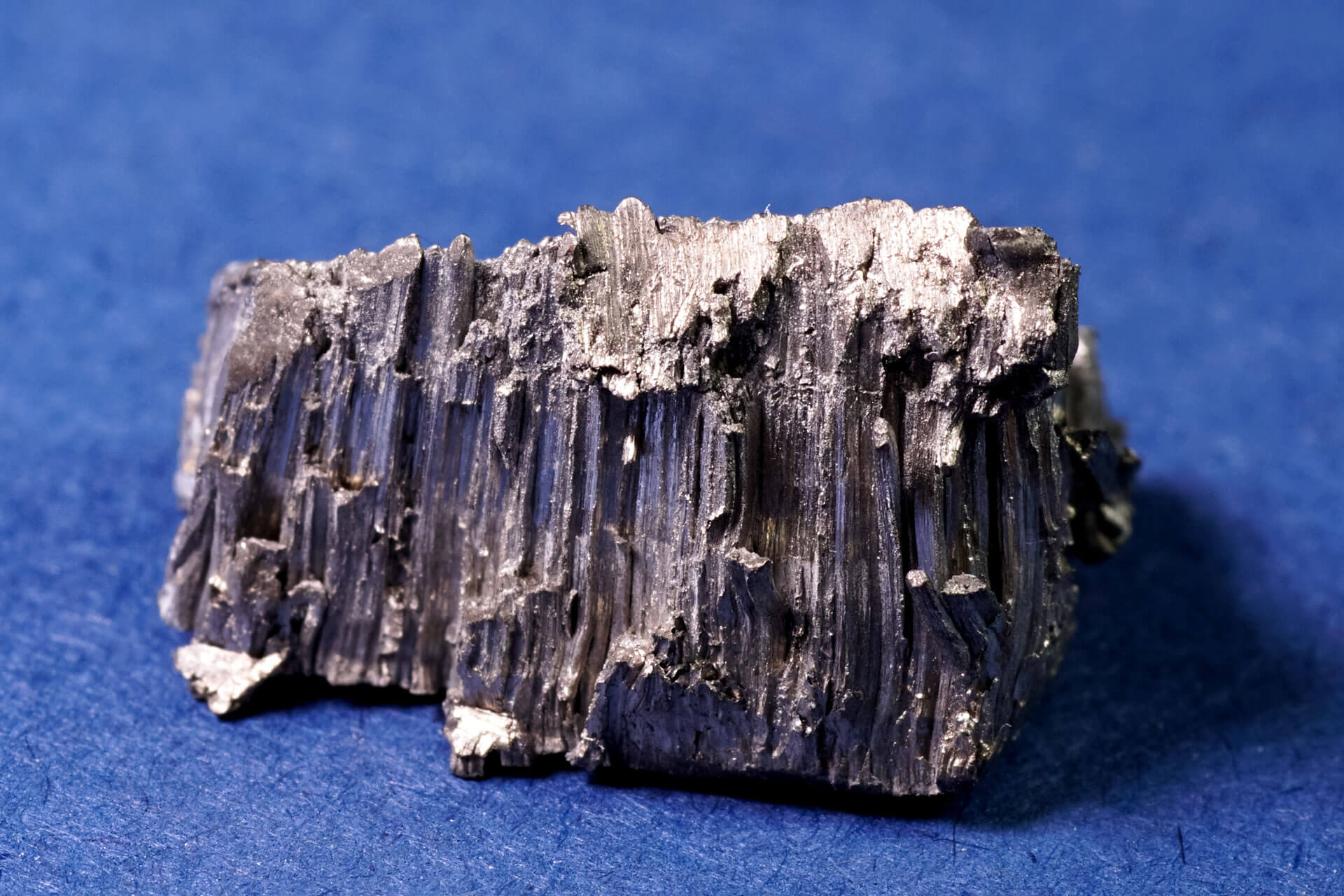
The rare earth market showed a two-tiered differentiation, with medium-heavy rare earth stabilizing after a decline. [SMM Rare Earth Daily Review]

Published: Apr 25, 2025 13:45
SMM Rare Earth Daily Review: Rare Earth Market Shows Divergence, Medium-Heavy Rare Earth Stabilizes. Today, the rare earth market prices exhibited a divergence trend. Specifically, in the oxide market, the price of Pr-Nd oxide decreased to 405,000-407,000 yuan per mt, the price of dysprosium oxide remained stable at 1.6-1.62 million yuan per mt, and the price of terbium oxide maintained at 6.74-6.8 million yuan per mt.

View SMM Rare Earth Quotations, Data, and Market Analysis

Order and View SMM Metal Spot Historical Price Trends

SMM, April 25: Today, the rare earth market prices showed a two-tiered differentiation trend. Specifically, in the oxide market, the price of Pr-Nd oxide decreased to 405,000-407,000 yuan per mt, the price of dysprosium oxide remained stable at 1.6-1.62 million yuan per mt, the price of terbium oxide maintained at 6.74-6.8 million yuan per mt, and the price of gadolinium oxide remained stable at 160,000-162,000 yuan per mt. The price of holmium oxide increased to 492,000-498,000 yuan per mt, while the price of erbium oxide fluctuated between 298,000-303,000 yuan per mt.

In the metal market, the price of Pr-Nd alloy decreased to 498,000-502,000 yuan per mt, the price of dysprosium-iron alloy remained stable at 1.6-1.61 million yuan per mt, the price of terbium metal decreased to 8.45-8.5 million yuan per mt, the price of gadolinium-iron alloy remained stable at 159,000-161,000 yuan per mt, the price of holmium-iron alloy increased to 505,000-515,000 yuan per mt, and the price of lanthanum-cerium alloy fluctuated between 17,000-22,000 yuan per mt.

Currently, the rare earth market prices overall show a two-tiered differentiation trend. In the medium-heavy rare earth market, as prices continued to decline, the selling frenzy among traders has ended, and the market prices have stabilized, returning to a relatively stable state. Meanwhile, in the light rare earth market, due to the lack of improvement in downstream end-use demand, the prices of Pr-Nd products continue to decline. Therefore, the rare earth market overall presents a two-tiered differentiation pattern, with medium-heavy rare earth prices stabilizing and light rare earth prices slightly weakening. It is expected that in the short term, the prices of medium-heavy rare earths will remain stable, while the prices of light rare earths may continue to weaken slightly.


Data Source Statement: Except for publicly available information, all other data are processed by SMM based on publicly available information, market communication, and relying on SMM‘s internal database model. They are for reference only and do not constitute decision-making recommendations.

For any inquiries or to learn more information, please contact: lemonzhao@smm.cn
For more information on how to access our research reports, please contact:service.en@smm.cn
Related News
Ex-China Rare Earth Projects Advancing Intensively, Pr-Nd Prices Driven Up by Tight Supply [SMM Rare Earth Ex-China Weekly Review]
Apr 17, 2026 14:38
Ex-China Rare Earth Projects Advancing Intensively, Pr-Nd Prices Driven Up by Tight Supply [SMM Rare Earth Ex-China Weekly Review]
Read More
Ex-China Rare Earth Projects Advancing Intensively, Pr-Nd Prices Driven Up by Tight Supply [SMM Rare Earth Ex-China Weekly Review]
This week, the ex-China rare earth market exhibited a trend of accelerated project deployment and price divergence. Price-wise, affected by undersupply in China, prices of praseodymium oxide, neodymium oxide, and corresponding metals rose notably, while other light rare earth and heavy rare earth prices remained generally stable. In terms of trading, Pr-Nd exports declined, and exports of heavy rare earths such as dysprosium and terbium remained restricted. Ex-China developments were active: US-based USA Rare Earth completed its first commercial yttrium metal casting and established a partnership with France's Carester; Japan launched a rare earth magnet recycling initiative for air conditioning compressors; Brazil's Aclara confirmed the commissioning plan for the Carina project in 2028; Canada's Neo achieved a breakthrough in terbium-dysprosium separation in Estonia; meanwhile, resource volumes in Finland, Alaska, Greenland, and other regions expanded significantly; Australia and the US provided financing for critical minerals projects; China's export controls raised European supply chain concerns; and Malaysian civil society organizations opposed the supply agreement between Lynas and the US Department of National Defense.
Apr 17, 2026 14:38
USA Rare Earth Produces Commercial-Grade Yttrium, Plans Major Expansion by 2030
Apr 17, 2026 13:56
USA Rare Earth Produces Commercial-Grade Yttrium, Plans Major Expansion by 2030
Read More
USA Rare Earth Produces Commercial-Grade Yttrium, Plans Major Expansion by 2030
[SMM Rare Earth Outside China] US rare earth producer USA Rare Earth (USAR) has produced commercial-grade yttrium metal through its wholly-owned subsidiary Less Common Metals (LCM). It is reported that the purity of the yttrium metal produced this time is between 99-99.5%. USAR acquired LCM in September 2025 for $125 million. LCM has a metal manufacturing capacity of 1,500 mt/year and plans to increase its rapid-solidification permanent magnet strip casting capacity by 26,000 mt/year in the UK, US, and France by 2030.
Apr 17, 2026 13:56
Swedish Mining Project Under Fire Over Indigenous Land Rights
Apr 17, 2026 12:24
Swedish Mining Project Under Fire Over Indigenous Land Rights
Read More
Swedish Mining Project Under Fire Over Indigenous Land Rights
According to Reuters, Swedish mining company LKAB is facing criticism after a report suggested its planned rare earths project near Kiruna could violate Sámi Indigenous rights. The deposit is estimated at around 1.2 billion tonnes of ore, containing about 2.2 million tonnes of rare earth elements, but the mine could interfere with traditional reindeer herding routes. The project is likely to face legal and social challenges as tensions rise between mineral development and Indigenous land use.
Apr 17, 2026 12:24