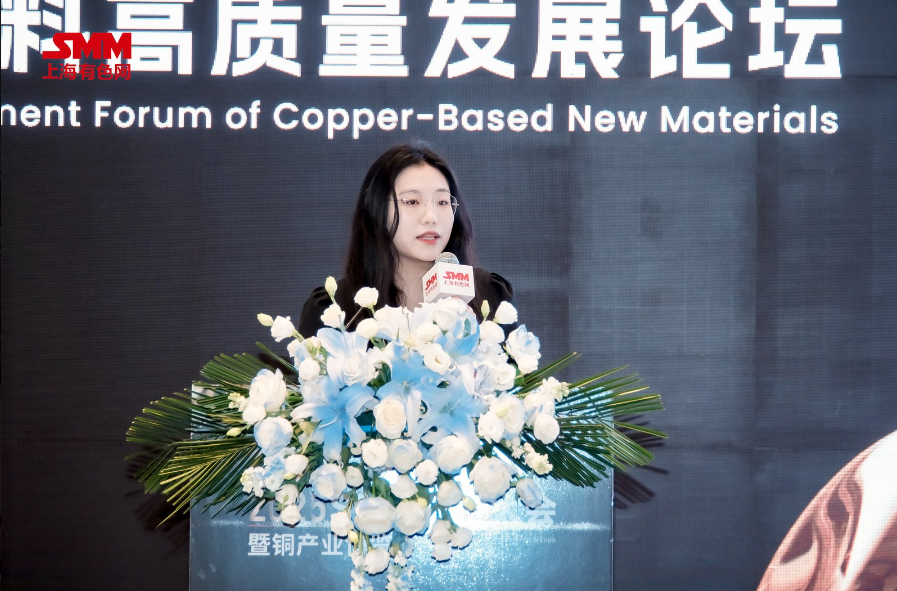
On April 24, at the CCIE-2025SMM (20th) Copper Industry Conference and Copper Industry Expo—High-Quality Development Forum for Copper-Based New Materials, hosted by SMM Information & Technology Co., Ltd. (SMM), Shanghai Nonferrous Metals Trading Center, and Shandong Aisi Information Technology Co., Ltd., with Jiangxi Copper Corporation and Yingtan Inland Port Holdings Co., Ltd. as main sponsors, Shandong Humon Smelting Co., Ltd. as a special co-organizer, and New Huang Group and Zhongtiaoshan Nonferrous Metals Group Co., Ltd. as co-organizers, SMM Senior Research Manager Shaoxue Yu delivered a presentation on the theme of "2025 Global Copper Foil Industry Landscape and Market Outlook."
1. Current Status of the Global Copper Foil Market
Global Copper Foil Capacity Distribution in 2024
By the end of 2024, global copper foil capacity is expected to reach 2.4202 million mt, including 1.436 million mt of lithium battery copper foil and 985,000 mt of electronic circuit copper foil. China's copper foil capacity will be 1.94 million mt, accounting for 80% of the global total. Jiangxi, Guangdong, and Taiwan provinces in China are the major global production hubs for copper foil.
Analysis of Global Copper Foil Capacity and Production, 2023-2025E
The capacity of both electronic circuit copper foil and lithium battery copper foil is expected to grow annually, with lithium battery copper foil expanding rapidly. By the end of 2024, global lithium battery copper foil capacity is projected to reach 1.44 million mt, with production at 840,000 mt, up 25.4% YoY. Global electronic circuit copper foil capacity is expected to reach 980,000 mt, with production at 590,000 mt, up 5% YoY.
►SMM Analysis:
In recent years, lithium battery copper foil capacity has expanded rapidly. Under severe overcapacity, price wars have erupted, intensifying market competition and increasing operational pressures on enterprises. Future capacity growth is expected to slow significantly.
The electronic circuit copper foil industry has a relatively stable foundation, with slower market expansion. However, there is a lack of capacity for flexible PCB copper foil and high-frequency, high-speed circuit copper foil, leading to reliance on imports.
Inventory Buildup Trend in Downstream Raw Materials in 2025Q2, Copper Foil Operating Rates Slow
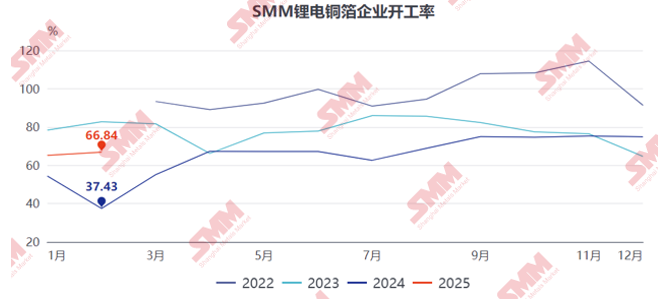
SMM expects the overall operating rate of copper foil enterprises in April 2025 to be 72.77%, up 0.95 percentage points MoM and 1.86 percentage points YoY. The operating rate for lithium battery copper foil in April is expected to be 69.77%, up 0.39 percentage points MoM and 2.47 percentage points YoY. The operating rate for electronic circuit copper foil in April is expected to be 78.60%, up 2.04 percentage points MoM and 1.07 percentage points YoY.
Tariffs to Impact Medium and Long-Term Downstream Consumption
In March 2025, SMM reported battery cell inventory at 216.0 GWh, up 1.6% MoM, with further inventory buildup expected in April.
►SMM Analysis:
End-use demand has rebounded, with increased production of both LFP and ternary battery cells. In the long term, disruptions from US-China policy dynamics are expected to lower forecasts for power and ESS demand.
From March to April, end-use demand rebounded to pre-holiday levels, with increases in battery cell production and shipments, and a decline in the inventory-to-sales ratio. In May, reciprocal tariffs imposed by the US are expected to impact some end-use demand, leading to continued inventory buildup for battery cells and limited growth in lithium battery copper foil operating rates.
US Tariffs Impact the Global Automotive Chain
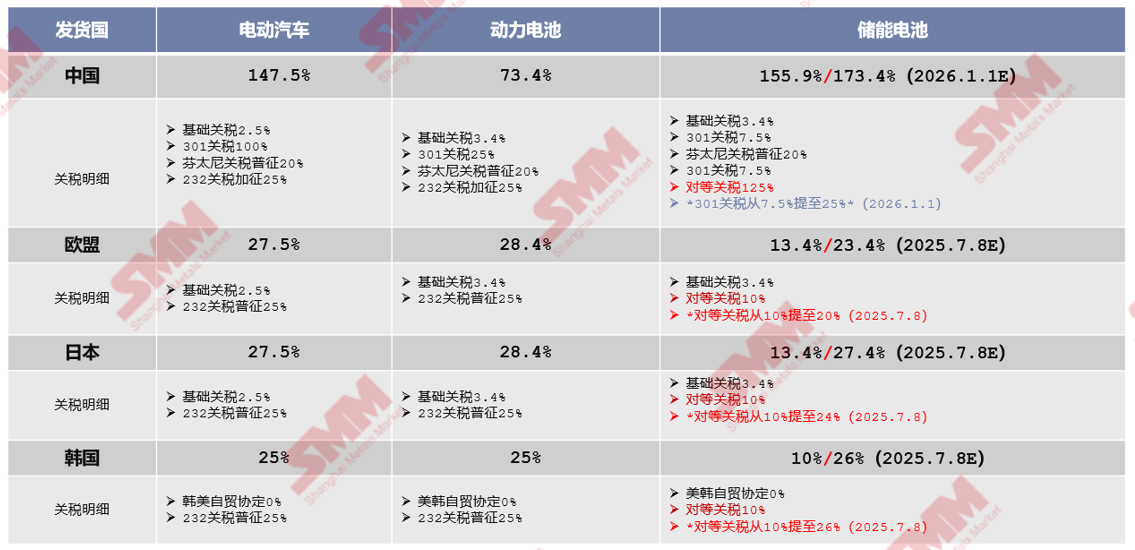
In 2024, China's NEV exports to the US accounted for less than 2% of China's total NEV exports. However, the US remains China's largest battery export market, which will suppress lithium battery consumption.
Optimistic Expectations for the NEV Industry Decline Under Tariff Impact
Under the US's widespread imposition of reciprocal tariffs, SMM has lowered its forecast for US auto sales in 2025. However, the Chinese market remains relatively optimistic, supported by policies to boost domestic demand and internal circulation.
►SMM Analysis:
Chinese Market: With the gradual implementation of national and local subsidy policies and old-for-new replacement policies, the end-user car market has shown signs of recovery.
Overseas Market: As NEV exports from Europe, Japan, and South Korea to the US are also affected by tariffs, SMM has revised down the forecast for US NEV sales growth to 3% (previously 6%).
China's Copper Foil Industry Faces Cut-Throat Competition, Processing Fees Once Fell Below Cost
With the continuous release of new capacity, severe overcapacity has emerged, intensifying market competition and cut-throat practices. Enterprises have lowered processing fees to compete for orders, leading to a continuous decline in copper foil processing fees.
►SMM Analysis:
Accelerating industry reshuffling and capacity exit.
Cost reduction and efficiency improvement, industry innovation.
Copper Foil Industry Entered a "Pain Period" at the End of 2023, Enterprises Generally Shifted from Profit to Loss
With the continuous release of new capacity, severe overcapacity has emerged, intensifying market competition and cut-throat practices. To compete for orders, enterprises have lowered processing fees. Behind the revenue growth without profit increase lies a severe supply-demand imbalance in the copper foil market.
►SMM Analysis:
Looking ahead to 2025, on one hand, as lithium battery demand continues to grow rapidly, copper foil processing fees are expected to rebound slightly. On the other hand, the industry will enter a phase of survival of the fittest, with potential mergers and acquisitions and the elimination of some capacity.
Tariff Impact on Copper Foil Industry Chain Export Demand
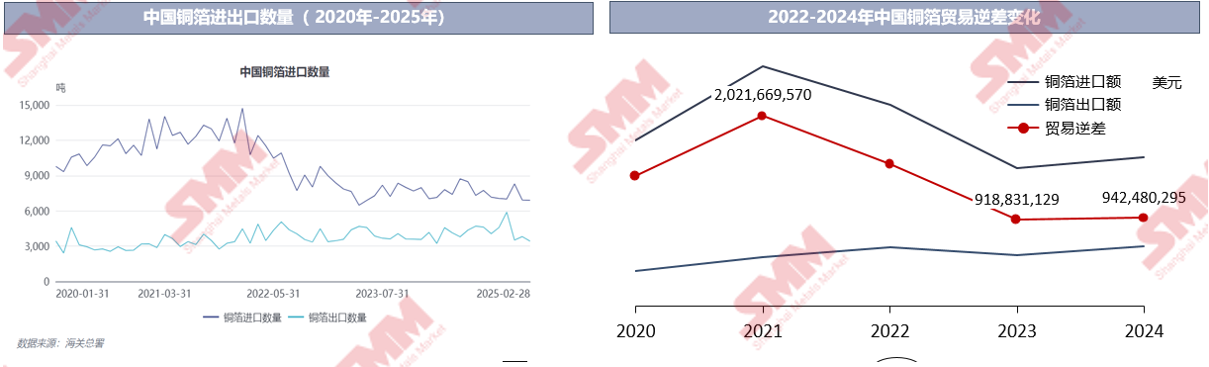
From raw materials to semi-finished products to end-use, the entire copper foil industry chain relies on exports. Domestic and overseas tariff policies will have a certain impact on copper foil consumption.
2. Global Lithium Battery Copper Foil Development Trends, 2025-2030E
Changes in Lithium Battery Copper Foil Thickness and Future Battery Production Analysis
As NEVs demand higher driving ranges, lightweight and thin designs have become the main trend. However, the copper foil usage per GWh will also significantly decrease.
►SMM Analysis:
Power Sector: Driven by the EU's "2030 Climate Target," battery capacity construction in Europe is accelerating. Due to tariffs, the capacity utilisation rate of the US's localized supply chain will also increase, but supply chain restructuring will take a long time.
ESS Sector: Driven by large projects in China, the US, Europe, and the Middle East, the global wind and solar energy storage allocation ratio will continue to rise.
Consumer Electronics Sector: With the emergence of new products such as AI smartphones and AI tablets, along with the implementation of related subsidy policies, the consumer electronics industry has shown signs of recovery.
Global Lithium Battery Copper Foil Production Growth Will Significantly Slow Down
With the continuous development of NEVs, energy storage systems, and portable electronic devices, lithium battery copper foil will continue to grow in scale, and capacity utilisation rates will continue to improve.
Behind the Difficulties Faced by Lithium Battery Copper Foil Enterprises Lies a Severe Supply-Demand Imbalance
An analysis of global lithium battery copper foil supply-demand balance was conducted from the perspectives of global lithium battery production, total demand, power battery demand, consumer electronics demand, ESS demand, comprehensive copper foil usage per battery, total global lithium battery copper foil demand, and global lithium battery copper foil supply.
3. Global Electronic Circuit Copper Foil Development Trends, 2025-2030E
Under the expansion of new industries, the growth rate of high-value-added products will significantly increase.
The rise of AI PCs and AI smartphones will also create new market opportunities for the copper clad laminate (CCL) industry, driving the development of special substrate CCLs.
►SMM Analysis:
With the continuous development of industries such as communications, automotive, and AI, as well as ongoing technological advancements, the global CCL sales market has certain growth potential.
In the future, high-value-added products will grow rapidly. For example, upgrades to AI servers and switches will drive demand for high-speed CCLs, while the rise of AI PCs and AI smartphones will also promote the development of special substrate CCLs.
After experiencing a downturn in previous years, the global electronic circuit copper foil market is warming up.
By 2030, driven by IDC construction, data communications, consumer electronics, and NEVs, global electronic circuit copper foil production is expected to reach 950,000 mt.
In the future, the pace of domestic substitution for high-end electronic circuit copper foil is accelerating.
Global Electronic Circuit Copper Foil Surplus Will Gradually Ease
SMM expects that after 2027, the global surplus of electronic circuit copper foil will significantly ease. Supported by strong policies, the Chinese market will maintain a stable recovery, while emerging markets in Southeast Asia have significant growth potential.
►SMM Analysis:
Communications Industry: The continuous development of 5G communications and the advancement of 6G technology R&D will drive the upgrading of communication infrastructure, increasing the share of high-frequency, high-speed CCLs.
Automotive Electronics Industry: With increasingly complex automotive electronic systems, the development of technologies such as autonomous driving, intelligent cockpits, and vehicle-road coordination will significantly increase the demand for PCBs, thereby driving stable growth in CCL demand.