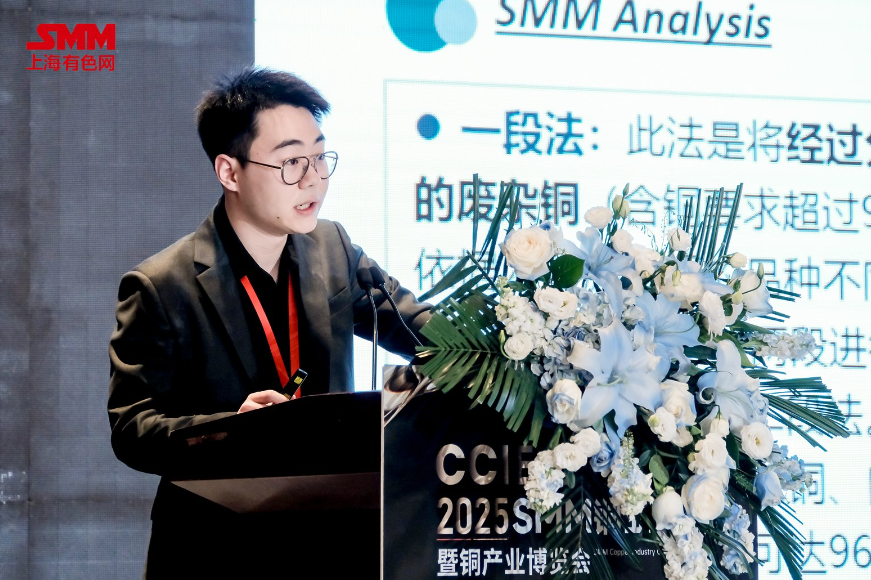
On April 24, at the CCIE 2025 SMM (20th) Copper Industry Conference & Copper Industry Expo - Secondary Copper Industry Green Development Forum, hosted by SMM Information & Technology Co., Ltd., SMM Metal Trading Center, and Shandong Aisi Information Technology Co., Ltd., with Jiangxi Copper Corporation and Yingtan Land Port Holdings Co., Ltd. as the main sponsors, Shandong Humon Smelting Co., Ltd. as the special co-organizer, and Xinhuang Group and Zhongtiaoshan Nonferrous Metals Group Co., Ltd. as co-organizers, SMM analyst Jiang Shanyu shared insights on how scrap-derived anode copper has become a critical supplement to copper smelting raw materials amid the backdrop of copper ore shortages.
1. Copper Scrap Smelting Process
►SMM Analysis
Direct Utilization (Flowing to the Processing End): Some scrap materials do not require smelting and can be directly used as substitutes for copper cathode in copper semis production, mainly in the secondary copper rod and brass billet industries.
Indirect Utilization (Flowing to the Smelting End): Some copper scrap needs to be used as a substitute for copper concentrates, requiring smelting into copper cathode before being supplied to users, known as secondary smelting.
Domestic copper scrap smelting primarily employs one-stage and two-stage methods.
►SMM Analysis
• One-Stage Method: This method involves directly adding sorted brass scrap and copper scrap into a reverberatory furnace for pyrometallurgical smelting, producing anode copper in one step. The advantages of this method include a short process, quick plant establishment, and low investment. However, it can only process scrap copper with relatively simple compositions (copper content exceeding 90%). Processing complex scrap copper is difficult, with long refining times, high labor intensity, low metal recovery rates (only 80–85%), and high copper content in slag (25–30%). Depending on the type of scrap copper fed into the furnace, the produced anode copper can be broadly classified into three categories: red copper anode, brass anode, and secondary blister copper anode.
• Two-Stage Method: This method is carried out in two stages. In the first stage, scrap copper is fed into a blast furnace for reducing smelting or into a converter for converting, producing blister copper. In the second stage, the blister copper is refined in a reverberatory furnace to produce anode copper. This method is called the two-stage method due to the two processes involved. The blister copper produced from blast furnace smelting is black in color, also known as black copper. Blister copper produced from converting scrap copper in a converter is also black. To distinguish it from blister copper produced from copper concentrates, it is often referred to as secondary blister copper. Brass scrap with high zinc content and white copper scrap are suitable for blast furnace smelting and reverberatory furnace refining processes. Scrap copper with high lead and tin content should first be converted in a converter to allow lead and tin to enter the converter slag. The secondary blister copper produced can then be refined in a reverberatory furnace or smelted in a blast furnace, achieving a copper recovery rate of over 96%, with only 0.8–2% copper in the slag and over 80% zinc recovery in the dust. The two-stage method is widely applied in China. Compared to the one-stage method, the two-stage method improves copper recovery by approximately 5% and reduces energy consumption by about 100 kg of standard coal per ton of anode copper.
• Three-Stage Method: Scrap copper is first smelted into black copper in a blast furnace, which is then converted into secondary blister copper in a converter. The secondary blister copper is sent to a reverberatory furnace for refining. This method involves three processes, hence the name three-stage method. The purpose of blast furnace smelting is to remove most of the zinc from the furnace charge and produce black copper with high impurities. The black copper is converted in a converter to remove impurities such as lead and tin, producing secondary blister copper. The secondary blister copper is refined in a reverberatory furnace to produce qualified copper anode. Although the three-stage method has a long process, increased equipment, higher investment, and a more complex procedure, it can handle various complex scrap copper compositions and has good comprehensive utilization, making it widely applied in many large secondary copper plants.
Anode Copper Smelting Process
2. Rapid Growth in the Supply of Scrap-Derived Anode Copper
China's Anode Copper Market Is Large
Deterioration of Copper Concentrate TC Forces Smelters to Seek Raw Material Supplements
The Proportion of Scrap Copper Flowing to the Smelting End Gradually Increases
Distribution of Anode Copper Capacity in China
►SMM Analysis
SMM statistics indicate that China's anode copper capacity (not for in-house production) is approximately 5.53 million mt, with a relatively high proportion using secondary copper as raw material, primarily distributed in east China. However, the actual capacity utilization rate is low.
Mineral-Derived vs. Scrap-Derived Anode Copper
Domestic Anode Copper Pricing Method: (buyer/seller selects the futures price minus the processing fee during the pricing period) × copper metal content.
►SMM Analysis
Mineral-derived anode copper is mainly concentrated in north China and circulates primarily in the form of long-term contracts, with relatively stable operating rates and processing fees.
Scrap-derived anode copper, influenced by factors such as policies, is mainly concentrated in south China, with relatively higher fluctuations in operating rates and processing fees.
Supply and Demand Distribution of China's Anode Copper Market
►SMM Analysis
The east China market has a large volume and high growth rate, but China still relies on imported anode copper. The northwest region has the largest deficit, with a significant mismatch between supply and demand.
In recent years, the production of scrap-derived anode copper has grown rapidly, with its proportion expanding year by year.
In recent years, anode copper imports have declined, while imports of secondary copper ingots have grown rapidly.
Domestic RCs have high volatility, blister copper imports are primarily under long-term contracts
►SMM Analysis
In recent years, due to tight copper concentrate supplies and increased demand following the expansion of overseas refined copper capacity, the supply of imported blister copper has been limited. The benchmark RCs for blister copper under long-term contracts has continued to decline, and spot imports are less active.
Copper prices affect the supply of secondary copper raw materials and the market demand for secondary copper rods, thereby causing fluctuations in domestic processing fees.
Refinery maintenance is one of the factors affecting anode copper demand.
• At the end of March 2025, Glencore Plc suspended copper shipments from its Altonorte smelter in Chile due to issues affecting the smelting furnace. The smelter primarily produces customized anode copper, with an annual copper production capacity of approximately 350,000 mt in metal content.
• An anode copper smelter in Zambia with a capacity of 350,000 mt in metal content will undergo maintenance from April to June 2025, affecting production during that period.
►SMM Analysis
Before smelter maintenance, refineries often stockpile anode copper to minimize the impact on copper cathode production during the maintenance period. After entering maintenance, the demand for blister copper and copper anode weakens.
Supply and Demand Balance of Anode Copper
►SMM Analysis
In recent years, the anode copper market has expanded rapidly, and with the decline in imports, supply has shifted domestically.
The growth in domestic anode copper supply mainly comes from the scrap-derived portion, with the proportion of scrap-derived anode copper increasing to about 65%, and the capacity to directly produce copper anode improving.
3. The Future of the Anode Copper Market
Strong Volatility in the Supply of Secondary Copper Raw Materials
►SMM Analysis
In 2024, China's copper scrap imports were approximately 2.25 million mt, up 13.26% YoY.
Domestic copper scrap supply is dependent on copper price fluctuations. When copper prices rise, suppliers of secondary copper are more willing to sell; conversely, they tend to hold back cargoes when prices fall.
Frequent Policies in the Secondary Copper Industry in Recent Years
►SMM Analysis
"Reverse Invoicing": Starting from April 29, 2024, when natural persons selling scrap products (hereinafter referred to as sellers) sell scrap products to resource recycling enterprises, eligible resource recycling enterprises may issue invoices to the sellers (hereinafter referred to as "reverse invoicing"). Scrap products refer to products that have lost all or part of their original use value during social production and consumption processes. Sellers refer to natural persons who sell scrap products they have used or purchased scrap products, with cumulative sales not exceeding 5 million yuan (excluding VAT) under "reverse invoicing" for no more than 12 consecutive calendar months.
Fair Competition Review Regulations: Article 10 stipulates that policy measures drafted by drafting units shall not contain the following content affecting production and operation costs without legal or administrative regulatory basis or without the approval of the State Council: (1) granting tax incentives to specific operators; (2) granting selective or differentiated fiscal rewards or subsidies to specific operators; (3) granting preferential treatment to specific operators in terms of factor acquisition, administrative fees, government funds, and social insurance premiums; (4) other content affecting production and operation costs.
US tariff policy: Affected by the anticipation that Trump would raise tariffs on China, many large Chinese copper scrap traders have gradually suspended imports of secondary copper raw materials and secondary copper alloy raw materials from the US. Considering factors such as shipping schedules and customs clearance, traders are concerned about potential retaliatory measures from China, which could lead to a sudden increase in tariffs.
It is expected that the proportion of copper scrap flowing to the smelting end will gradually increase in the future.
►SMM Analysis
Driven by factors such as the boost from China's "program of large-scale equipment upgrades and consumer goods trade-ins" policy, the establishment of the China Resources Recycling Group (a central state-owned enterprise), and copper prices fluctuating at highs, it is expected that domestic copper scrap supply will continue to grow. However, imports may decline in 2025.
In the coming years, due to the ongoing shortage of copper concentrates, SMM expects that more copper scrap will flow to the smelting sector.
Future growth in demand for copper anode may slow down.
Domestically, the growth rate of refining capacity is expected to remain higher than that of smelting capacity in the future. The resulting gap theoretically needs to be filled by copper anode and copper scrap.
Overseas, although there will be expansion in copper anode capacity in the future, it is fundamentally a transfer of copper concentrate raw materials. However, due to the shortage of copper concentrate raw materials, it will be difficult to achieve the target of increasing smelting capacity, which may lead to a decline in global smelting production and a widening of the gap with refining capacity.