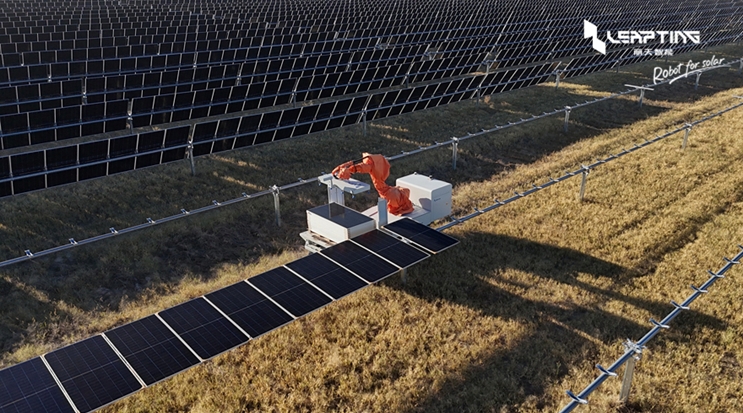
Since the LEAPTING Automatic Navigation PV Module Mounting Robot developed was officially deployed at the Australian project site in early February, within less than two months, under the rigorous monitoring of LEAPTING's professional team, the robot has successfully completed its first commercial PV module installation project in the Australian market. The project has achieved efficient, safe, and stable installation of nearly ten thousand modules, significantly reducing the original construction schedule.
Recently, the professional team from LEAPTING, accompanied by this advanced robotic system—the "Automatic Navigation PV Module Mounting Robot"—has returned successfully. The successful completion of this project not only marks a significant breakthrough for LEAPTING in the Australian photovoltaic energy market but also establishes it as the first exemplary commercial case in the field of intelligent module installation. This achievement sets a new benchmark for intelligent installation solutions for photovoltaic modules in both the Australian and global markets.
Assisting power stations in achieving efficiency improvements and cost reductions while eliminating safety hazards
Driven by the global carbon neutrality goal, the scale of photovoltaic clean energy construction is expanding at an unprecedented rate, with increasingly diverse and complex application scenarios. For example, in the construction of large-scale photovoltaic power stations, the number of photovoltaic modules may reach millions. Furthermore, as modules enter the era of high-power, their size has significantly increased, with weights exceeding 30 kilograms. These factors impose higher demands on traditional manual handling and installation methods. Additionally, large-scale power stations are typically located in remote areas with harsh construction environments and intense sunlight, further increasing safety risks and uncertainties during the construction process.

In light of these challenges, the owner of this Australian project chose to collaborate with LEAPTING. As an enterprise specializing in providing intelligent robotic solutions for the entire lifecycle of photovoltaic power stations, LEAPTING is committed to addressing industry pain points through technological innovation. The owner aims to leverage LEAPTING Automatic Navigation PV Module Mounting Robot to effectively address issues such as insufficient human resources, low manual installation efficiency, and high safety risks. By replacing labor-intensive manual operations with intelligent technology, the goals of improving efficiency, reducing costs, and enhancing construction safety can be achieved.
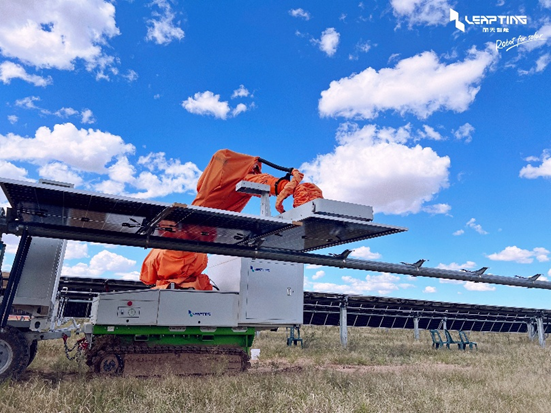
Module installation is fast, accurate, and stable, shortening the project cycle by 25%
It is reported that this project is located in New South Wales, Australia. The region is characterized by vast expanses and sparse population, with complex and variable climatic conditions. However, due to its extremely high light intensity, it is an ideal location for constructing large-scale photovoltaic power stations. The LEAPTING Automatic Navigation PV Module Mounting Robot is equipped with advanced automatic navigation systems and high-precision visual recognition technology, enabling it to adapt to various complex terrains and environmental conditions. As China's first photovoltaic module installation robot capable of independently adapting to complex working environments, it achieves real-time sensing and precise identification of the power station infrastructure environment through the integration of high-precision intelligent perception systems, visual recognition algorithms, and multimodal 3D sensors. Specifically, the robot can accurately determine the installation position and angle of the modules and precisely align them onto the supports.
In the past, installing a single photovoltaic module weighing over 30 kilograms typically required 3 to 4 workers to complete the entire transportation and installation process. Now, with the assistance of the Automatic Navigation PV Module Mounting Robot, the entire process can be completed in just 1 minute. Moreover, traditional manual installation methods often lead to project delays due to weather conditions, labor shortages, or human operational errors, and may even result in personnel injuries. However, after introducing robot-assisted operations to replace manual work, the installation efficiency has increased 3 to 5 times compared to manual labor. The overall construction cycle of this project has been successfully shortened by 25%, while achieving zero damage to both personnel and modules. Through the detailed insights shared by Mr. Lu Tao, Senior Manager of the International Sales Department at LEAPTING, the research and development purpose of the Automatic Navigation PV Module Mounting Robot is once again validated—to provide a more efficient and intelligent installation solution for photovoltaic power stations, thereby significantly reducing the labor intensity of manual work.
For more information: https://youtu.be/EL1VU2KPPRg
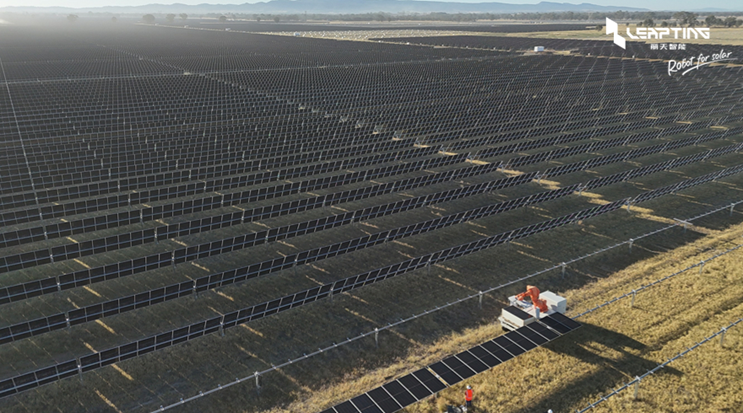
Next, following a brief period of debugging and performance testing, the Automatic Navigation PV Module Mounting Robots will embark on another journey to Australia in early May to support the construction of another large-scale photovoltaic power station. The infrastructure construction of this new round of power station projects will involve the installation of nearly half a million photovoltaic modules. Otherwise, LEAPTING will deploy multiple robots to work collaboratively, further enhancing construction efficiency and reliability.
Here, we sincerely invite all partners of LEAPTING to continuously follow our next progress and jointly witness the outstanding performance of this intelligent solution in the field of energy construction.
【About LEAPTING】
Huzhou LEAPTING Technology Co., Ltd. specializes in the development and provision of intelligent robots for photovoltaic energy applications. As a leading manufacturer of intelligent robots for photovoltaic power plants, we integrate R&D, design, manufacturing, and comprehensive service delivery to provide cutting-edge solutions. The company's product line includes a comprehensive range of intelligent robots for photovoltaic power plants, covering module mounting, power plant inspection, module cleaning and other applications. Each product integrates advanced technologies such as automatic driving and digital twin, and is supported by big data cloud platform and IoT system. We deliver high-performance, high-quality and cost-effective customized robot solutions for photovoltaic power plants.
PR contact: hailey.fan@leapting.com
![[SMM PV News] US Solar Faces Labor Shortage Ahead of 'OBBBA' Deadline](https://imgqn.smm.cn/usercenter/xBtJB20251217171738.jpg)
![[SMM PV News] France Unveils 2026 Solar Auction Calendar and New Supply Rules](https://imgqn.smm.cn/usercenter/CpbPE20251217171736.jpg)
![[SMM PV News] Gulf Conflict Shifts Energy Markets, Impacting 'PPAs' and 'BESS'](https://imgqn.smm.cn/usercenter/xAoMy20251217171743.jpg)