At the CLNB 2025 (10th) New Energy Industry Chain Expo - Hydrogen Energy Industry Development Forum hosted by SMM Information & Technology Co., Ltd. (SMM), Professor Wu Xiaohua from the School of Automotive and Transportation at Xihua University shared insights on the topic of "Economic Analysis of Hydrogen Use in Fuel Cell Commercial Vehicles." She stated that hydrogen energy technology plays a crucial role in the transition to low-carbon transportation, offering unique value. It demonstrates significant advantages in long-range driving, heavy-duty transport, low-temperature adaptability, and rapid refueling, with economic and environmental benefits already emerging in scenarios such as port logistics, intercity freight, and public transportation. However, challenges such as high costs in hydrogen production, storage, and transportation, an incomplete hydrogen refueling infrastructure network, and the need to improve the localisation rate of core technologies currently hinder its cost competitiveness compared to traditional internal combustion engine vehicles and pure electric commercial vehicles. With breakthroughs in large-scale green hydrogen production technology and the continuous decline in fuel cell system costs, the life cycle economics of hydrogen fuel cell commercial vehicles are expected to achieve a leap forward in the next 5-10 years.
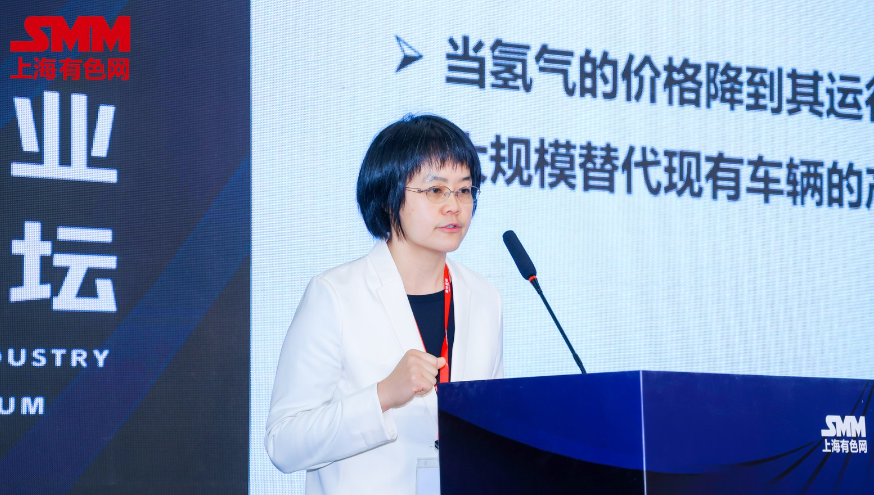
Economic Analysis of Hydrogen Use in Fuel Cell Commercial Vehicles
National Energy Security and Carbon Neutrality Strategy Urgently Require New Energy
Hydrogen energy is globally recognized as a key carrier for energy transition and an important pathway to achieving carbon neutrality goals. Fuel cell vehicles, the most significant form of hydrogen energy utilization, are included in the national hydrogen energy industry development plan.

Hydrogen energy and new energy vehicles are strategic emerging industries in Sichuan Province and will become new pillars of Sichuan's modern industrial system.
Sichuan Province is a major producer of clean energy in China, but the utilization of clean energy is insufficient, making its integration a significant scientific challenge.
The hydrogen energy and fuel cell vehicle industry is a key solution to this issue. In particular, the widespread adoption of fuel cell commercial vehicles will play a decisive role in addressing the above problems.
In 2024, Sichuan Province's peak shaving and abandoned hydropower exceeded 10 billion kWh. According to the hydrogen energy industry plan, by focusing on hydropower-to-hydrogen technology and developing large-scale hydropower-to-hydrogen technology, the potential for renewable energy hydrogen production will reach 500,000 mt/year, greatly enriching the means of renewable energy resource integration.
The "Sichuan Province Action Plan for Further Promoting the Development and Application of the Entire Hydrogen Industry Chain (2024-2027)" (Chuan Ban Fa [2024] No. 48) requires "further expanding the application of hydrogen fuel cell vehicles."
Commercial vehicles in China contribute nearly 75% of freight transport, and their carbon emissions account for 77% of road traffic emissions.
Hydrogen fuel cells, which meet the demands of heavy-duty and long-range applications, are an inevitable choice for the electrification of commercial vehicles.
Commercial vehicle applications are primarily operational, making them highly sensitive to the economics and lifespan of the power system.
Cost Analysis of Hydrogen Fuel Cell Commercial Vehicles vs. Internal Combustion Engine and Pure Electric Commercial Vehicles
When the price of hydrogen drops to a level where its operating costs are lower than those of diesel or pure electric vehicles, hydrogen fuel cell vehicles are considered to have the industrial foundation for large-scale replacement of existing vehicles, and the large-scale commercial operation model of hydrogen fuel cells becomes viable.
When the price of hydrogen fuel falls below 20 yuan/kg, it will have strong appeal in the commercial vehicle end-use market.
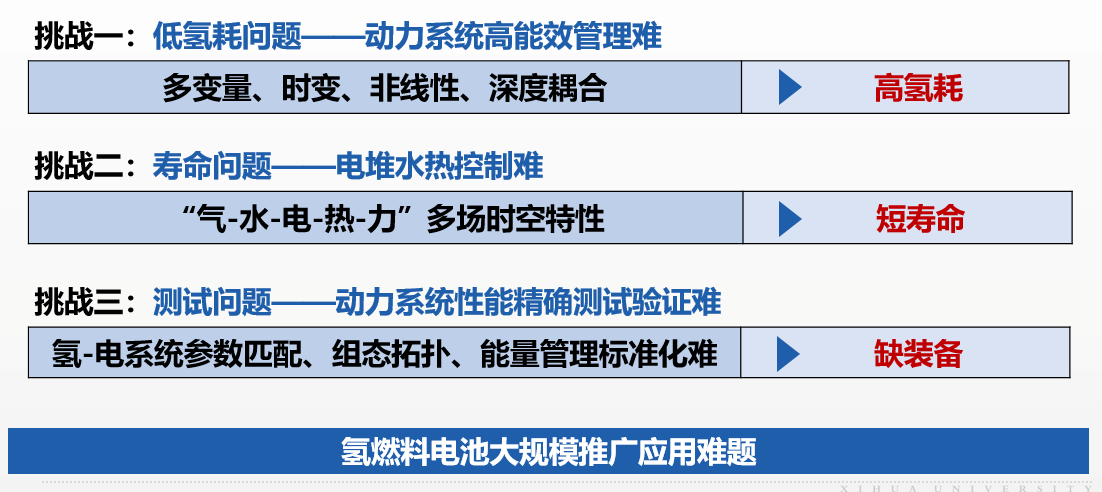
Currently, the challenges in the large-scale application of hydrogen fuel cells lie in high purchase and usage costs!!!
High Usage Costs
Power System Structure and Energy Management of Hydrogen Fuel Cell Commercial Vehicles
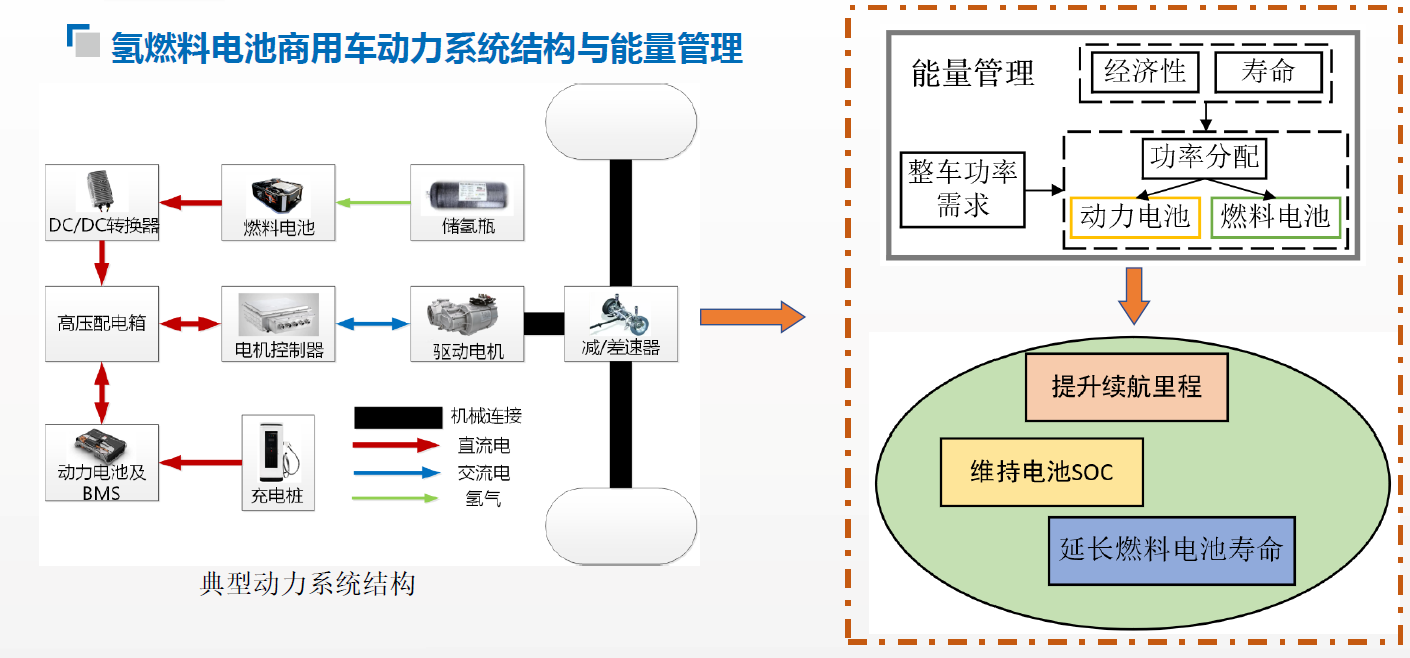
Overcoming the control challenges of maintaining optimal output under complex real-world loads in the power system to achieve efficient vehicle operation
(1) Reinforcement Learning-Based Intelligent Energy Management Technology for Power Systems
Clarify the energy consumption mechanism under complex vehicle operating conditions.
Construct macro, meso, and micro models of the hydrogen fuel cell commercial vehicle system and parts for control purposes.
Develop a reinforcement learning-based intelligent energy management design method for hydrogen fuel cell commercial vehicles.
(2) Multi-Objective Optimization-Based Power System Parameter Matching Design Technology
Reveal the multi-objective competition mechanism in power system parameter matching design.
Propose a power system parameter selection method based on Pareto optimal theory analysis and a convex optimization-based global optimal rapid solution method for power systems, addressing the challenges of applying complex nonlinear optimization methods in practical engineering.
Develop a hydrogen fuel cell commercial vehicle power system with optimal component parameter matching and control parameters.
(3) Data-Driven Onboard Fuel Cell Life Degradation Prediction Technology
Extract life degradation characteristic parameters for vehicle and big data application scenarios.
Considering the coupling behavior mechanism of power sources, develop a data-driven short-term life prediction model for onboard fuel cells.
To meet long-term vehicle control and performance evaluation needs, develop a long-term life degradation prediction model for onboard fuel cells using relative power loss rate as a health indicator.
Overcome the challenges of precise testing of power system performance to achieve accurate testing and quantitative evaluation
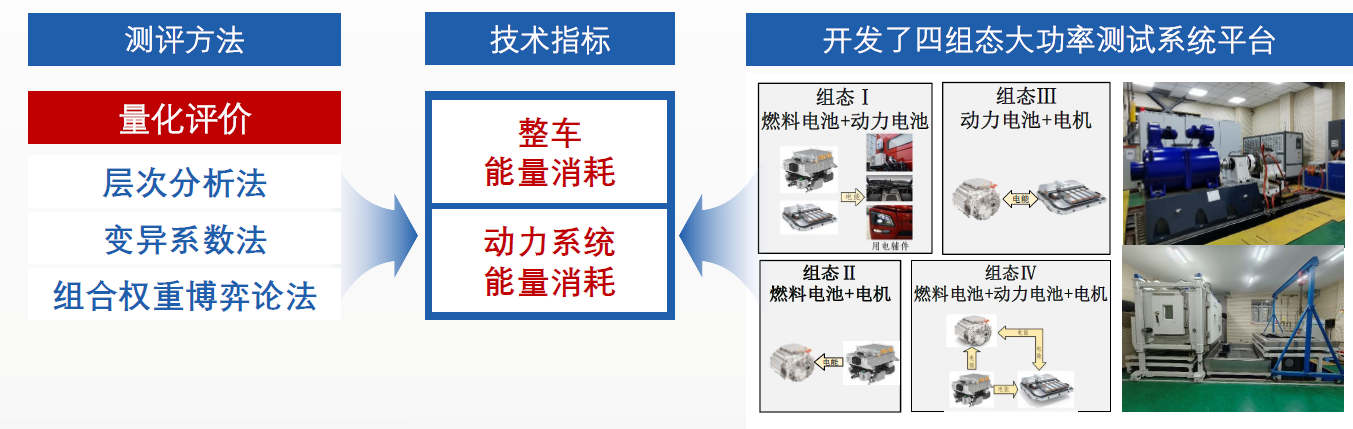
The electromechanical synthetic absorption power exceeds 650 kW, with an absolute test power error of no more than 3.25 kW.
(1) Comprehensive Performance Testing and Evaluation Method for Hydrogen Fuel Cell Commercial Vehicle Power Systems
Comprehensive Performance Evaluation System for Fuel Cell Bus Power Systems
Quantitative evaluation method: Use the Analytic Hierarchy Process to determine the subjective evaluation coefficient matrix, the Coefficient of Variation method to calculate the objective evaluation coefficient, and game theory to determine the combined weight.
Construct a comprehensive performance evaluation system for hydrogen fuel cell commercial vehicle power systems.
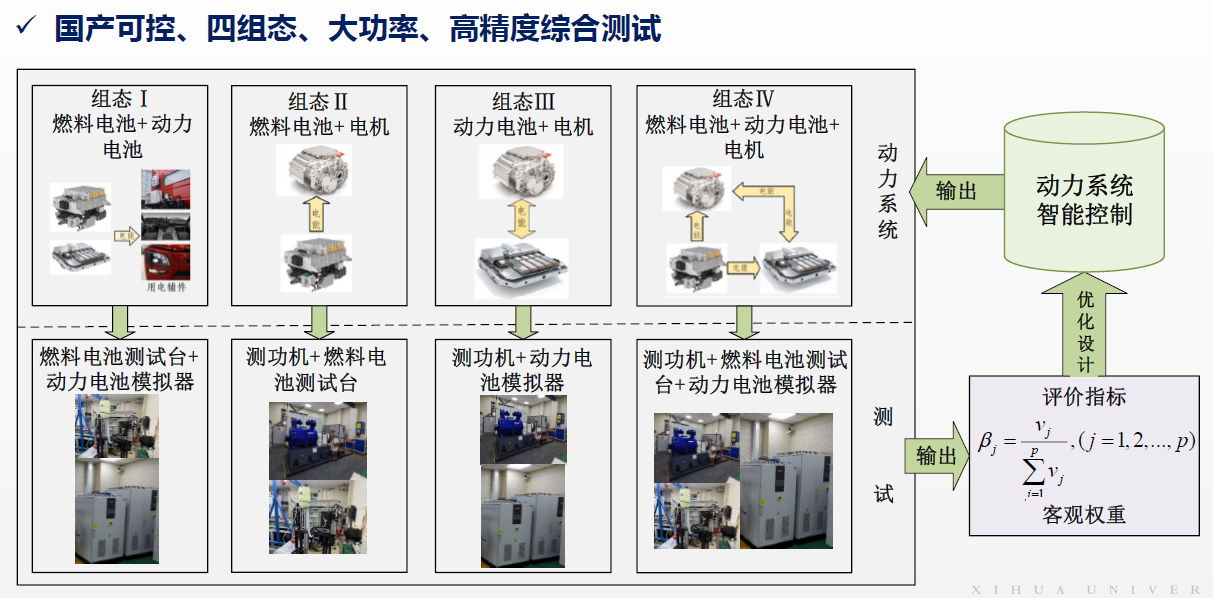
(2) Four-State Performance Testing Platform for Hydrogen Fuel Cell Commercial Vehicle Power Systems
Hydrogen Fuel Cell Commercial Vehicles - Opportunities and Challenges Coexist
Advantages: Hydrogen energy technology plays a crucial role in the transition to low-carbon transportation, offering unique value.
It demonstrates significant advantages in long-range driving, heavy-duty transport, low-temperature adaptability, and rapid refueling, with economic and environmental benefits already emerging in scenarios such as port logistics, intercity freight, and public transportation.
Challenges: High costs in hydrogen production, storage, and transportation, an incomplete hydrogen refueling infrastructure network, and the need to improve the localisation rate of core technologies currently hinder its cost competitiveness compared to traditional internal combustion engine vehicles and pure electric commercial vehicles.
With breakthroughs in large-scale green hydrogen production technology and the continuous decline in fuel cell system costs, the life cycle economics of hydrogen fuel cell commercial vehicles are expected to achieve a leap forward in the next 5-10 years.
Follow Us For More Information
LinkedIn: https://www.linkedin.com/company/98924065/admin/dashboard/
Facebook: https://www.facebook.com/profile.php?id=61572704694550