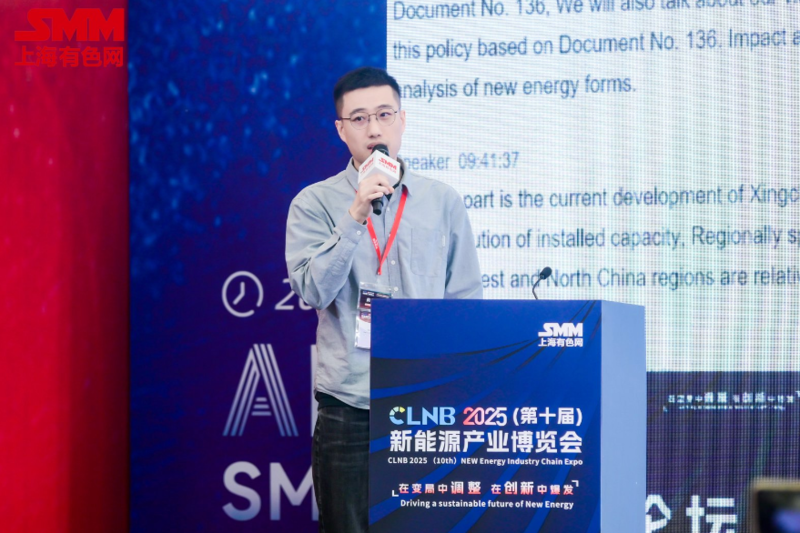
At the CLNB 2025 (10th) New Energy Industry Chain Expo - New Energy PV ESS Forum hosted by SMM Information & Technology Co., Ltd., Tuo Tang, Consulting Engineer at the Policy and System Research Institute of Nengjian Times (Shanghai) New Energy Storage Technology Research Institute Co., Ltd., shared insights on the topic of "How Can the PV ESS Industry Transition from 'Cut-throat Competition' to 'Win-win' amid overcapacity."
He stated that the transaction prices in the new energy market may further decline, especially for PV projects with higher output consistency, where negative electricity prices may occur during peak PV generation periods during the day. The strategy for new energy investment and development has shifted from "pure resource competition" to "comprehensive capability competition," with the returns of new energy investment entities directly linked to capabilities in planning and layout, cost control, transaction operations, and technological innovation. The demand for power system regulation resources faces a short-term decline but a long-term increase, with regulatory resources transitioning from "policy-driven" to "market-driven," potentially leading to a further widening of the peak-valley price spread and an increase in auxiliary service revenues. The focus of ESS development on the power supply side has cooled, shifting towards grid-side and user-side shared standalone ESS.
I. Overview of New-Type Energy Storage Development
I. Overview
Installation Distribution: The scale of new-type energy storage installations continues to grow rapidly, reaching 73.76 million kW by the end of 2024, with an average energy storage duration of 2.3 hours. Regionally, north-west and north China benefit from abundant wind and solar resources, leading to large-scale ESS installations. In terms of power station scale, there is a trend towards centralized and large-scale projects. Regarding energy storage duration, there is a trend towards longer storage times.
Technology Routes: Lithium-ion batteries remain the mainstream. Flow batteries, compressed air energy storage, and hydrogen storage are undergoing demonstration applications. Flywheel energy storage has been applied in projects, but on a relatively small scale; gravity energy storage has yet to see any operational projects in China.
Application Scenarios: Mainly include the power supply side, grid side, and user side. In the early stages of development, ESS integration with new energy on the power supply side was predominant. In recent years, standalone ESS power stations on the grid side have gained attention and rapid development. On the user side, industrial and commercial ESS is currently the main application, with highly customized scenarios and varying scales, ranging from hundreds of kW to tens of MW.
Cost Situation: Over the past year, the prices of lithium battery raw materials (lithium carbonate) have generally continued to decline, coupled with intense market price competition, leading to a continuous decrease in battery cell prices, which in turn has driven down the transaction prices of energy storage systems and EPC.
II. Discussion on Key Issues in New-Type Energy Storage
II. Key Issues
Utilization: The utilization of some new-type energy storage projects has fallen short of expectations. The main reasons include: 1) uneven equipment quality in some projects, resulting in low availability; 2) small scale and low access voltage levels, making it difficult to dispatch; 3) low operational levels in some projects, preventing full utilization of energy storage regulation capabilities; 4) lack of clear investment return models, reducing the enthusiasm of owners to use ESS.
Functional Positioning: Reducing new energy curtailment.
Functional Positioning: Substituting for power transmission and distribution investments. Deploying grid-side ESS near heavily loaded sections of transmission channels can alleviate grid congestion and promote wind and solar consumption. However, it is currently not suitable for solving substation overload issues, as ESS power stations do not have advantages in land use and cost compared to main transformer expansions.
Project Economics: Assuming the energy stored is all curtailed new energy, ideally, it is then discharged at the new energy on-grid tariff. ESS only becomes economical when the levelized cost of storage (LCOS) is less than the new energy on-grid tariff; otherwise, it is better to directly curtail the energy.
III. Policy Situation and Impact Analysis
Development History: The development of new energy on-grid tariffs has transitioned from policy pricing to market-oriented reforms. The "Notice" (Document No. 136) clarifies that the on-grid electricity of new energy projects should, in principle, all enter the power market, with tariffs formed through market transactions, and establishes a "more refund, less compensation" differential settlement mechanism to stabilize corporate returns and promote high-quality development of new energy.
Mechanism Electricity: Provinces should align with current policies on guaranteed electricity scale, considering the non-hydro renewable energy consumption responsibilities and user affordability adjustments for the year. Therefore, the guaranteed electricity scale in each province will remain stable, mainly including the previous year's policy-guaranteed new energy electricity and newly added new energy mechanism electricity.
Mechanism Electricity Prices: Pricing follows the marginal clearing model, with projects selected based on bid prices from low prices to high prices, and the mechanism electricity prices are, in principle, determined by the highest bid of the selected projects. The upper limit of the mechanism electricity prices can be considered as the local coal power benchmark electricity prices or the on-grid tariff level of typical units with high yield rates; the lower limit can refer to the on-grid tariff level of the most advanced units of the same type in each province.
Policy Impact
The transaction prices in the new energy market may further decline, especially for PV projects with higher output consistency, where negative electricity prices may occur during peak PV generation periods during the day;
The strategy for new energy investment and development has shifted from "pure resource competition" to "comprehensive capability competition," with the returns of new energy investment entities directly linked to capabilities in planning and layout, cost control, transaction operations, and technological innovation;
The demand for power system regulation resources faces a short-term decline but a long-term increase, with regulatory resources transitioning from "policy-driven" to "market-driven," potentially leading to a further widening of the peak-valley price spread and an increase in auxiliary service revenues.
The power generation-side ESS has cooled, shifting towards grid-side and user-side shared standalone ESS.
LinkedIn: https://www.linkedin.com/company/98924065/admin/dashboard/
Facebook: https://www.facebook.com/profile.php?id=61572704694550