Surge in Bauxite Arrivals and Shipments Indicates Strong Import Outlook

Published: Apr 15, 2025 19:05
Source: SMM

SMM April 15 News:

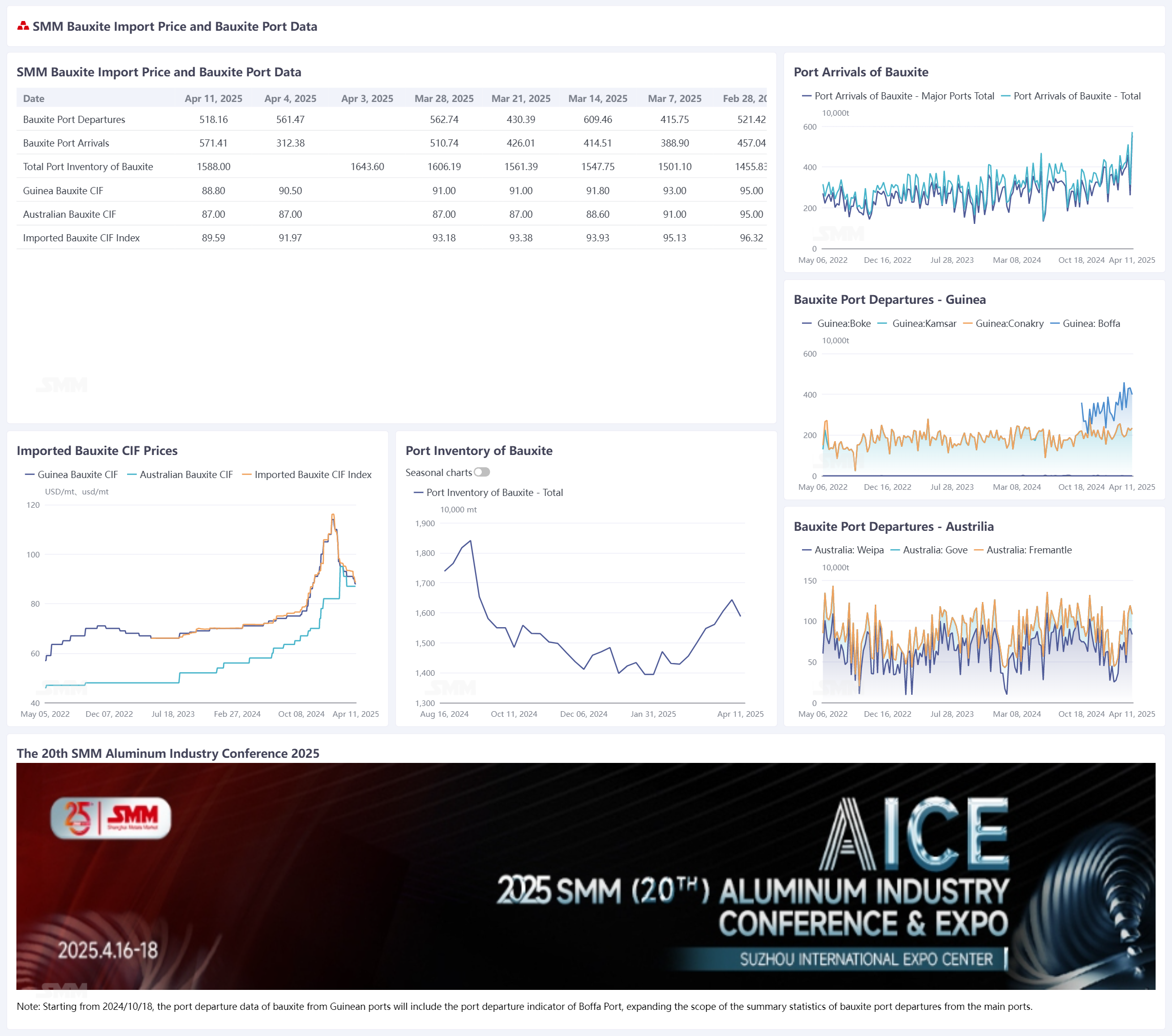
Recent data on April 11 showed a significant increase in the weekly total port arrivals of bauxite at domestic ports, reaching 5.7141 million mt, up by 2.5903 million mt compared to the previous week. Meanwhile, the weekly total port departures of bauxite from main ports in Guinea decreased by 328,000 mt to 3.9875 million mt, and in Australia by 110,800 mt to 1.0815 million mt.

In the short term, the outlook for domestic bauxite imports remains strong. March saw an average weekly port arrivals of 4.35 million mt, a notable increase from January and February. During the first two weeks of April, the average weekly port arrivals further rose to 4.42 million mt, indicating a potential increase in bauxite imports compared to March.

The increase in bauxite imports is attributed to higher shipments from Guinea and Australia, with expectations of even more influx in the coming months. Bauxite imports from Guinea are expected to rise as shipments from late January to February are received, while the impact of the rainy season in Australia is diminishing, leading to increased shipments.

On the shipments front, the weekly average port departures of bauxite from Guinea in March increased to 3.86 million mt/week compared to February's 3.47 million mt/week. The trend continued in the first two weeks of April with an average of 4.15 million mt/week. This suggests a potential for further increases in domestic bauxite imports in May-June from Guinea.

Overall, the increase in bauxite imports is likely to drive the growth of bauxite supply in China. However, demand for alumina has been declining, which may lead to a surplus in the bauxite market. Coupled with the stocking demand for raw materials from new capacity, bauxite inventories at alumina refineries and ports are expected to rise.

Data Source Statement: Except for publicly available information, all other data are processed by SMM based on publicly available information, market communication, and relying on SMM‘s internal database model. They are for reference only and do not constitute decision-making recommendations.

For any inquiries or to learn more information, please contact: lemonzhao@smm.cn
For more information on how to access our research reports, please contact:service.en@smm.cn
Related News
SHFE Aluminum Edged Up After Halting Its Decline, Spot Aluminum Stabilized and Improved [SMM South China Spot Aluminum Daily Review]
52 mins ago
SHFE Aluminum Edged Up After Halting Its Decline, Spot Aluminum Stabilized and Improved [SMM South China Spot Aluminum Daily Review]
Read More
SHFE Aluminum Edged Up After Halting Its Decline, Spot Aluminum Stabilized and Improved [SMM South China Spot Aluminum Daily Review]
52 mins ago
SHFE Cast Aluminum Alloy Warrants Drop by 2,047 mt to 42,944 mt on March 24
1 hour ago
SHFE Cast Aluminum Alloy Warrants Drop by 2,047 mt to 42,944 mt on March 24
Read More
SHFE Cast Aluminum Alloy Warrants Drop by 2,047 mt to 42,944 mt on March 24
[SMM Flash News] SHFE data showed that as of March 24, the total registered volume of cast aluminum alloy warrants was 42,944 mt, a decrease of 2,047 mt from the previous trading day. By region, the total registered volume was Shanghai (2,755 mt, down 422 mt), Guangdong (17,257 mt, down 210 mt), Jiangsu (4,209 mt, down 813 mt), Zhejiang (13,672 mt, down 483 mt), Chongqing (3,723 mt, down 119 mt), and Sichuan (1,327 mt, increase 0 mt).
1 hour ago
What Could Change if Middle East Aluminum Trade Reroutes—and Supply Becomes Substitutable
1 hour ago
What Could Change if Middle East Aluminum Trade Reroutes—and Supply Becomes Substitutable
Read More
What Could Change if Middle East Aluminum Trade Reroutes—and Supply Becomes Substitutable
Strait of Hormuz disruptions and Iran tensions are driving up aluminum prices and premiums. Aluminium Bahrain and Qatalum have cut output, while feedstock is tight. Rerouting via Port of Sohar or Saudi ports raises costs and delays. Buyers are turning to China, India, Russia, Canada, and scrap to offset risk. Prolonged disruption could reduce Middle East market share and reprice it as higher-risk supply.
1 hour ago
Surge in Bauxite Arrivals and Shipments Indicates Strong Import Outlook - Shanghai Metals Market (SMM)