Recently, the International Energy Agency (IEA) released its latest report, pointing out that with the sharp rise in demand and the continuous decline in prices, the global battery market size is expanding rapidly.
According to IEA data, in 2024, global EV sales increased by 25% to 17 million units, with annual battery demand surpassing 1 TWh for the first time; global battery capacity reached 3 TWh, and if all announced projects are completed, battery capacity is expected to triple over the next five years.
Meanwhile, the average price of EV batteries has fallen below 100 US dollars/kWh, breaking this threshold means that EVs can compete with traditional internal combustion engine vehicles in terms of cost. The IEA analysis indicates that, in addition to robust demand for EVs, the decline in key battery material prices is also a major factor in the cost reduction, with lithium prices falling by more than 85% compared to their peak in 2022. Furthermore, technological advancements have also contributed to the downward trend in battery prices.
The IEA states that the decrease in raw material prices for batteries and continuous technological innovation are driving the global battery industry into a new phase of development, accelerating the transition from regional markets to a global market. Looking ahead, factors such as economies of scale, supply chain collaboration, manufacturing efficiency, and technological innovation are expected to accelerate the integration of the battery industry on a larger scale. At the same time, localization of manufacturing driven by governments is reshaping the battery supply chain.
Battery Price Decline Slows in Chinese Market
Battery Price Decline Slows in Chinese Market
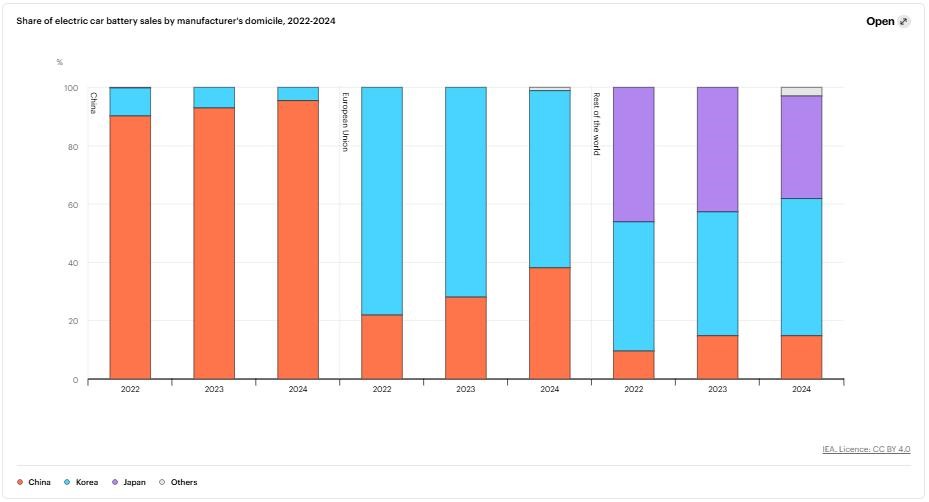
In 2024, batteries produced in China accounted for over three-quarters of global sales. Not only that, but the average price of Chinese batteries also saw the fastest decline, down nearly 30%, making them more than 30% and 20% cheaper than those produced in Europe and North America, respectively. The selling prices of some EVs manufactured in China have already fallen below those of internal combustion engine vehicles.
The IEA attributes the cost advantages of Chinese companies to four main factors: technological innovation benefits from scale effects, high levels of supply chain integration, increased market share of LFP, and intensified cut-throat competition.
Specifically, over 70% of the world's cumulative EV battery production came from China, with major players like CATL and BYD concentrating industry resources and driving innovation. These companies expanded production faster and more efficiently than their competitors, achieving higher yields.
Simultaneously, the Chinese battery ecosystem covers all steps in the supply chain, from mining and refining of metals to the manufacturing of equipment, precursors, and other components, as well as the final production of batteries and EVs, leading to a quicker and more significant reduction in manufacturing costs.
Furthermore, Chinese battery companies hold a clear advantage in the production of lower-cost LFP batteries, which now account for nearly half of the global EV market. These batteries are about 30% cheaper than the currently dominant NMC batteries.
The IEA also noted that, under intense competition in the Chinese market, some companies have been squeezing profit margins, selling batteries at lower prices to consolidate and expand their market share. However, the trend of declining battery prices in the Chinese market is expected to slow in the future. Amid fierce market competition and continuously shrinking profit margins, some battery producers will be eliminated, while others will gain greater influence and pricing power. Nevertheless, it is projected that China will remain the world's largest battery producer over the next decade.
Accelerated Expansion of Battery Production in Markets Outside China
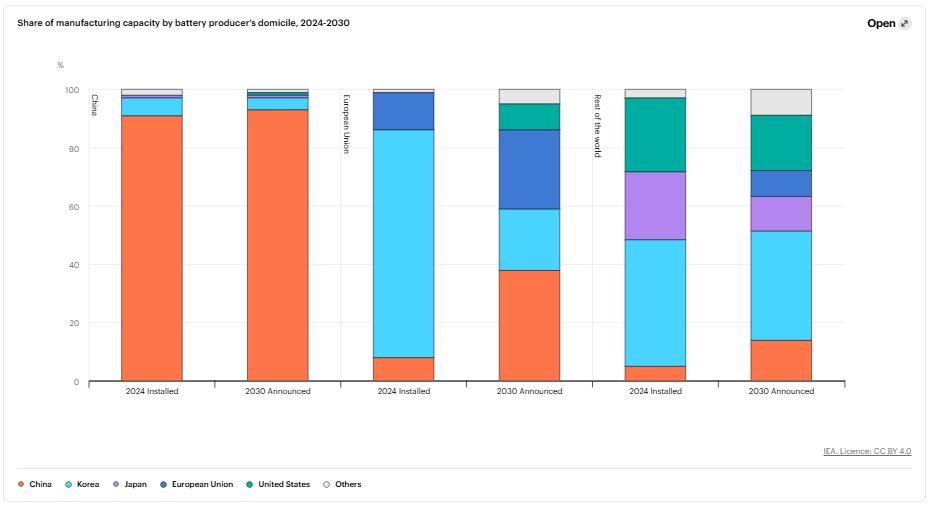
The IEA noted that although China currently dominates the battery market, battery production in other markets is also advancing rapidly. Japanese and South Korean companies are major players in the global battery industry. These two countries' battery manufacturers and suppliers mainly produce NMC batteries, with limited capacity, but they are traditional battery manufacturers with substantial overseas investments. South Korea's overseas battery annual capacity is close to 400GWh, far exceeding Japan (60GWh) and China (30GWh). The main challenge for South Korean batteries comes from their lag in transitioning to LFP, and they have started to increase related efforts in recent years.
Since the implementation of battery production tax credits in the US in 2022, battery capacity has doubled, reaching over 200GWh by 2024, with an additional nearly 700GWh under construction. Approximately 40% of the existing capacity is operated or developed through close collaboration between established battery manufacturers and automakers. However, US battery manufacturing progress is relatively slow, with cathode and anode materials primarily relying on imports. Over the past two years, while the demand scale for energy storage systems has been relatively small, the annual demand growth rate exceeds 60%, becoming a major driver of demand growth outside of EVs.
Additionally, several Southeast Asian countries and Morocco are emerging as potential production centers for batteries and their components. Among them, Indonesia, which holds half of the world's nickel ore, will begin producing its first batch of EV batteries and graphite anode factories in 2024. Morocco, on the other hand, has the largest phosphate reserves, a crucial raw material for LFP batteries.
Regarding the European market, the IEA mentioned, "Battery production in Europe is at a make-or-break moment." Battery production costs in the region are about 50% higher than in China, and the battery supply chain ecosystem is relatively weak, with a severe shortage of specialized talent. Currently, many European battery producers are postponing or canceling plans to expand battery production lines due to uncertain profit prospects.
The IEA cited an example: Northvolt, the largest battery producer in Europe, has filed for bankruptcy protection, highlighting the gap in scale and technology between European and Asian companies in battery manufacturing.
The IEA also mentioned that despite current challenges, it is still possible for a more competitive battery industry to emerge in Europe. Additionally, some South Korean companies have already begun investing in LFP battery production in Europe to better compete with Chinese producers. Chinese battery manufacturers may continue to expand their business footprint in Europe.
Finally, the IEA warned that although battery prices are rapidly declining and innovation is ongoing, the concentration of the battery supply chain in recent years has raised security concerns in some countries.
The IEA believes that in emerging markets, EVs are the only strong driver capable of supporting large-scale production, but local demand may not be sufficient. Introducing mature battery companies through joint ventures or technology licensing can shorten the cycle for localized production and supply chain development. At the same time, enhanced international cooperation is needed. Some countries' market sizes in the battery sector are too small to attract sufficient investment, requiring deep cooperation in the EV and battery fields with other countries, as well as with resource-rich countries in new energy minerals such as South America, Africa, Australia, and Indonesia, to further achieve the goal of localized battery production.
Note: This news is sourced from https://www.itdcw.com/ and translated by SMM.