Import Losses Widen, Net Imports of Primary Aluminum Plunged YoY in January-February

Published: Mar 22, 2025 14:29
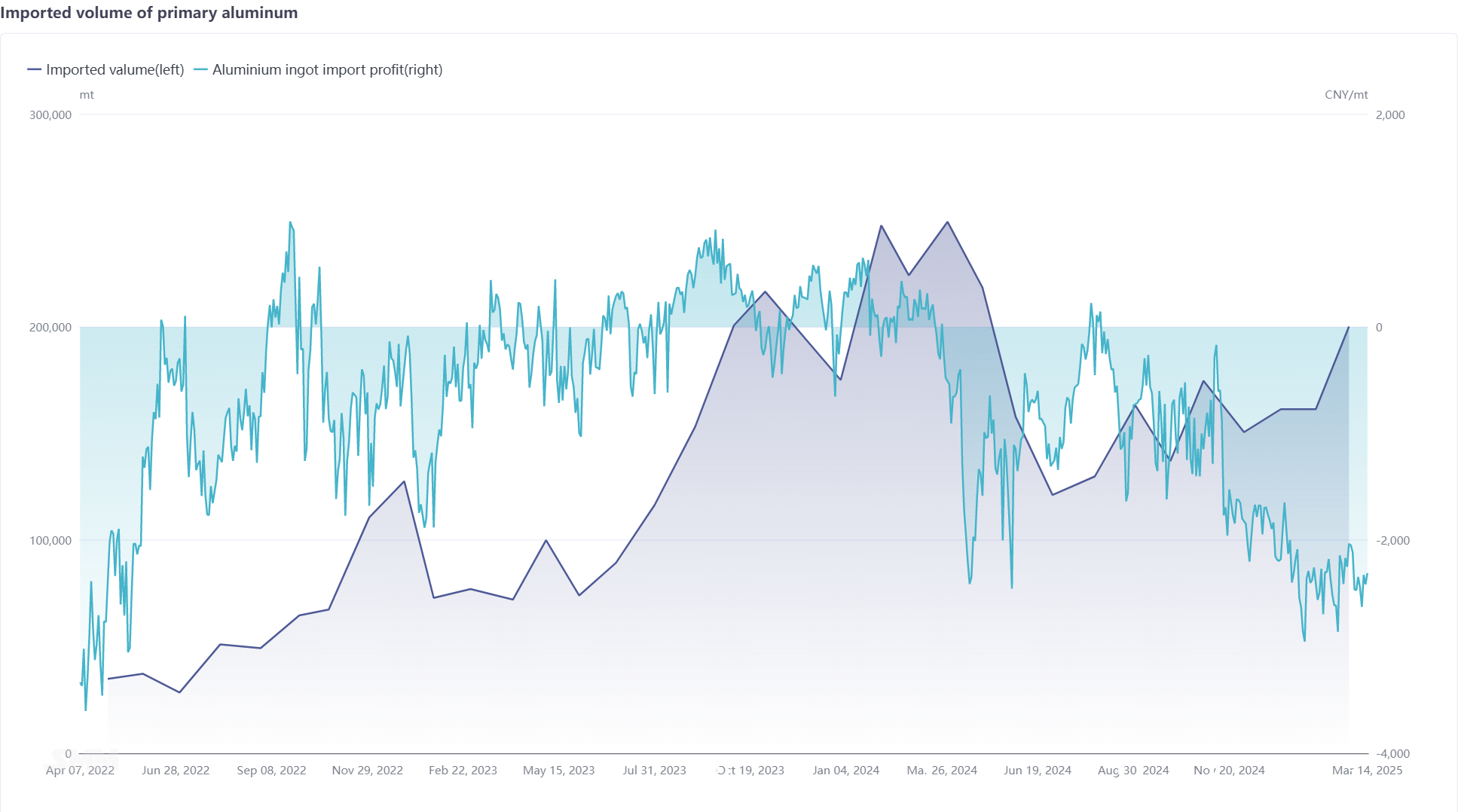
In January-February 2025, the cumulative net imports of primary aluminum in China were approximately 349,800 mt, down 25.7% YoY. (The above import and export data are based on HS codes 76011090, 76011010) Aluminum prices still maintain a pattern of LME outperforming SHFE, with the domestic import window closed and import losses fluctuating around 2600 yuan/mt. The willingness of overseas suppliers to clear customs and ship to China has decreased. SMM expected that in March, domestic primary aluminum imports would mainly be fulfilled through long-term contracts, making it difficult to see an increase in net imports.

SMM March 22 News:

Primary Aluminum Imports: According to data from the General Administration of Customs, domestic primary aluminum imports in January 2025 were approximately 161,000 mt, almost flat MoM and down 34.8% YoY; in February, imports were about 200,000 mt, up 24.0% MoM and down 10.7% YoY. The total cumulative imports for January-February 2025 were around 362,000 mt, down 23.4% YoY.

Primary Aluminum Exports: According to data from the General Administration of Customs, domestic primary aluminum exports in January 2025 were approximately 8,000 mt, down 33.4% MoM and up 814.8% YoY; in February, exports were about 3,000 mt, down 59% MoM and up YoY. The total cumulative exports for January-February 2025 were around 12,000 mt, up 1,116.9% YoY.

Net Primary Aluminum Imports: The cumulative net imports of primary aluminum for January-February 2025 were approximately 349,800 mt, down 25.7% YoY. (The above import and export data are based on HS codes 76011090 and 76011010)

From the perspective of import sources, the main countries and regions of origin for domestic primary aluminum imports in January-February 2025 were the Russian Federation, China, India, Indonesia, Malaysia, and others. Among these, the total imports from Russia in January-February were about 313,300 mt, up 13.1% YoY, accounting for 87% of the total imports for January-February. Additionally, the imports from China in January-February were about 8,600 mt, down 63.3% YoY. This portion mainly consisted of Chinese alumina exported to Russia, processed into aluminum ingots, and then re-imported to the Chinese market. In terms of the origin of the ingots, it was still primarily Russian aluminum. Therefore, the total imports from Russian sources in January-February reached 321,900 mt, accounting for 89% of the total domestic primary aluminum imports. Currently, overseas primary aluminum imports are in a loss state, and the import losses are widening. Notably, some non-major import sources increased in January-February 2025, such as Qatar and Austria.
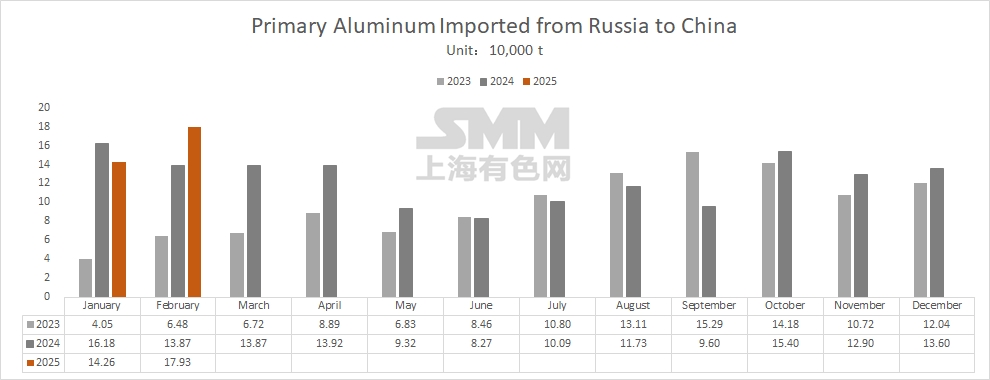
From the perspective of trade modes: In terms of the trade modes for primary aluminum imports in January-February, the import losses widened, and suppliers' willingness to clear customs and send to the Chinese market decreased. Most imports were under long-term contracts, with the cumulative total imports significantly down 23.4% YoY.

SMM Brief Comment: The current aluminum prices still maintain an LME outperforms SHFE trend, with the domestic import window closed and import losses fluctuating around 2,600 yuan/mt. Overseas suppliers' willingness to clear customs and send to China has decreased. SMM expects that in March 2025, domestic primary aluminum imports will mainly be under long-term contracts, and it will be difficult to see an increase in net imports.
Data Source Statement: Except for publicly available information, all other data are processed by SMM based on publicly available information, market communication, and relying on SMM‘s internal database model. They are for reference only and do not constitute decision-making recommendations.

For any inquiries or to learn more information, please contact: lemonzhao@smm.cn
For more information on how to access our research reports, please contact:service.en@smm.cn
Related News
Fed Governor Milan Pushes for Over 100 Basis Points Cut, Contradicts Barkin on Caution
16 hours ago
Fed Governor Milan Pushes for Over 100 Basis Points Cut, Contradicts Barkin on Caution
Read More
Fed Governor Milan Pushes for Over 100 Basis Points Cut, Contradicts Barkin on Caution
Federal Reserve Governor Milan pointed out that it is necessary for the US Fed to cut interest rates by more than 100 basis points this year. At the same time, he is very much looking forward to the performance of Kevin Warsh as Fed Chairman. However, Richmond Fed President Barkin emphasized that monetary policy must remain cautious until inflation fully pulls back to the target level, thereby ensuring the stability of the labour market.
16 hours ago
Democratic Senators Demand Delay in Fed Nomination Amid Criminal Investigation
16 hours ago
Democratic Senators Demand Delay in Fed Nomination Amid Criminal Investigation
Read More
Democratic Senators Demand Delay in Fed Nomination Amid Criminal Investigation
All 11 Democratic members of the US Senate Banking Committee jointly sent a letter to the committee's chairman, Tim Scott, requesting that all nomination processes for the prospective Fed Chairman, Kevin Warsh, be postponed until the criminal investigation into current Fed Chairman Powell and other board members is concluded. However, Scott stated that Warsh's confirmation was a done deal.
16 hours ago
Fed to Keep Large Banks' Capital Levels Unchanged, Postpones Stress Test Reforms Until 2027
16 hours ago
Fed to Keep Large Banks' Capital Levels Unchanged, Postpones Stress Test Reforms Until 2027
Read More
Fed to Keep Large Banks' Capital Levels Unchanged, Postpones Stress Test Reforms Until 2027
The US Fed has announced that it will maintain the capital levels of large banks unchanged during the upcoming stress test cycle (corresponding to the 2026 cycle). At the same time, the US Fed is planning multidimensional reforms to this annual test, aiming to enhance its transparency. The US Fed's Vice Chair for Supervision, Bowman, revealed that adjustments to the stress capital buffer requirements for large banks will be postponed until 2027. This move is intended to provide the US Fed with sufficient time to evaluate potential flaws that may be exposed in its testing models when assessing banks' financial conditions under simulated economic downturn scenarios.
16 hours ago