Is the destocking of copper cathode due to consumption?

Published: Mar 14, 2025 19:12 (GMT+8)
Source: SMM
According to SMM data, starting from March 6, 2025, SMM mainstream copper cathode social warehouse inventories began consecutive destocking, with a total reduction exceeding 20,000 mt over the past three statistical periods. As of March 14, 2025, domestic copper cathode inventories totaled 345,500 mt, down 33,600 mt YoY, indicating that the destocking turning point in 2025 arrived earlier than in 2024.
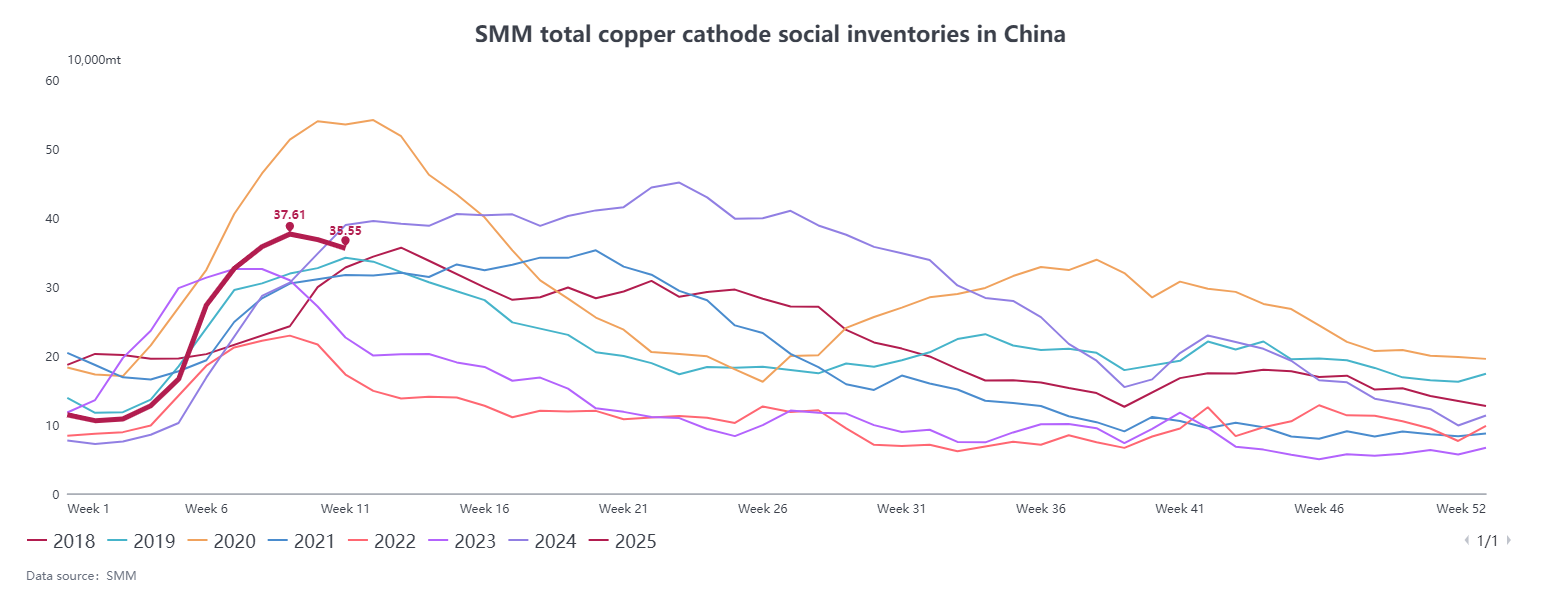
According to SMM data, starting from March 6, 2025, SMM mainstream copper cathode social warehouse inventories began consecutive destocking, with a total reduction exceeding 20,000 mt over the past three statistical periods. As of March 14, 2025, domestic copper cathode inventories totaled 345,500 mt, down 33,600 mt YoY, indicating that the destocking turning point in 2025 arrived earlier than in 2024.


This Friday, copper prices broke through the 80,000 yuan/mt threshold. However, with inventory depletion and the Contango price spread between SHFE copper 2503 and 2504 contracts widening again, spot copper continued to be converted by suppliers into futures warrants, reducing the circulation of spot copper. Additionally, as delivery approaches, spot traders held firm on spot premiums, with spot discounts narrowing throughout the week until turning into slight premiums.
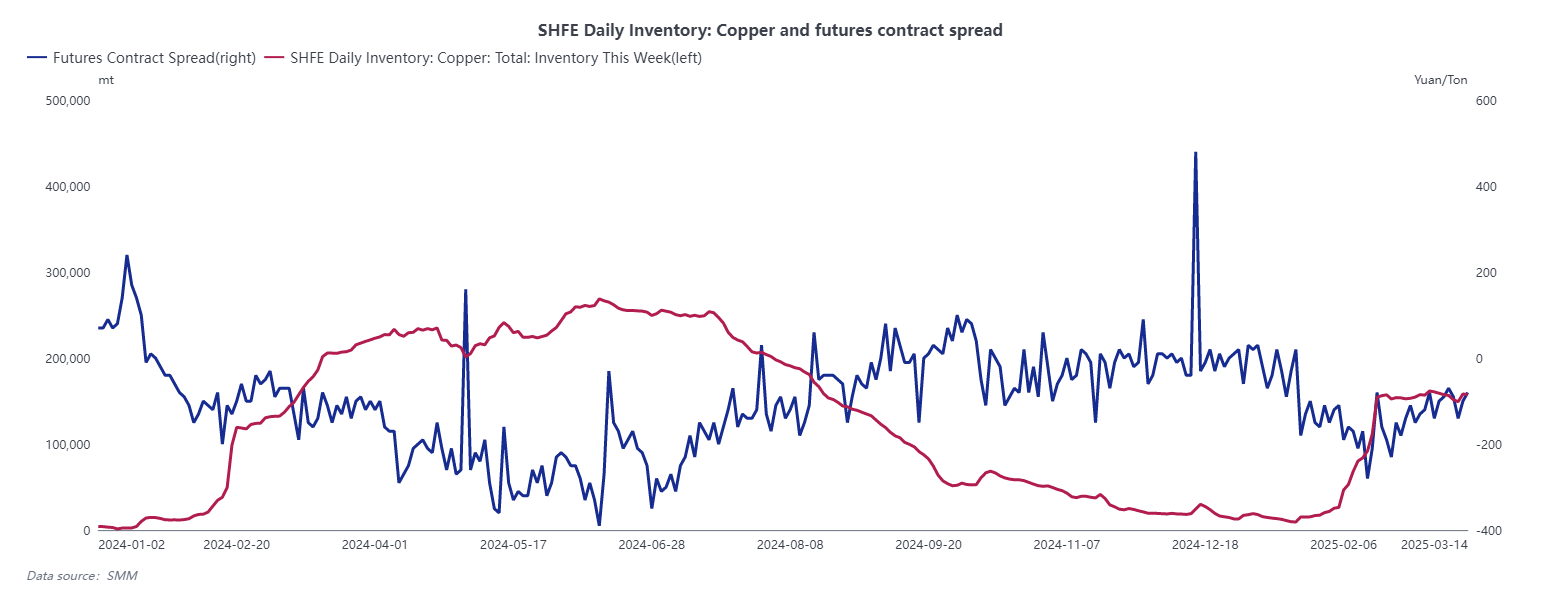

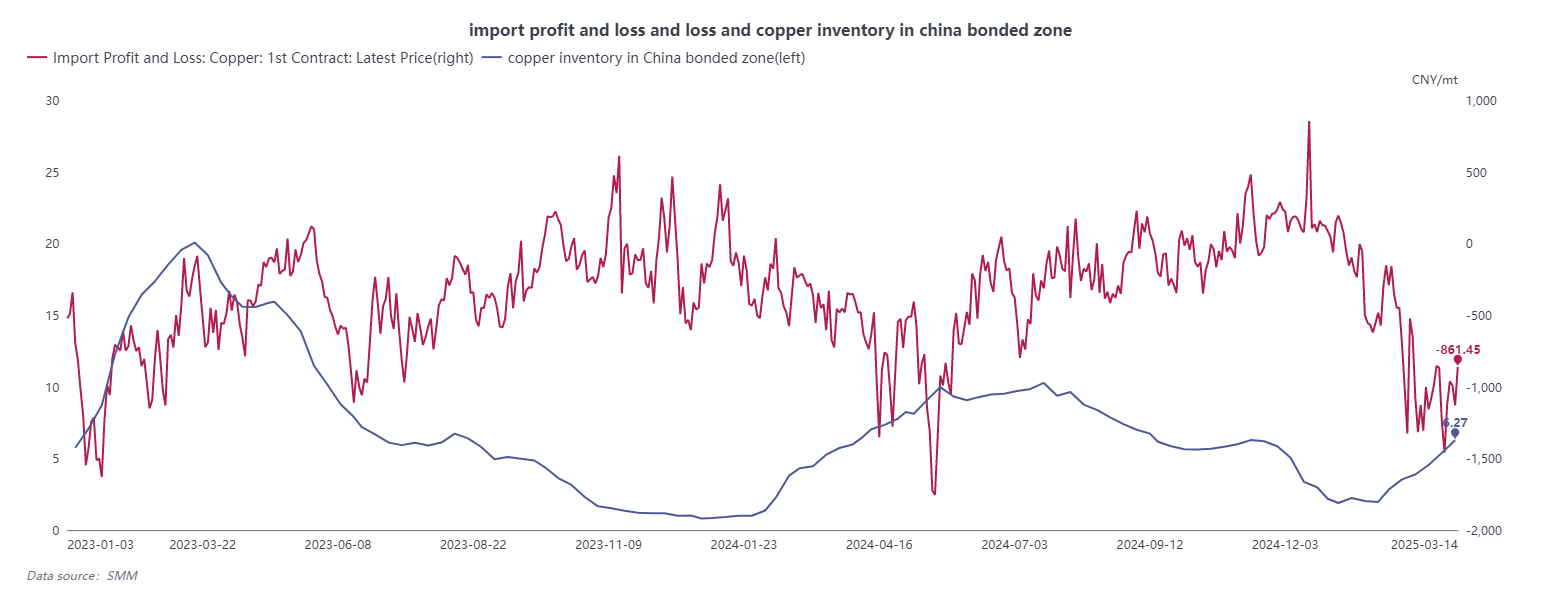
Supply side, export opportunities opened up, and global trade flows shifted due to the rise in COMEX copper prices. Bonded zone inventories increased, smelter exports grew, and Yangshan copper premiums rose, leading to reduced domestic trade supplies of imported copper. Meanwhile, smelter maintenance reduced supply around east China, and recent warehouse inflows declined.


Under the backdrop of copper prices reaching 80,000 yuan/mt, downstream procurement sentiment was significantly suppressed. Large copper rod enterprises, despite having orders, showed weakened demand for copper cathode procurement, primarily consuming previously stocked low-cost raw materials. Small and medium-sized enterprises also focused on long-term contract pick-ups for copper cathode procurement. This week, the weekly operating rate (March 7–13) of major domestic copper cathode rod enterprises rose to 75.14%, up 2.01 percentage points MoM but 1.36 percentage points lower than expected. Raw material inventories continued to decline, down 10.50% MoM. Secondary copper raw material suppliers sold actively at high prices, and secondary copper rod enterprises reported that after the rebound in copper prices, the circulation of secondary copper raw materials in the market was significantly higher than before. It is expected that secondary copper raw materials will partially supplement copper cathode raw materials.

In summary, copper prices suppressed a significant increase in downstream operating rates, with limited growth in new orders. Destocking was mainly driven by reduced smelter supply and decreased imports of copper. Although downstream processing enterprises also saw a decline in raw material inventories, this was primarily due to the consumption of previously purchased low-cost inventories, with no strong willingness to continue large-scale procurement of copper cathode. Looking ahead to next week, under the pressure of high copper prices, downstream enterprises are expected to focus on just-in-time procurement. However, supply reduction remains a persistent issue, and it is anticipated that after the delivery of the SHFE copper 2503 contract, social inventories will continue to decline.
Data Source Statement: Except for publicly available information, all other data are processed by SMM based on publicly available information, market communication, and relying on SMM's internal database model. They are for reference only and do not constitute decision-making recommendations.

For any inquiries or for more information, please contact: lemonzhao@smm.cn
For more information on how to access our research reports, please contact:service.en@smm.cn
Related News
KGHM and South32 launch US$725m Sierra Gorda expansion, lifting copper capacity 26%
9 hours ago
KGHM and South32 launch US$725m Sierra Gorda expansion, lifting copper capacity 26%
Read More
KGHM and South32 launch US$725m Sierra Gorda expansion, lifting copper capacity 26%
KGHM and South32 have broken ground on a fourth grinding line at the Sierra Gorda copper-molybdenum mine in Chile's Atacama region. The US$725 million expansion runs for three years from January 2027, with completion by late 2029 and full output in H2 2030. Ore processing capacity rises 26%, from 131,000 tonnes per day to 165,000 tpd. Annual copper output is projected to climb from 165,000 tonnes in 2025 to 195,000 tonnes, with 6,000 tonnes of molybdenum, 58,000 ounces of gold and 1.7 million ounces of silver as by-products. The project creates over 900 direct jobs and is funded from operating cash flow and debt. Unit operating costs are expected to fall about 10%.
9 hours ago
Emerita Extends Final Review of Iberian Belt West PFS, Release Expected in Coming Weeks
10 hours ago
Emerita Extends Final Review of Iberian Belt West PFS, Release Expected in Coming Weeks
Read More
Emerita Extends Final Review of Iberian Belt West PFS, Release Expected in Coming Weeks
Emerita Resources has provided an update on the Preliminary Feasibility Study (PFS) for its Iberian Belt West polymetallic project in Spain, saying the study is well advanced but remains under final technical review.​ The company said the review process has been expanded to include additional technical and quality-assurance oversight before publication. As a result, Emerita now expects the PFS to be released in the coming weeks rather than within the previously indicated timeframe.​ Iberian Belt West hosts copper, zinc, lead, gold and silver mineralization and is one of Emerita’s principal development-stage assets in Spain. The PFS is expected to provide updated detail on the proposed mine plan, processing configuration, capital requirements, operating costs and project economics.​ Emerita said the additional review work is intended to ensure consistency and completeness across the technical disciplines contributing to the study before it is finalized.​ The company did not announce a revised specific publication date, and no new production, capital or economic figures were disclosed in the latest update.​ The extended review delays the next major technical milestone for Iberian Belt West, but the company continues to indicate that the PFS is nearing completion. For the copper market, the significance of the study will depend on the production profile and project economics ultimately disclosed, particularly the contribution of copper relative to the project’s other payable metals. Attention will therefore remain on the timing of the PFS release and whether the final study materially changes the project’s development outlook.
10 hours ago
Cascadia Intersects 75.55 m at 1.19% Cu at Carmacks Copper-Gold Project
10 hours ago
Cascadia Intersects 75.55 m at 1.19% Cu at Carmacks Copper-Gold Project
Read More
Cascadia Intersects 75.55 m at 1.19% Cu at Carmacks Copper-Gold Project
Cascadia Minerals has reported additional drill results from its 2026 exploration programme at the Carmacks copper-gold project in Yukon, Canada, with new step-out drilling extending mineralization at Zone 2000S beyond the boundaries of the existing Mineral Resource.​ Drill hole CD-26-058 returned 75.55 metres grading 1.19% copper, 0.97 g/t gold, 10.4 g/t silver and 335 ppm molybdenum, equivalent to 2.18% copper-equivalent. The interval included 48.66 metres grading 1.61% copper, 1.39 g/t gold, 15.1 g/t silver and 475 ppm molybdenum, equivalent to 3.03% CuEq.​ Within the same hole, a higher-grade interval of 14.50 metres returned 2.30% copper, 2.68 g/t gold, 29.5 g/t silver and 1,015 ppm molybdenum, equivalent to 5.08% CuEq.​ A second hole, CD-26-059, intersected 93.99 metres grading 0.96% copper, 0.70 g/t gold, 4.6 g/t silver and 919 ppm molybdenum, equivalent to 1.94% CuEq. This included 63.97 metres at 1.26% copper, 0.96 g/t gold, 6.3 g/t silver and 1,049 ppm molybdenum, equivalent to 2.52% CuEq.​ Cascadia said the latest results continue to expand mineralization at Zone 2000S beyond the limits of the current Mineral Resource and highlight the higher-grade nature of the extension. The reported drill intervals represent drilled thicknesses, with true widths estimated at approximately 60–70%.​ The latest step-out results indicate that copper-gold mineralization at Zone 2000S extends beyond the boundaries of the current Carmacks Mineral Resource. The broad intervals and higher-grade internal zones could support future resource expansion if additional drilling confirms continuity. However, the new intersections have not yet been incorporated into an updated Mineral Resource Estimate, meaning their ultimate impact on project scale and mine planning remains to be determined.
10 hours ago