Copper Cathode Inventory Decline: Is Consumption Really Good? [SMM Analysis]

Published: Mar 14, 2025 17:08
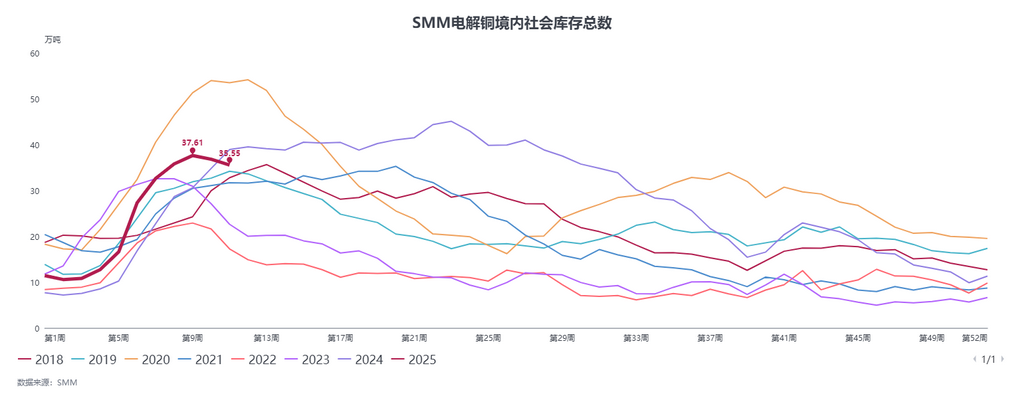
[SMM Analysis] According to SMM data, starting from March 6, 2025, inventories of mainstream copper cathode in SMM social warehouses began consecutive destocking, with a total destocking of over 20,000 mt in the past three statistical periods. As of March 14, 2025, domestic copper cathode inventories totaled 345,500 mt, 33,600 mt lower YoY, indicating that the destocking turning point in 2025 arrived earlier than in 2024.

》View SMM Metal Quotes, Data, and Market Analysis

》Subscribe to View Historical Price Trends of SMM Metal Spot             

       According to SMM data, starting from March 6, 2025, SMM mainstream copper cathode social warehouse inventories began consecutive destocking, with a total reduction exceeding 20,000 mt over the past three statistical periods. As of March 14, 2025, domestic copper cathode inventories totaled 345,500 mt, down 33,600 mt YoY, indicating that the destocking turning point in 2025 arrived earlier than in 2024.
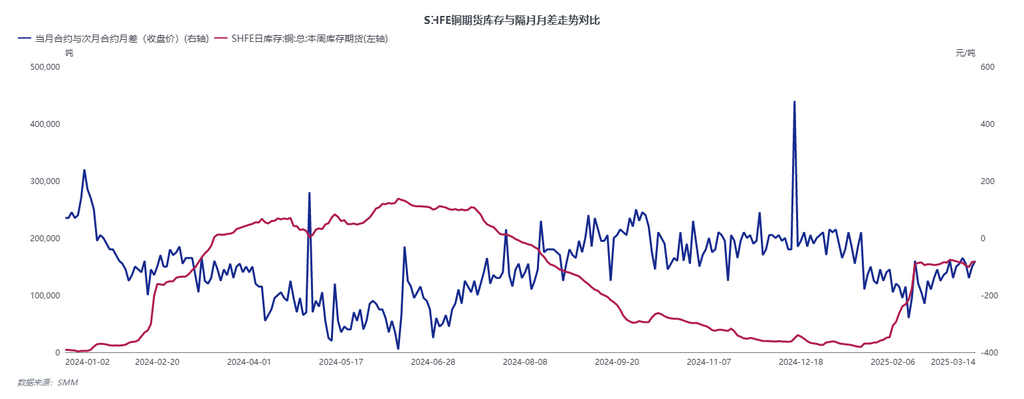
       This Friday, copper prices broke through the 80,000 yuan/mt threshold. However, with inventory depletion and the Contango price spread between SHFE copper 2503 and 2504 contracts widening again, spot cargoes continued to be converted into futures warrants by suppliers, reducing the circulation of spot copper. As the delivery date approached, spot traders held firm on spot premiums, with spot discounts narrowing throughout the week until a slight premium was observed.
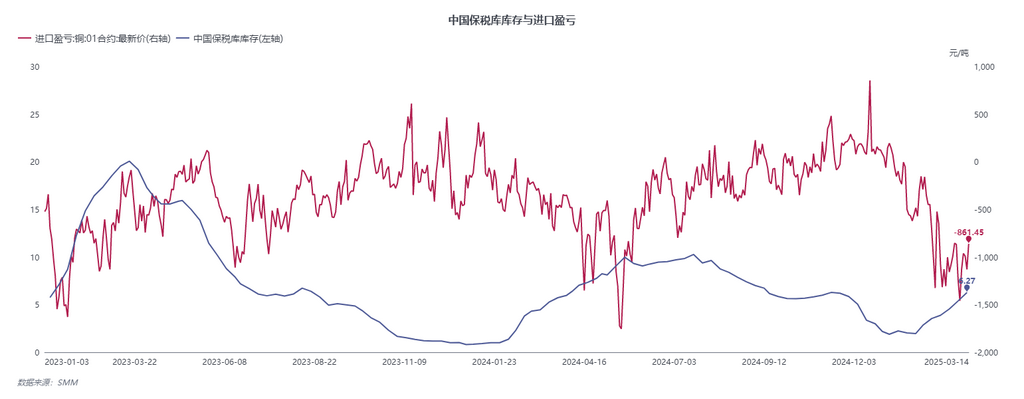
       Supply side, export opportunities opened up, and global trade flows shifted due to rising COMEX copper prices. Bonded zone inventories increased, smelter exports grew, and Yangshan copper premiums rose, leading to reduced domestic trade supplies of imported copper. Meanwhile, smelter maintenance reduced supply around east China, and recent inbound inventory volumes declined.
       Under the backdrop of copper prices reaching 80,000 yuan/mt, downstream procurement sentiment was significantly suppressed. Large copper rod enterprises, despite having orders, showed weakened demand for copper cathode procurement, focusing on consuming previously stocked low-cost raw materials. Small and medium-sized enterprises primarily relied on long-term contract cargo pick-up for copper cathode procurement. This week, the weekly operating rate (March 7-13) of major domestic copper cathode rod enterprises rose to 75.14%, up 2.01 percentage points MoM but 1.36 percentage points lower than expected. Raw material inventories continued to decline, down 10.50% MoM. Secondary copper raw material suppliers sold at high prices, and secondary copper rod enterprises reported that after the rebound in copper prices, the circulation of secondary copper raw materials in the market was significantly higher than before. It is expected that secondary copper raw materials will partially supplement copper cathode raw materials.

       In summary, copper prices suppressed a significant increase in downstream operating rates, with limited growth in new orders. Destocking was mainly driven by reduced smelter supply and decreased replenishment of imported copper. Although raw material inventories at downstream processing enterprises also declined, this was primarily due to the consumption of previously procured low-cost inventories, with no intention of further large-scale copper cathode procurement. Looking ahead to next week, under the pressure of high copper prices, downstream enterprises are expected to continue favoring just-in-time procurement. However, supply reduction remains a persistent issue, and it is anticipated that after the delivery of the SHFE copper 2503 contract, social inventories will continue to decline.



                                                                                                                 》View SMM Metal Industry Chain Database
 

Data Source Statement: Except for publicly available information, all other data are processed by SMM based on publicly available information, market communication, and relying on SMM‘s internal database model. They are for reference only and do not constitute decision-making recommendations.

For any inquiries or to learn more information, please contact: lemonzhao@smm.cn
For more information on how to access our research reports, please contact:service.en@smm.cn
Related News
[SMM Analysis] The "Counter-Cyclical" Logic of Copper Smelting: When Sulfuric Acid Becomes the Main Product
10 hours ago
[SMM Analysis] The "Counter-Cyclical" Logic of Copper Smelting: When Sulfuric Acid Becomes the Main Product
Read More
[SMM Analysis] The "Counter-Cyclical" Logic of Copper Smelting: When Sulfuric Acid Becomes the Main Product
[SMM Analysis] The "Counter-Cyclical" Logic of Copper Smelting: When Sulfuric Acid Becomes the Main Product
[SMM Analysis: The "Counter-Cyclical" Logic of Copper Smelting: When Sulfuric Acid Becomes the Main Product]
10 hours ago
BC Copper 2604 Closed Lower with a Wide Trading Range, Pressured by Both Geopolitics and Interest Rate Cut Expectations [SMM BC Copper Commentary]
11 hours ago
BC Copper 2604 Closed Lower with a Wide Trading Range, Pressured by Both Geopolitics and Interest Rate Cut Expectations [SMM BC Copper Commentary]
Read More
BC Copper 2604 Closed Lower with a Wide Trading Range, Pressured by Both Geopolitics and Interest Rate Cut Expectations [SMM BC Copper Commentary]
11 hours ago
Inner Mongolia Approves 500 kV Project, Boosting Ordos City's Power Grid in 14th Five-Year Plan
11 hours ago
Inner Mongolia Approves 500 kV Project, Boosting Ordos City's Power Grid in 14th Five-Year Plan
Read More
Inner Mongolia Approves 500 kV Project, Boosting Ordos City's Power Grid in 14th Five-Year Plan
Recently, the 500 kV transmission and transformation project of Jiri (Kusha II) was officially approved by the Energy Bureau of Inner Mongolia Autonomous Region, marking a good start for the power grid construction of Ordos City in the first year of the 14th Five-Year Plan. The project is located in the territory of Hangjin Banner, with a total investment of 1.52554 billion yuan. It is a key hub project to ensure the output and consumption of new energy power in the northwestern region of Hangjin Banner. The project plans to build one 500 kV substation and about 194 km of 500 k V lines, which will pass through Hangjin Banner and Dalad Banner.
11 hours ago
Copper Cathode Inventory Decline: Is Consumption Really Good? [SMM Analysis] - Shanghai Metals Market (SMM)