[SMM Construction Material Inventory] Further Reduction in Crude Steel Production, Decline in Both In-Plant and Social Inventories

Published: Mar 13, 2025 18:21 (GMT+8)
[SMM Construction Material Inventory: Further Reduction in Crude Steel Production, Decline in Both In-Plant and Social Inventory] This week, the total rebar inventory was 7.9754 million mt, down 59,800 mt WoW, a decrease of 0.74% (previous value: -0.45%). On a YoY basis, it decreased by 4.074 million mt compared to the same period last year on the lunar calendar, a drop of 33.81% (previous value: -35.12%).

This week, the total rebar inventory nationwide continued to decrease slightly, with social inventory shifting from an increase to a decrease. The total rebar inventory declined by 0.74% WoW, while the total wire rod inventory fell by 2.05% WoW. During the week, construction steel market prices fluctuated downward, with low market trading activity. However, news of production cuts led to a slight rebound, driving speculative demand in the market. Meanwhile, end-use demand continued to recover, resulting in a slight decline in total construction steel inventory this week.

This week, the total rebar inventory stood at 7.9754 million mt, down by 59,800 mt WoW, a decline of 0.74% (previous value: -0.45%). Compared to the same period last year on the lunar calendar, it decreased by 4.074 million mt, a YoY decline of 33.81% (previous value: -35.12%).

Table 1: Overview of Rebar Inventory

Source: SMM

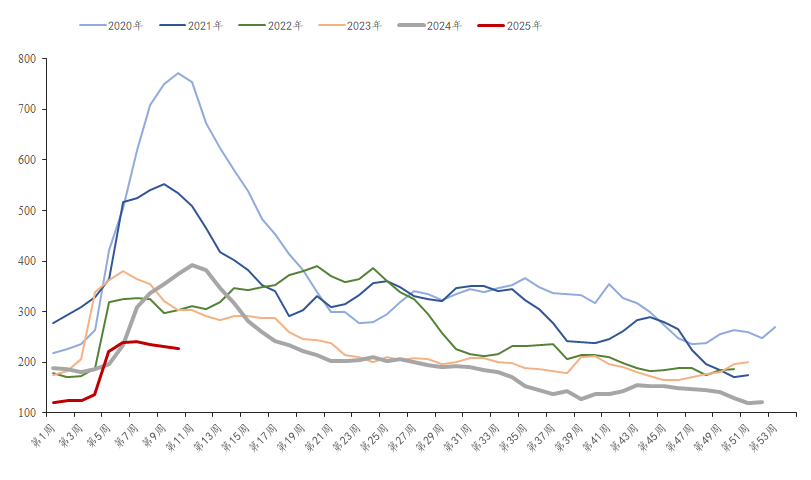
 This week, in-plant rebar inventory was 2.2736 million mt, down by 34,600 mt WoW, a decline of 1.5% WoW (previous value: -2.21%). Compared to the same period last year on the lunar calendar, it decreased by 1.5504 million mt, a YoY decline of 40.54% (previous value: -41.18%). Direct supply from steel mills remained relatively stable. However, spot prices weakened during the week, leading to reduced restocking by agents, while production increased slightly. As a result, the decline in in-plant inventory narrowed compared to last week.

Chart-1: Rebar In-Plant Inventory Trends, 2019-2024
Source: SMM

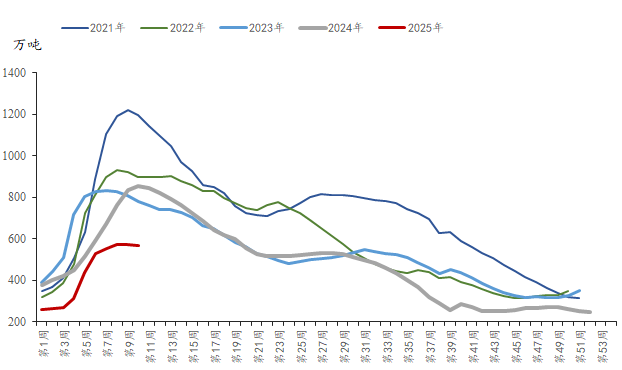
 This week, social rebar inventory was 5.7017 million mt, down by 25,200 mt WoW, a decline of 0.44% WoW (previous value: +0.28%). Compared to the same period last year, it decreased by 2.5236 million mt, a YoY decline of 30.68% (previous value: -32.31%). With the accelerated recovery of demand in northern regions, market spot inventory shifted from an increase to a decrease, marking a turning point in social inventory this week.

Chart-2: Rebar Social Inventory Trends, 2019-2024
Source: SMM

Looking ahead, blast furnace steel mills currently maintain certain profitability, and some blast furnaces in north-west China are scheduled to resume production mid-month after maintenance. The capacity utilisation rate of EAF steel mills has recovered to 40.6%, but their operating rate remains constrained by profitability, making further increases difficult. Construction steel production is expected to increase slightly. On the demand side, with the accelerated recovery in northern regions, demand intensity continues to improve. Although the Two Sessions did not bring substantial benefits, coal mine production cuts and steel production controls are boosting market sentiment. Meanwhile, supply growth remains limited. Construction steel inventory is expected to continue destocking next week, with a larger destocking margin.

Data Source Statement: Except for publicly available information, all other data are processed by SMM based on publicly available information, market communication, and relying on SMM's internal database model. They are for reference only and do not constitute decision-making recommendations.

For any inquiries or for more information, please contact: lemonzhao@smm.cn
For more information on how to access our research reports, please contact:service.en@smm.cn
Related News
[Coal to Power India Till 2035-36 — A Boost for Steel & Induction Furnace Sector]
45 mins ago
[Coal to Power India Till 2035-36 — A Boost for Steel & Induction Furnace Sector]
Read More
[Coal to Power India Till 2035-36 — A Boost for Steel & Induction Furnace Sector]
[Coal to Power India Till 2035-36 — A Boost for Steel & Induction Furnace Sector]
India's Power Ministry has confirmed that coal will keep supplying nearly half of the country's electricity through 2035-36, as rising power demand and the limits of round-the-clock renewable supply mean thermal power remains essential; to meet this, India plans to raise coal power capacity from around 224 GW today to about 315 GW by 2035-36, which is good news for the steel and induction furnace sector since it means more stable, reliable electricity supply to support continuous furnace operations and production growth in the coming decade.
45 mins ago
[SMM Steel] European HRC: Supply Tightness Fails to Lift Prices
1 hour ago
[SMM Steel] European HRC: Supply Tightness Fails to Lift Prices
Read More
[SMM Steel] European HRC: Supply Tightness Fails to Lift Prices
[SMM Steel] European HRC: Supply Tightness Fails to Lift Prices
[Europe] As mill operations face repeated disruptions, domestic supply within the European Union has seen periodic shortages. This week, three production disruptions were reported across the Netherlands, Germany, and Italy; notably, ArcelorMittal Eisenhüttenstadt announced a temporary partial shutdown of its 5A blast furnace. Despite these bullish supply-side factors, buying interest remains subdued, leaving hot-rolled coil (HRC) prices with only marginal gains and trading within a narrow range overall. In Northern Europe, burdened by high inventories, mills quoted a delivered base price of 760 EUR/tonne DDP (~866 USD/tonne) to buyers currently hesitant to book large volumes; for orders reaching 5,000 tonnes, delivered base prices could potentially be negotiated down to 730 EUR/tonne DDP (~832 USD/tonne). Traders reported that most concluded transactions currently fall between 740–760 EUR/tonne EXW (~844–866 USD/tonne). The domestic Italian market remains sluggish, where the core challenge lies in mills struggling to pass costs onto downstream sectors while attempting to secure sufficient sales volumes.
1 hour ago
[SMM Steel] Sea Bottlenecks Fuel Land Routes: Iran Billet & HRC Command Border Premiums as Slab Pivots Domestic
1 hour ago
[SMM Steel] Sea Bottlenecks Fuel Land Routes: Iran Billet & HRC Command Border Premiums as Slab Pivots Domestic
Read More
[SMM Steel] Sea Bottlenecks Fuel Land Routes: Iran Billet & HRC Command Border Premiums as Slab Pivots Domestic
[SMM Steel] Sea Bottlenecks Fuel Land Routes: Iran Billet & HRC Command Border Premiums as Slab Pivots Domestic
[Iran] Iranian steel exports displayed a distinct structural divergence of "constrained maritime logistics versus buoyant overland border trade." Disrupted Black Sea supplies from Russia and Ukraine diverted West Asian buying interest toward Iranian material. Iranian suppliers recently concluded at least 15,000 tonnes of square billets at 420–430 USD/tonne FCA at Iranian border crossings, primarily for transit via Iraq to Syria and Jordan; despite border congestion inflating transport costs, buyers readily paid premiums to secure prompt cargoes. In contrast, seaborne exports were severely stifled by US naval enforcement, vessel shortages, and elevated insurance premiums, leaving liquidity for bulk shipments paralyzed (freight to Sohar, Oman stood at 18–25 USD/tonne). With major mills fully booked through late November, spot sea liquidity remained thin, limited to small billet parcels sold to neighboring Gulf markets at 410–415 USD/tonne FOB. Notably, slab export activity ground to a halt as mills turned their focus entirely to domestic demand. In the flat steel segment, HRC moved steadily via the Shalamcheh border crossing to Iraq at 540–560 USD/tonne FCA; meanwhile, across the Caspian Sea route, a lack of available vessel capacity prevented Russian material from concluding, keeping import activity virtually frozen.
1 hour ago