Silicon Metal Prices Continue to Decline, Market Slump Difficult to Break [SMM Analysis]

Published: Mar 11, 2025 17:03 (GMT+8)
Source: SMM
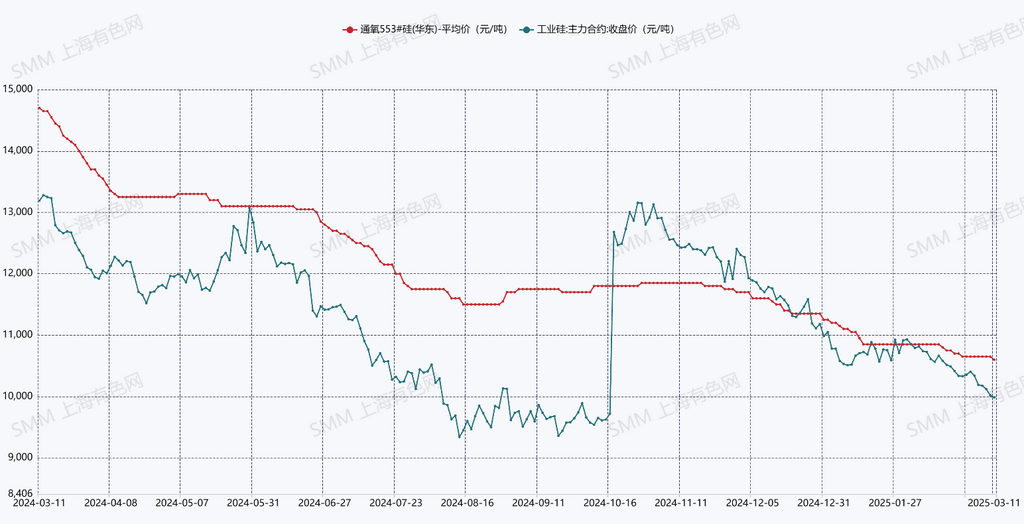
[SMM Silicon Market February-March Brief: Silicon Metal Prices Continue to Decline, Market Slump Difficult to Break] From February to early March, spot silicon metal maintained a weak trend, with SMM east China above-standard #553 silicon down 250 yuan/mt, a decrease of 2.3% MoM. While spot prices remained weak, futures prices also fell to new lows after implementing new standards. On March 11, the most-traded Si2505 futures contract officially dropped below 10,000 yuan/mt, closing at 9,985 yuan/mt, down 805 yuan/mt or 7.5% MoM. The sharp decline in silicon metal futures prices, along with the inflow of warehouse warrants and non-standard supplies into the market, accelerated the drop in spot silicon metal prices, with pessimistic and negative market sentiment proving difficult to reverse.

SMM March 11 News: From February to early March, spot silicon metal continued its weak trend. SMM east China above-standard #553 silicon fell by 250 yuan/mt MoM, a decrease of 2.3%. While spot prices remained weak, futures prices also dropped to new lows after implementing the new standard. On March 11, the most-traded Si2505 futures contract officially fell below 10,000 yuan/mt, closing at 9,985 yuan/mt, down 805 yuan/mt MoM, a decrease of 7.5%. The sharp decline in silicon metal futures prices, along with the influx of warehouse warrants and non-standard cargoes into the market, accelerated the drop in spot silicon metal prices, with market sentiment remaining pessimistic and difficult to reverse.

Supply: According to SMM data, silicon metal production in February 2025 was 289,500 mt, down 14,500 mt MoM, a decrease of 4.8%. Based on daily average production, February's average daily output was higher than January's. By province, silicon enterprises in Xinjiang, Inner Mongolia, and Gansu showed relatively high operating rates, with the combined supply from these three regions accounting for over 80%, while Sichuan and Yunnan accounted for less than 6%. In March, with the production release from newly resumed silicon furnaces and the expected resumption of production by some silicon enterprises, coupled with an increase in production days, silicon metal production in March is expected to increase significantly, reaching over 340,000 mt.
Demand: SMM data shows that the operating rate of the polysilicon industry fluctuated slightly from February to March. Polysilicon production in February was 90,100 mt, and March production is expected to reach 94,600 mt. By April-May, monthly polysilicon production may increase to 110,000 mt. Silicone enterprises experienced a significant decline in operating rates in February, with silicone DMC production at 199,500 mt, down 9.6% MoM. Operating rates in March are expected to remain relatively stable. The decline in production was driven by proactive maintenance of some silicone monomer capacities, reducing demand for silicon metal. For silicone, the decrease in DMC production, combined with restocking during the downstream "mini peak season," pushed silicone product prices upward, significantly improving the profitability of the silicone industry. The operating rate of the aluminum-silicon alloy industry gradually returned to normal levels from February to March.

Bullish Factors: Improved profitability of silicone enterprises

Bearish Factors: Increased supply from resumed capacities of northern silicon metal producers, new existing capacities awaiting commissioning, difficulties in inventory destocking, and weak price trends for silicon coal as a raw material

SMM Viewpoint: Based on supply-demand balance calculations, the industry experienced slight destocking in January-February. However, with the increase in operating capacity and significant production growth on the supply side in March, coupled with minimal demand growth, the balance is expected to shift back to surplus in March. Polysilicon enterprises have relatively large supporting silicon metal capacities, with large-scale silicon enterprises (annual capacity of 100,000 mt or more) accounting for a higher proportion of supply and offering greater supply stability compared to small and medium-sized enterprises. The fundamental outlook for silicon metal remains strong supply and weak demand. Even if some small and medium-sized enterprises implement production cuts, it will be difficult to change the current supply-demand situation. Spot silicon metal prices are expected to remain at low levels in the near term.

For more detailed market information and updates, or if you have other inquiries, please call 021-51666820.


Data Source Statement: Except for publicly available information, all other data are processed by SMM based on publicly available information, market communication, and relying on SMM's internal database model. They are for reference only and do not constitute decision-making recommendations.

For any inquiries or for more information, please contact: lemonzhao@smm.cn
For more information on how to access our research reports, please contact:service.en@smm.cn
Related News
[India Extends Export-Risk Support as UAE Remains Major Steel Export Market]
6 mins ago
[India Extends Export-Risk Support as UAE Remains Major Steel Export Market]
Read More
[India Extends Export-Risk Support as UAE Remains Major Steel Export Market]
[India Extends Export-Risk Support as UAE Remains Major Steel Export Market]
India has extended enhanced export-credit insurance support for shipments to West Asia until March 31, 2027, providing continued risk protection for exporters as the UAE remains one of the country's largest finished-steel export markets. The Directorate General of Foreign Trade extended the eligibility timeline under Component II of the Resilience & Logistics Intervention for Export Facilitation (RELIEF), citing continued geopolitical disruptions and their impact on maritime logistics across the Gulf and adjoining regions. The extension is relevant to India's steel trade with the region. Ministry of Steel data sourced from the Joint Plant Committee show that India exported 2.986 million tonnes of finished steel during April-August 2026, up 34.1% year on year. The UAE received 389,200 tonnes, accounting for 13.0% of India's total finished-steel exports and ranking as the country's second-largest export destination after Vietnam. The UAE's importance was even greater earlier in the financial year. It was India's largest finished-steel export destination during April-June, receiving 249,000 tonnes, or 15.6% of total exports. Cumulative shipments to the UAE increased to 339,600 tonnes during April-July before reaching 389,200 tonnes by the end of August. RELIEF covers consignments destined for or transshipped through specified West Asian markets including the UAE, Saudi Arabia, Kuwait, Qatar, Oman and Bahrain, among others. Under Component II, eligible exporters obtaining ECGC cover can receive risk coverage of up to 95%, while premiums are prevented from increasing beyond pre-disruption levels during the eligible period. The government said the intervention responds to extraordinary freight escalation, higher insurance premiums and war-related export risks caused by disruptions in the Gulf and wider West Asian maritime corridor. For the steel sector, the measure can help limit payment and insurance risks for eligible shipments to a region that has become an important outlet for Indian finished steel. However, the support should not be interpreted as applying to all Indian steel exports to West Asia. Component II specifically covers Full Container Load and Less than Container Load cargo, along with reefer containers, meaning its direct applicability is strongest for eligible containerised steel shipments rather than conventional bulk or breakbulk cargoes.
6 mins ago
[SMM Coal Flash] Coal India Raises September Coal Supplies 12.5% YoY
7 mins ago
[SMM Coal Flash] Coal India Raises September Coal Supplies 12.5% YoY
Read More
[SMM Coal Flash] Coal India Raises September Coal Supplies 12.5% YoY
[SMM Coal Flash] Coal India Raises September Coal Supplies 12.5% YoY
Coal India Limited (CIL) increased coal supplies by 12.5% year on year to 61.20 million tonnes in September FY2026-27, according to a company press release. Coal supplies to the power sector rose 10.63% YoY to 48.90 million tonnes, while coal production increased 9.18% to 53.50 million tonnes. In the second quarter, CIL’s coal supplies rose 12.04% YoY to 186.04 million tonnes, including 148.20 million tonnes supplied to the power sector.
7 mins ago
[SMM Coal Flash] IRESS Proposes Separate Coal DMO Quota for Power Sector from 2027
9 mins ago
[SMM Coal Flash] IRESS Proposes Separate Coal DMO Quota for Power Sector from 2027
Read More
[SMM Coal Flash] IRESS Proposes Separate Coal DMO Quota for Power Sector from 2027
[SMM Coal Flash] IRESS Proposes Separate Coal DMO Quota for Power Sector from 2027
Indonesia Resources Studies (IRESS) has proposed separating the coal Domestic Market Obligation (DMO) for the power sector from other domestic demand starting in 2027, with coal supplied to private smelters excluded from the DMO calculation. IRESS said around 70 million tonnes of the 239 million-tonne DMO target in 2025 was allocated to smelters. The group proposed setting a separate electricity DMO quota for each coal producer under the 2027 RKAB, with compliance based on actual deliveries to power plants.
9 mins ago