As the country with the largest nickel ore reserves and the leading exporter of nickel smelting products, Indonesia has garnered extensive attention in the nickel market. In recent years, Indonesia has introduced a series of policies to regulate nickel resources, ranging from RKAB quota approvals at the mining end to the SIMBARA system, which is expected to officially launch in early 2025. These measures have significantly impacted the upstream supply landscape of nickel. This article focuses on the specifics of the SIMBARA system. Introduction to the SIMBARA System The full name of the SIMBARA system is "Sistem Informasi Mineral dan Batubara Antar Kementerian/Lembaga," a blockchain-based digital platform designed to provide a fully transparent traceability system for Indonesia's local supply chain. First implemented in 2022 to track coal, the system is planned to expand its application to other minerals. In July 2024, the Indonesian President and several cabinet members attended the unveiling ceremony for the expanded SIMBARA system. This updated system now includes regulatory oversight for tin and nickel commodities, surpassing its initial focus on coal when it was launched in 2022.
Core Functions of SIMBARA
The SIMBARA application serves as a monitoring tool for non-tax state revenue (PNBP) and mineral and coal transactions. It is also part of the governance process for minerals and coal from upstream to downstream, including fulfilling payment obligations and port clearance procedures. SIMBARA features an integrated monitoring ecosystem for all management and supervision applications and acts as a data center for minerals and coal. SIMBARA integrates processes from upstream activities such as planning and exploration to downstream processes including mining, processing, and refining, ensuring comprehensive oversight. This includes a single identity for taxpayers and payers, mining license processes, sales planning, sales verification, PNBP payments, exports, transportation or shipping, and export foreign exchange earnings. This holistic approach aims to enhance the management and regulatory framework governing these critical resources. The Indonesian Minister of Energy and Mineral Resources (ESDM) stated that SIMBARA demonstrates the government's strong commitment to improving the management of Indonesia's natural resources. He emphasized that SIMBARA not only aims to streamline processes but also seeks to revolutionize resource management by incorporating key principles such as efficiency, transparency, and systemization.
Role of the SIMBARA System
Taking the nickel industry as an example, the Indonesian government will be able to track nickel ore sales in real-time through the SIMBARA portal, monitoring transportation from mines to domestic processing facilities, including inter-island shipments. The system will also link to mining quotas, covering detailed aspects such as mining locations, processing procedures, transportation, and exports. This system helps ensure that local producers comply with global mining standards while reducing issues such as illegal mining, child labor, and environmental damage. "With this system, we can work in an orderly, consistent, firm, and authoritative manner without burdening operators," said Luhut Pandjaitan, Indonesia's Coordinating Minister for Maritime and Investment Affairs. Improved compliance is expected to increase royalties from tin and nickel miners by 50 trillion to 100 trillion Indonesian rupiah within a year. He also noted that SIMBARA would help prevent corruption and illegal mining. In the future, SIMBARA is expected to expand further to include other commodities such as gold, bauxite, and crude palm oil.
Specific Content and Processes of the SIMBARA System (Using the Nickel Industry as an Example)
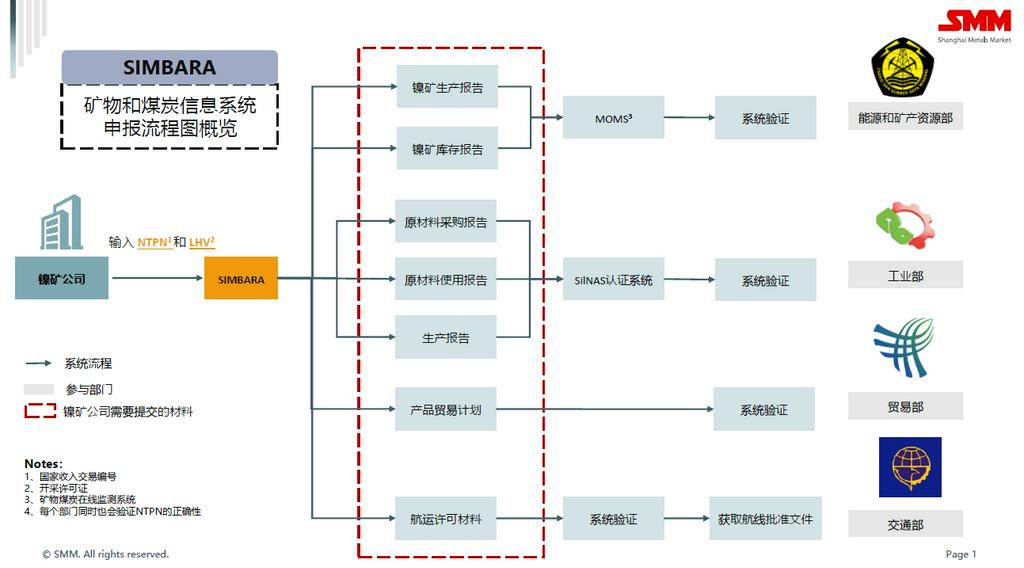
For the nickel industry, all nickel ore mining companies must submit required materials (e.g., nickel ore production reports, nickel ore inventory reports, raw material procurement reports, etc.) through the SIMBARA system to relevant departments for approval. This process involves reviews by four main government departments: the Indonesian Ministry of Energy and Mineral Resources, the Ministry of Industry, the Ministry of Trade, and the Ministry of Transportation. The specific documents to be submitted and their corresponding government departments are shown in the diagram.
Impact of the SIMBARA System Launch in 2025 on the Nickel Industry
Starting in early 2025, the SIMBARA system will officially launch, requiring all Indonesian nickel ore mines to complete all system approvals before legal sales can occur. Simultaneously, the Mineral and Coal Online Monitoring System (MOMS) digital platform, developed by the Ministry of Energy and Mineral Resources, will seamlessly integrate with SIMBARA, providing real-time monitoring and management functions for coal, tin, and nickel commodities. MOMS is designed to be scalable and will gradually expand to include more mineral commodities in the future. At the beginning of the year, to ensure the legal sale of nickel ore through the SIMBARA system, local mines in Indonesia actively submitted materials. However, the nickel ore production and inventory reports required by the MOMS system needed third-party certification. The time and process for third-party certification and approval temporarily affected the availability of nickel ore in January. Nevertheless, due to the supplementary quota method implemented in Q4 of the previous year and the concentrated restocking by downstream smelters, downstream smelters' inventories remained above safe levels. In a market environment with subdued purchasing sentiment, the SIMBARA and MOMS systems did not directly impact local nickel ore prices.
Subsequently, as downstream purchasing sentiment gradually improved, the SIMBARA system began to have new impacts.
According to SMM statistics, Indonesian nickel products have cumulatively consumed over 240 million wmt of nickel ore (including pyrometallurgical and hydrometallurgical ores), a figure higher than the tax revenue collected by the Indonesian government from the mining end. This discrepancy suggests potential tax evasion in some ore sales processes. However, with the launch of the SIMBARA system in 2025, illegal sales of nickel ore were strongly curbed, which may have affected the supply of nickel ore in Indonesia's domestic trade to some extent. Looking ahead, as mines gradually complete the approval processes required by the SIMBARA system, the system is expected to become more familiar and accepted by local mines and downstream smelters. In the long term, this system will play a significant role in promoting the sustainable development of the mining industry and enhancing the Indonesian government's tax collection. It will undoubtedly further strengthen Indonesia's position in the global mineral resources sector.
SMM will continue to monitor updates to the SIMBARA system and provide the market with first-hand intelligence on Indonesian policies.
![[SMM 니켈 플래시 뉴스] 일일 업데이트 — 2026년 9월 2일](https://imgqn.smm.cn/usercenter/qLeLR20251217171733.jpg)