SMM February 23 News:
Against the backdrop of the rapid development of global high-tech industries, the importance of high-purity aluminum as a key foundational material is increasingly prominent. This article focuses on the international standard differences of high-purity aluminum and the development status of the electrode foil industry chain, providing a brief analysis of the technical distinctions in purity definition systems among China, Japan, and Western countries.
The industry standards for high-purity aluminum exhibit significant international differences, with each country establishing classification systems based on technical requirements and industrial foundations. In China, the "Nonferrous Metals Industry Standard of the People's Republic of China" defines high-purity aluminum as refined aluminum with an aluminum content of ≥99.995% and first clarified classifications in 2008: 5NAl (purity ≥99.999%) and 5N5Al (purity ≥99.9995%). After the 2018 standard revision, a 6N grade (purity ≥99.9999%) was added, further refining the quality thresholds. Japan adopts a broader definition, categorizing aluminum with an aluminum content of ≥99.95% as high-purity aluminum, including refined primary aluminum. It is further divided into three grades: special-grade aluminum (purity ≥99.995%), first-grade aluminum (≥99.990%), and second-grade aluminum (≥99.950%). Western countries define aluminum with ≥3N5 (aluminum content ≥99.95%) as high-purity aluminum, while aluminum with a purity exceeding 5N5 (≥99.9995%) is classified as "ultra-high-purity aluminum," highlighting the specialized demand for extremely pure materials.
High-purity aluminum is a high-tech, high-value-added material primarily used in advanced technology fields and scientific research. For instance, the anode foil of electrolytic capacitors is made from aluminum with a purity of 3N5-4N8, while the cathode foil is produced using aluminum with a purity of 2N7-3N. Electronic foil serves as the upstream raw material for producing electrode foil, with etched foil and formed foil collectively referred to as electrode foil. Etched foil is the upstream raw material for formed foil.
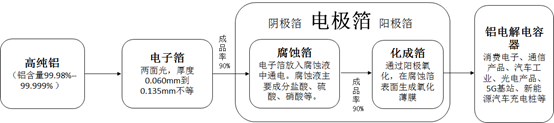
As shown in the figure, electronic foil is rolled from high-purity aluminum with a purity of over 99.98%, with thicknesses typically ranging from 60μm to 130μm.
Electronic foil is immersed in an etching solution composed mainly of sulphuric acid, nitric acid, hydrochloric acid, and other substances. By applying electricity, the aluminum foil is etched to form sponge-like or tunnel-like pores, resulting in etched foil. The purpose of increasing the surface area of the aluminum foil is to enhance its specific capacitance. The higher the specific capacitance, the less aluminum foil is required, and the smaller the capacitor becomes. The loss during the etching process is significantly higher than for other aluminum foils, with approximately 100 mt of electronic foil typically yielding only about 60 mt of etched foil. By subjecting the etched foil to anodisation, a thin oxide film is formed on the aluminum foil surface, creating formed foil. The purpose of anodisation is to improve the voltage resistance of the aluminum foil. The higher the voltage resistance, the greater the power of the capacitor.
In capacitors, etched foil can serve as the cathode, while the anode must use formed foil. Therefore, etched foil and formed foil are collectively referred to as electrode foil. Both types of foil are used together in capacitors, with the primary downstream applications still being traditional appliances such as home appliances. However, applications in 5G base stations and NEV charging piles currently account for a relatively small proportion but are growing at an exceptional rate.
At present, electrode foil prices are high and exhibit significant price differences, generally exceeding 40,000 yuan/mt, with the highest prices reaching several hundred thousand yuan/mt. The main reason for the price disparity is the difference in production costs, as the "forming" process in electrode foil production consumes a substantial amount of electricity. Energy costs account for approximately 50% of the total production cost. Currently, China's annual electrode foil production is about 200 million m², but the highest-end electrode foil still needs to be imported from Japan and South Korea. Customs data shows that over 80% of China's imported aluminum foil comes from Japan and South Korea, with electrode foil and electronic foil accounting for a significant proportion. In recent years, China's leading enterprises in the electrode foil industry have continuously enhanced their technological capabilities, with some products now comparable in quality to similar Japanese products and gaining recognition from Japanese customers. With technological breakthroughs and international certifications achieved by domestic leading enterprises, China is gradually transitioning from a follower to a competitor in the electrode foil field. This progress not only concerns the independent controllability of the materials industry but also provides critical support for the development of China's strategic emerging industries such as 5G base stations and NEVs.