SMM, February 5:
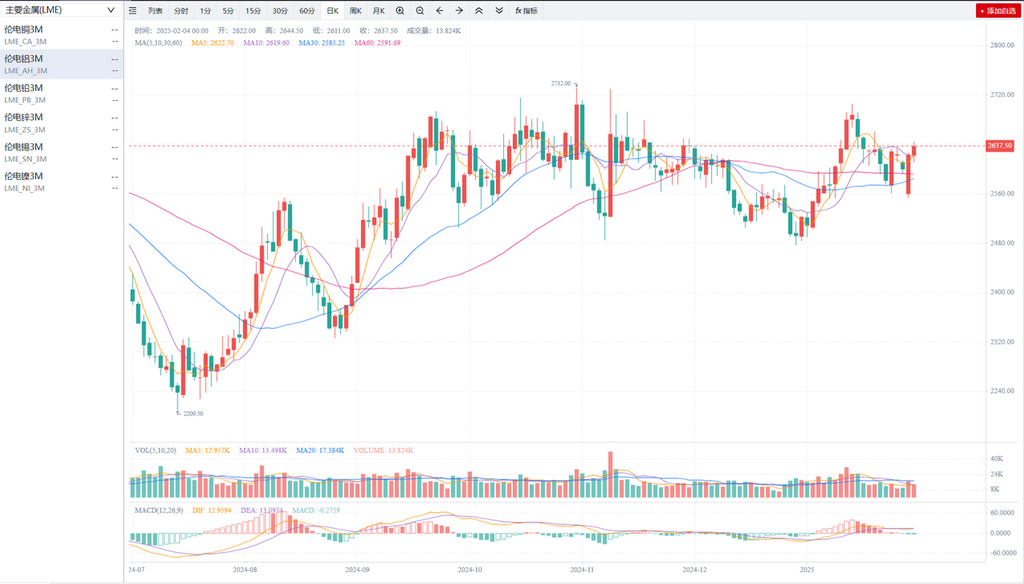
Before the Chinese New Year holiday, domestic aluminum prices shifted lower as end-use consumption weakened. On January 27, the most-traded SHFE aluminum contract (AL2503) closed at 20,240 yuan/mt, down 0.78% on the day. During the Chinese New Year holiday (January 28 to February 4), the SHFE aluminum market was closed, while LME aluminum prices maintained a fluctuating trend, with a high of $2,634/mt and a low of $2,553/mt. On February 4, LME aluminum closed at $2,637.5/mt, up 1.11% over the period.
Macro Economy: US Fed Maintains Cautious Stance on Rates, US and Eurozone Economies Slow
The US Fed recently stated that there is no urgent need for an interest rate cut until inflation and employment data require further adjustments, keeping the federal funds rate in the 4.25%-4.50% range. Fed official Raphael Bostic noted that while inflation is expected to continue declining, heightened economic uncertainty necessitates cautious policy adjustments to avoid overcorrection. The market remains focused on the timing and scale of future Fed rate cuts.
In Q4 2024, US GDP growth slowed to 2.3%, down from 3.1% in Q3, reflecting weakened growth momentum. Although inflation has significantly eased, the market remains wary of potential upside risks, particularly additional tariff policies that may be implemented by the Trump administration, which could increase cost pressure. Affected by economic data, the US dollar index fell below 107.8 on January 31, weakening the US dollar, while the 10-year US Treasury yield hovered around 4.5%.
In the Eurozone, Q4 2024 economic growth stagnated, recording 0.0% QoQ, with risks of weak demand and sluggish business activity intensifying. To stimulate the economy, the European Central Bank decided to cut the benchmark interest rate by 25 basis points to 2.75%, marking the fifth rate cut in this cycle and underscoring the urgency to boost economic growth.
EU Sanctions Tighten, US Tariffs Add Pressure, Global Aluminum Supply Chain Faces Adjustments
EU Expands Restrictions on Russian Aluminum Imports
On January 16, 2025, the EU announced plans to expand import restrictions on Russian aluminum products in its 16th round of sanctions in response to the ongoing Ukraine crisis. However, as Russia has successfully redirected its aluminum exports to non-sanctioned countries, the global impact of this measure is expected to be limited. Following the announcement, LME aluminum briefly surpassed $2,600/mt, hitting a one-month high before pulling back. The related sanctions are expected to be finalised in February.
Since the outbreak of the Russia-Ukraine conflict, the EU has significantly reduced its imports of Russian aluminum, with Russian aluminum now accounting for approximately 6% of the EU's total primary aluminum imports, a sharp decline from 2022. Supplies from the Middle East, India, and Southeast Asia have gradually filled the gap in the EU market. Meanwhile, Russian aluminum is increasingly flowing into China, with China importing 263,000 mt of Russian aluminum in the first three quarters of 2024, accounting for 33% of Russia's total aluminum exports. Considering China's aluminum production has nearly reached its capacity ceiling of 45 million mt, China's demand for imported aluminum is expected to persist.
US Tariff Hike Impacts Canadian Aluminum Trade
On February 2, Trump announced a 25% tariff on aluminum imports from Canada and Mexico, effective February 4, along with an additional 10% tariff on Chinese imports on top of existing tariffs. For China, the aluminum semis export tax rebate policy canceled in December last year will partially offset the tariff impact. However, Canada faces greater pressure—93.75% of its primary aluminum exports, totaling 1.55 million mt in 2024, were destined for the US, while US domestic primary aluminum supply only meets one-sixth of its consumption. Under these circumstances, the tariff hike will inevitably push up US domestic aluminum prices, ultimately affecting end-use consumers. The Canadian government is negotiating with the US to seek tariff exemptions or other trade compensation measures. On February 4, Mexico and Canada reached an agreement with the US to delay the tariff implementation by 30 days in exchange for enhanced border security measures with the US.
Amid tariff expectations, Canadian aluminum traders have begun arbitrage activities in the European market. According to SMM, the Rotterdam P1020A dp premium has dropped from $370/mt in early January to $320-330/mt, indicating market adjustments to hedge against US tariff policies. If the tariff policy continues, more Canadian aluminum may flow into the European market, further impacting global trade patterns and the European market's price structure.
Summary
Before the Chinese New Year, domestic aluminum market demand weakened, while LME aluminum prices fluctuated during the holiday. From a macro perspective, the US Fed has no immediate plans for rate cuts, US economic growth is slowing, and the Eurozone economy is stagnating with continued rate cuts, posing challenges to global economic recovery. On the supply side, the EU plans to expand sanctions on Russian aluminum, but the global market has partially absorbed the impact, with supplies from the Middle East and Southeast Asia filling the gap, while Russian aluminum flows to China have increased. The US's 25% tariff on Canadian aluminum may raise costs in the North American aluminum market, with Canada seeking countermeasures and arbitrage activities emerging in the European market. Overall, the global aluminum market is expected to undergo structural adjustments in the short term due to policy impacts, requiring close attention to US and European trade policies and changes in major consumer market demand.
Source: SMM Click on the SMM Industry Database for More Information