New Orders for Silicon Enterprises Were Sluggish During the Week, and the Operating Rate of Sample Silicon Enterprises Was Basically Stable [SMM Weekly Survey on Silicon Metal].

Published: Jan 17, 2025 18:36 (GMT+8)
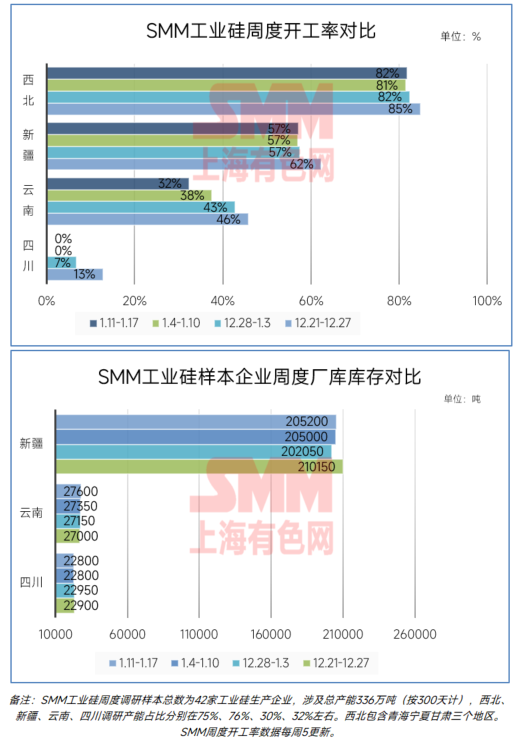
New Orders for Silicon Enterprises Remained Sluggish During the Week; Sample Silicon Enterprises' Operating Rates Were Basically Stable" According to the SMM survey, the weekly production of sample silicon enterprises in Xinjiang (accounting for 79% of capacity) was 27,700 mt, with a weekly operating rate of 57%, which was basically flat WoW. The weekly production of sample silicon enterprises in Yunnan (accounting for 30% of capacity) was 11,095 mt, with a weekly operating rate of 82%, remaining basically flat MoM. The weekly production of sample silicon enterprises in Sichuan (accounting for 32% of capacity) was 2,757 mt, with a weekly operating rate of 32%, which declined WoW, while in-plant inventory fluctuated slightly.


》View SMM Silicon Product Prices

》Subscribe to View Historical Price Trends of SMM Metal Spot Cargo

SMM, January 17: According to the SMM survey, the weekly production of silicon enterprises in Xinjiang (accounting for 79% of capacity) was 27,700 mt, with a weekly operating rate of 57%, which was basically flat WoW. In-plant inventory was also basically flat MoM. This week, the operating rate of Xinjiang silicon enterprises remained basically stable. The resumption time for previously suspended capacity due to maintenance remains uncertain. Spot silicon prices were basically stable, while downstream restocking demand was relatively small, and new orders during the week were sluggish. Attention should be paid to maintenance capacity and the operating conditions of small and medium-sized silicon enterprises.

The weekly production of silicon enterprises in north-west China (accounting for 75% of capacity) was 11,095 mt, with a weekly operating rate of 82%, which was basically flat MoM. The operating rate of sample silicon enterprises remained stable during the week, with few maintenance plans before the Chinese New Year. The operating rate is expected to remain stable in the near term.

The weekly production of silicon enterprises in Yunnan (accounting for 30% of capacity) was 2,757 mt, with a weekly operating rate of 32%, which declined WoW. In-plant inventory fluctuated slightly. Due to sampling bias, the weekly operating rate in Yunnan appeared relatively high. Recently, some silicon enterprises in Baoshan have implemented production cuts, and additional capacity is expected to be cut by the end of the month, leading to a further decline in the operating rate. The remaining operating silicon enterprises in Yunnan are limited.

The weekly production of silicon enterprises in Sichuan (accounting for 32% of capacity) was 0 mt, with a weekly operating rate of 0%, which declined MoM. Currently, none of the sample silicon enterprises in Sichuan are in operation, with only a few furnaces operating across the entire province.


》Click to View the SMM Metal Industry Chain Database

Data Source Statement: Except for publicly available information, all other data are processed by SMM based on publicly available information, market communication, and relying on SMM's internal database model. They are for reference only and do not constitute decision-making recommendations.

For any inquiries or for more information, please contact: lemonzhao@smm.cn
For more information on how to access our research reports, please contact:service.en@smm.cn
Related News
[JFE Steel expects 600,000-tonne output cut after typhoon damage]
2 hours ago
[JFE Steel expects 600,000-tonne output cut after typhoon damage]
Read More
[JFE Steel expects 600,000-tonne output cut after typhoon damage]
[JFE Steel expects 600,000-tonne output cut after typhoon damage]
Japan's JFE Steel expects its output to fall by about 600,000 tonnes after heavy rain and Typhoon No. 25 damaged facilities at its East Japan Works in the Chiba area. The company said the impact is likely to be prolonged because the typhoon caused additional damage after August downpours in Chiba. Several facilities were flooded in August; restoration has proceeded with safety first and operations resumed gradually, but blast furnaces have yet to return to normal. Typhoon No. 25 brought further flooding at some facilities there, with repairs under way. JFE said the estimated cut may change with restoration progress and it is still assessing impacts on output and earnings. Some deliveries have been delayed and the company is coordinating with customers to limit supply disruption.
2 hours ago
[India's crude steel output up 4.6% in August as global production declines]
2 hours ago
[India's crude steel output up 4.6% in August as global production declines]
Read More
[India's crude steel output up 4.6% in August as global production declines]
[India's crude steel output up 4.6% in August as global production declines]
India's crude steel output rose 4.6% y-o-y to 14.8 million tonnes in August, retaining its No.2 global rank, while world output slipped 1.2%, per worldsteel. China stayed first at 74.6 mt, down 3.7%; the US was third at an estimated 7.3 mt, up 3%; Japan made 6.7 mt, Russia 5.5 mt and South Korea 5.4 mt. The 70 reporting countries produced 144.2 mt, about 98% of 2025 world output. In January-August, India's output climbed 6% to 115.9 mt, China's fell 3.1% to 651.9 mt and global output eased 0.7% to 1.225 billion tonnes. Asia and Oceania made 106.7 mt in August, down 1.4%, dragged by China. Vietnam jumped 36.4% to 2.7 mt and Brazil fell 6.2% to 2.7 mt. North America gained 3.9%, Africa 8.8%; West Asia, South America and Russia plus other CIS excluding Ukraine fell 4.6%, 4.9% and 5.6%.
2 hours ago
[Ukraine's steel industry nears collapse as top producers halt output]
2 hours ago
[Ukraine's steel industry nears collapse as top producers halt output]
Read More
[Ukraine's steel industry nears collapse as top producers halt output]
[Ukraine's steel industry nears collapse as top producers halt output]
Ukraine's top steelmaker, ArcelorMittal Kryvyi Rih, said on Sept 25 it cannot restart production amid surging Russian strikes. The sector has absorbed at least nine ballistic missile attacks since August, costing nearly 100 million USD, per industry body Ukrmetallurgprom. Steel was 7% of Ukraine's GDP. Strikes have damaged blast furnaces and halted pig iron output, forcing Ukraine's three largest producers to suspend operations, the worst year since 2022, when Azovstal and Illich were destroyed and 40% of national output lost. Closed Black Sea ports block trade, rail and Polish/Romanian routes lift coal freight costs 50-60%, and June EU tariffs plus CBAM curb European sales. Even with 51 nations backing Black Sea trade at the UN Sept 23, restarting output needs months and tens of millions of dollars.
2 hours ago