Silicon Coal Prices May Soften Again in Early 2025, Potentially Reducing Losses for Silicon Plants [SMM Analysis]

Published: Jan 17, 2025 16:31
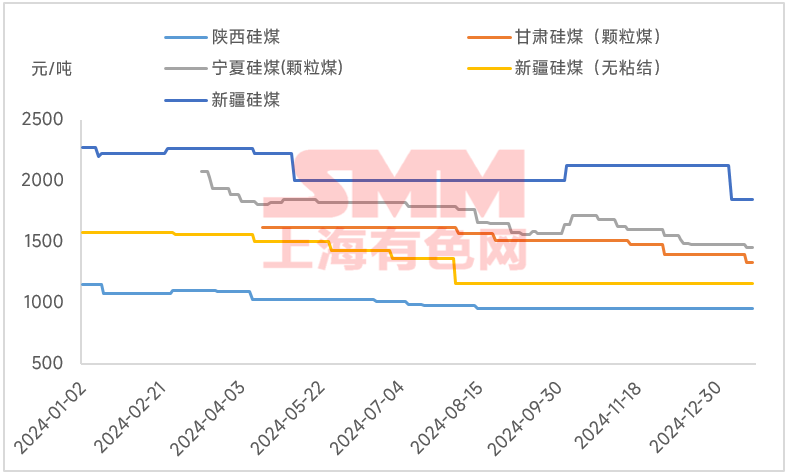
[Further Decline in Silicon Coal Prices in Early 2025 May Reduce Silicon Plant Losses] Entering January 2025, silicon coal prices in the raw material segment of silicon metal were the first to decrease. Starting with silicon coal in the Xinjiang region at the beginning of the month, recent price reductions have also been observed in the Ningxia and Gansu regions to varying degrees. The decline in silicon coal prices in multiple regions at the beginning of 2025 is expected to slightly lower the production costs of silicon metal.


》View SMM Silicon Product Prices


》Subscribe to View Historical Price Trends of SMM Metal Spot Cargo                

Entering January 2025, silicon coal prices in the raw material segment of silicon metal were the first to decline, starting with silicon coal in the Xinjiang region at the beginning of the month. Recently, silicon coal prices in Ningxia and Gansu regions have also seen varying degrees of reduction. The decline in silicon coal prices in multiple regions at the beginning of 2025 has slightly lowered the cost of silicon metal.

Currently, in the smelting process of silicon metal, silicon coal is a major carbonaceous reducing agent, especially in the all-coal smelting process. Fluctuations in silicon coal prices significantly impact the cost of silicon metal. Since 2025, the successive decline in silicon coal prices in multiple regions has been somewhat beneficial for silicon metal enterprises. However, as silicon metal prices have continued to operate below the cost line, the recent decline in silicon coal prices has not turned losses into profits but has only slightly reduced the losses of silicon metal plants.

Silicon coal prices in the Xinjiang region, which have long remained at high levels, saw a significant reduction at the beginning of this month under the pressure of weak operations and declining production by downstream silicon metal plants. Currently, prices are fluctuating around 1,800 yuan/mt, but they remain relatively high compared to granular coal prices in other regions. Recently, granular silicon coal prices in Ningxia and Gansu regions have also declined. The main reason for the recent price reduction in granular silicon coal in Ningxia and Gansu is the continued downward fluctuation of coking coal prices, which has loosened raw coal prices at the mine, reducing silicon coal costs and allowing silicon coal plants to offer further price concessions to downstream silicon plants. Moreover, many silicon coal plants in Ningxia and Gansu have indicated that subsequent prices will continue to adjust according to market trends. Silicon coal plants in Gansu have explicitly stated that if coking coal prices continue to decline, leading to lower silicon coal costs, they will consider further reducing silicon coal prices. Currently, granular silicon coal prices in Ningxia are at 1,360-1,550 yuan/mt, while in Gansu, prices are at 1,320-1,340 yuan/mt.

Based on the current coal consumption of 1.8 mt in the all-coal smelting process, we can calculate that the decline in silicon coal prices in Xinjiang, Ningxia, and Gansu regions during January 2025 could reduce silicon metal costs by 126-495 yuan/mt (data is for reference only; actual conditions depend on the specific regions of silicon coal chosen by each plant and the different ratios used by each plant). Additionally, as silicon metal plants have a certain procurement cycle for raw materials, the silicon coal currently used for production and smelting was mostly purchased before the price reduction, resulting in a lag in cost fluctuations.

Data Source Statement: Except for publicly available information, all other data are processed by SMM based on publicly available information, market communication, and relying on SMM‘s internal database model. They are for reference only and do not constitute decision-making recommendations.

For any inquiries or to learn more information, please contact: lemonzhao@smm.cn
For more information on how to access our research reports, please contact:service.en@smm.cn
Related News
Vietnam Imposes 27.83% Temporary Tariff on Certain Chinese Hot-Rolled Steel Products
Apr 3, 2026 18:40
Vietnam Imposes 27.83% Temporary Tariff on Certain Chinese Hot-Rolled Steel Products
Read More
Vietnam Imposes 27.83% Temporary Tariff on Certain Chinese Hot-Rolled Steel Products
On April 2, the Ministry of Industry and Trade issued Decision No. 612/QD-BCT, imposing a temporary anti-circumvention tariff of up to 27.83% on certain hot-rolled steel products from China. The measure applies to specific flat-rolled steel products (alloy or non-alloy), with thicknesses of 1.2–25.4mm and widths between 1,880mm and 2,300mm, that have not been further processed beyond hot rolling.
Apr 3, 2026 18:40
Risks in the Ferrous Metals Sector Began to Accumulate [SMM Steel Industry Chain Weekly Report]
Apr 3, 2026 18:25
Risks in the Ferrous Metals Sector Began to Accumulate [SMM Steel Industry Chain Weekly Report]
Read More
Risks in the Ferrous Metals Sector Began to Accumulate [SMM Steel Industry Chain Weekly Report]
This week, ferrous metals were in the doldrums. The main logic during the week remained weakening cost support. On Tuesday, Iran proposed charging transit fees for the Strait of Hormuz, while Trump made conciliatory remarks, saying that “even if the Strait of Hormuz remained largely closed, he would still be willing to end military action against Iran.” Market expectations for tighter crude oil supply weakened, and declines in the energy sector dragged down the coal sector, weakening the cost-side logic. During the week, inventories of the five major steel products continued to decline, but apparent demand remained at a low level for the same period in previous years, providing limited fundamental-driven momentum to futures. In the spot market, purchasing interest was average, mainly focused on restocking at low prices. Spot prices were relatively firm, and the spot-futures price spread widened somewhat......
Apr 3, 2026 18:25
MMi Daily Iron Ore Report (April 3)
Apr 3, 2026 18:23
MMi Daily Iron Ore Report (April 3)
Read More
MMi Daily Iron Ore Report (April 3)
Today, the DCE iron ore fluctuated in the doldrums, with the most-traded contract I2605 eventually closing at 799.5 yuan/mt, down 0.50% from the previous trading session. Spot prices fell by about 2-5 yuan from the previous trading day. Traders were moderately active in offering quotes, while steel mills mainly restocked to meet rigid demand; as of now, spot market transactions were mediocre.
Apr 3, 2026 18:23