SMM January 15: Macro factors, on November 15, with approval from the State Council, the Ministry of Commerce, in conjunction with the Ministry of Industry and Information Technology, the General Administration of Customs, and the State Cryptography Administration, issued Announcement No. 51 of 2024, releasing the "Export Control List of Dual-Use Items of the People's Republic of China." This list, effective from December 1, 2024, includes items related to antimony, germanium, gallium, magnesium-based biomaterials, among others.
In early December, the Ministry of Commerce announced that, in accordance with the relevant provisions of the "Export Control Law of the People's Republic of China" and other laws and regulations, to safeguard national security and interests and fulfill international non-proliferation obligations, it decided to strengthen export controls on related dual-use items to the US. The announcement specifies the following: 1. Prohibition of exports of dual-use items to US military users or for military purposes. 2. In principle, no licenses will be granted for the export of dual-use items related to gallium, germanium, antimony, and superhard materials to the US; stricter end-user and end-use reviews will be implemented for the export of dual-use graphite items to the US. Any organization or individual from any country or region that violates the above regulations by transferring or providing related dual-use items originating from the People's Republic of China to US organizations or individuals will be held legally accountable. This announcement took effect upon its release.
According to customs data, gallium exports in 2023 were approximately 41.2 mt, while customs data for January-November 2024 showed gallium exports of about 22.2 mt. It is expected that the full-year customs data for 2024 will show a significant decline compared to 2023. The policy announcements in November-December indicate that China's export control measures for metals such as gallium and germanium will remain stringent and may become even stricter. This suggests that the overall export volume of metals like gallium and germanium in the future (2025) may see a certain degree of decline.
Fundamentals, supply side, in Q4 2024, germanium ore supply remained tight. Although there was a slight increase compared to Q3, the increase was relatively small. The main sources of raw materials remained constrained, with limited ore output. Some enterprises in south China planned to increase production in Q4, but progress was minimal due to raw material shortages. The nationwide germanium market production in 2024 is estimated at 150-160 mt, a decline compared to 2023. However, from the perspective of large manufacturers' inventories, levels remained medium to high, primarily allocated for fulfilling long-term contract obligations and future supply chain needs, with external sales still being conservative. The same applies to small and medium-sized manufacturers. From the perspective of downstream enterprises, inventory levels showed signs of bottoming out, and downstream stocking willingness was strong, particularly among manufacturers of lenses and optical components.
Demand side, the infrared optics sector accounted for approximately 40%, with overall demand in 2024 increasing significantly, though it slightly declined near year-end in Q4. The semiconductor sector accounted for about 10%, with overall demand in 2024 showing significant growth and stable demand in Q4. The telecommunications fiber optics sector accounted for about 40%, with overall demand in 2024 remaining stable without significant growth, and Q4 demand falling short of expectations. Other sectors, such as PV and industrial production, accounted for about 10%, with Q4 demand declining.
Imports and exports, customs data showed germanium exports of approximately 6.376 mt in Q3. In Q4, exports for October-November were about 3.467 mt, indicating that Q4 germanium exports are expected to decline compared to Q3.
Prices, after reaching a peak of approximately 19,000 yuan/kg in Q3, market prices stabilized in Q4 as the supply and demand fundamentals adjusted. By late November to early December, as downstream demand declined, prices showed a pullback trend, though the extent of the pullback was moderate. By the end of December, germanium ingot prices were around 17,500 yuan/kg.
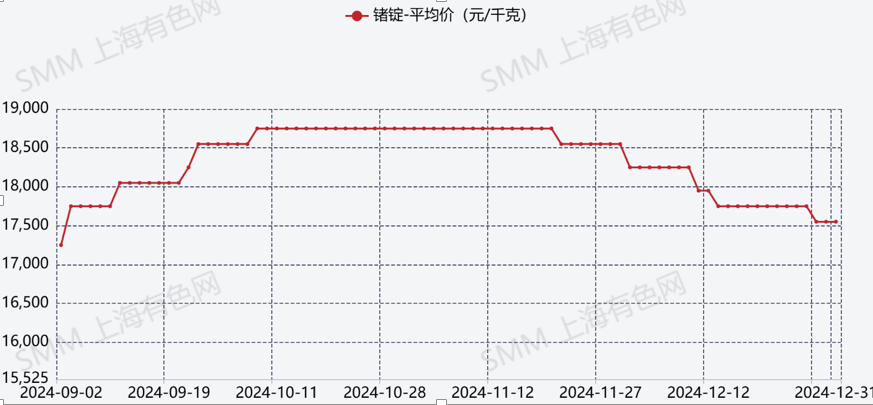
Market outlook, due to the robust consumption growth in germanium's major downstream industries, particularly the strong growth expectations for germanium demand in the infrared and telecommunications fiber optics sectors, germanium prices are expected to remain favorable in the long term. The price range is likely to operate between 16,000-25,000 yuan/kg.
Future focus, with the development of high-data computing and transmission industries such as autonomous driving and AI, germanium fiber optics, as an important material in the optical fiber communication field, play an irreplaceable role in enhancing fiber optic refractive index and optimizing transmission performance. The replacement of standard optical fibers with germanium fiber optics may lead to significant germanium demand, potentially impacting germanium market prices.

![[SMM Analysis] DRC Coltan in 2025: What Production and Export Data Reveal](https://imgqn.smm.cn/usercenter/NPpAM20251217171723.jpeg)