2024 Indium Market Brief Analysis [SMM Indium Market Analysis]

Published: Jan 13, 2025 15:23

SMM January 13: From the perspective of macro factors, China's display production in 2024 is expected to show an overall growth trend. According to market research institutions, China's standalone monitor market shipments in H1 2024 are approximately 10.5 million units, with stable YoY performance. Additionally, IDC forecasts that China's PC monitor market shipments in 2024 will reach 27 million units, up 3.3% YoY. The overall positive outlook for the display industry ensures demand for ITO targets.

Fundamentally, from the supply side, Q4 domestic production and supply remained stable. In China, as the zinc industry continues to operate at full capacity, the supply of by-product indium will not face short-term shortages. However, with the decline in the supply of indium-containing materials, the overall indium production in 2024 is expected to show a downward trend, with an estimated market production of approximately 960 mt.

Demand side, with the arrival of the traditional off-season in the indium market in Q4, domestic end-use demand saw a significant decline compared to Q2 and Q3. Various end-use sectors held a bearish view on indium prices, purchasing raw materials as needed with weak stocking intentions. Overall, the 2024 ITO target market demand is estimated at approximately 480 mt, with slight MoM growth but relatively small in magnitude. Indium compounds are estimated at about 40 mt, also with slight growth. Solder alloys are around 15 mt, remaining stable. PV thin films are approximately 20 mt, with slight growth. Other fields, including heterojunction batteries, are estimated at about 110 mt. Speculative demand, however, has significantly weakened.

From the perspective of imports and exports, customs data for January-November 2024 shows a net export of indium-related products of approximately 286 mt. Therefore, from a fundamental perspective, the current indium market is in a relatively balanced state of supply and demand, with supply slightly exceeding demand. As a result, indium prices have remained high. However, with demand softening slightly near year-end in Q4 and the reduction in speculative demand, prices have shown a downward trend.
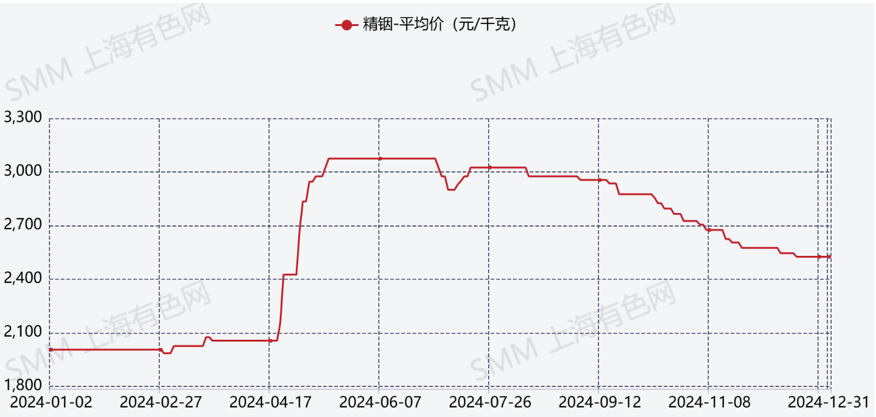
From a price perspective, prices reached their annual peak in Q2, exceeding 3,000 yuan per kilogram. Starting in Q3, prices showed a weakening trend, with the downward slope increasing in Q4. By December, prices stabilized again at around 2,500 yuan per kilogram. One of the main influencing factors on prices remains speculative capital involvement in some forward transactions, which has had a certain impact on spot prices.

Market trends indicate that, given the relatively mature fundamentals of the indium market, future supply changes are expected to be minimal, and there are no significant growth areas in downstream demand. Indium prices are expected to operate within the range of 2,400-2,800 yuan per kilogram in the future. However, speculative capital-driven fluctuations could lead to greater price volatility.


Data Source Statement: Except for publicly available information, all other data are processed by SMM based on publicly available information, market communication, and relying on SMM‘s internal database model. They are for reference only and do not constitute decision-making recommendations.

For any inquiries or to learn more information, please contact: lemonzhao@smm.cn
For more information on how to access our research reports, please contact:service.en@smm.cn
Related News
[SMM Analysis]  Tungsten Market Shifts to High-Level Shock; Sentiment Turns Cautious Amid Intensified Supply-Demand Game
11 hours ago
[SMM Analysis] Tungsten Market Shifts to High-Level Shock; Sentiment Turns Cautious Amid Intensified Supply-Demand Game
Read More
[SMM Analysis]  Tungsten Market Shifts to High-Level Shock; Sentiment Turns Cautious Amid Intensified Supply-Demand Game
[SMM Analysis] Tungsten Market Shifts to High-Level Shock; Sentiment Turns Cautious Amid Intensified Supply-Demand Game
SMM March 13: This week, China’s domestic tungsten market exhibited high-level oscillations with intensified supply-demand competition. Multiple mines put products up for auction during the week, but transactions were bleak.As of March 13, tungsten prices remained largely stable, yet market sentiment became extremely divided.
11 hours ago
Titanium Market Structure Becomes Clearer: Upstream Consolidates at Weak Levels, Midstream and Downstream Strength Expected [SMM Titanium Weekly Review]
Mar 13, 2026 17:49
Titanium Market Structure Becomes Clearer: Upstream Consolidates at Weak Levels, Midstream and Downstream Strength Expected [SMM Titanium Weekly Review]
Read More
Titanium Market Structure Becomes Clearer: Upstream Consolidates at Weak Levels, Midstream and Downstream Strength Expected [SMM Titanium Weekly Review]
[SMM Titanium Weekly Review: Titanium Dioxide Showed Signs of Recovery; Diverging Strength Across the Titanium Industry Chain Market This Week] This week, the titanium industry chain in China showed pronounced structural divergence, with the tug-of-war between sellers and buyers across upstream and downstream segments intensifying and cost pass-through facing obstacles. Overall, the sector was characterized by a combination of weak recovery and localized strong support. Trading in upstream titanium ore and titanium slag was sluggish. Downstream processing enterprises tightly controlled costs, with procurement consistently maintained at a pace driven by rigid demand. Coupled with inventory at high levels across the industry, the raw material end remained under pressure, enterprises’ willingness to operate stayed weak, capacity release was constrained, and the supply-demand imbalance continued to stand out. In the midstream titanium dioxide segment, pressure from elevated costs of raw materials and energy sharply increased production-side strain. Enterprises held prices firm and showed a strong willingness to sell, and while domestic trade demand did not see a noticeable increase in volume—relying only on rigid-demand support—overseas markets still demonstrated a certain degree of resilience, leaving the overall market running relatively strong. The downstream sponge titanium and titanium products segments performed impressively: sponge titanium inventories remained low, and, together with robust downstream restocking demand, top-tier enterprises proactively adjusted prices, with enterprises showing strong confidence in holding prices firm. The titanium products market saw stable supply and demand: the supply-side operating rate was steady, while demand-side differentiation was evident. Civilian applications were mainly driven by rigid-demand restocking, while orders in high-end fields such as aerospace and military industries were steady. The market recovered steadily, and differences in the pace across segments of the industry chain also set the tone for subsequent market dynamics.
Mar 13, 2026 17:49
Manganese-based Battery Materials: Differentiated Trends, Cost-Supported Stability
Mar 13, 2026 13:52
Manganese-based Battery Materials: Differentiated Trends, Cost-Supported Stability
Read More
Manganese-based Battery Materials: Differentiated Trends, Cost-Supported Stability
This week, China’s domestic manganese-based battery materials market has shown a differentiated operation trend. The price of battery-grade manganese tetroxide has slightly declined, the price of electrolytic manganese dioxide has slightly increased, and lithium manganate has maintained a weak balance of supply and demand.
Mar 13, 2026 13:52