Chinese New Year Break Plan for 2025 Released, Solar Cell Production Cuts by 13.3% [SMM Survey]

Publicado: Jan 2, 2025 14:53
The 2025 Chinese New Year break plan has been announced. Except for battery manufacturers that will halt production, most battery facilities are expected to rotate shifts during the holiday, with production lines continuing operation without shutdown. A few battery manufacturers will suspend production and take a three-week break, during which they will carry out line repairs, production line maintenance, and upgrades. However, the overall impact on supply is relatively small. The more significant impact comes from the production cut plans of leading semi-integrated and integrated battery companies. In January 2025, battery production cuts amounted to 7.36 GW, with the top three companies accounting for nearly 80% of the reduction.

The 2025 Chinese New Year break schedule has been released. Except for battery manufacturers that have ceased production, most battery bases plan to rotate shifts during the holiday, with production lines continuing operation without shutdowns. A few battery manufacturers will halt production for three weeks for line repairs, maintenance, and upgrades during the holiday, but the overall impact on supply is relatively small. The more significant impact comes from the production cut plans of leading semi-integrated and integrated battery enterprises. In January 2025, battery production cuts amounted to 7.36 GW, with the top three companies accounting for nearly 80% of the reductions.

According to the SMM survey, the planned production of solar cells in January 2025 was 48.13 GW, including 3.42 GW of P-type cells and 44.74 GW of N-type cells, down 13.3% MoM. The decline in January production was mainly due to the Chinese New Year holiday, compounded by labour shortages and logistics constraints, leading to a downturn in both upstream and downstream demand.
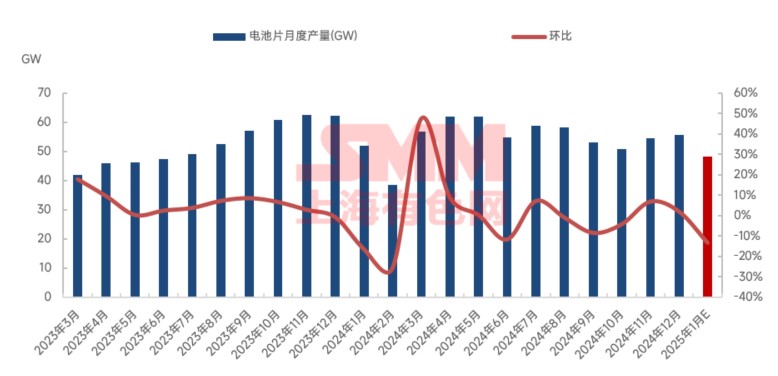
Among the 60 companies that had achieved large-scale production in January, 13 remained in a state of shutdown. During December 2024-January 2025, 1-2 companies resumed production after shutdowns, and 1-2 battery manufacturers are expected to resume production after the Chinese New Year. Battery production in February 2025 is expected to remain largely stable.

By manufacturer type, the January production schedule for integrated and semi-integrated manufacturers totaled 34.06 GW, including 2.12 GW of P-type cells and 31.93 GW of N-type cells, down 15.69% MoM. Specialized battery manufacturers scheduled 14.07 GW, including 1.30 GW of P-type cells and 12.7 GW of N-type cells, down 6.94% MoM.

By technology type, domestic PERC cell production in January decreased by 15.57%, Topcon cell production decreased by 14.35%, HJT cell production decreased by 11.36%, while BC cell production remained largely stable.

By size, the reduction in PERC cell production was mainly in the 182 size, with other PERC sizes already discontinued. Topcon cell production cuts were primarily in the 210R size and other non-mainstream sizes (proprietary sizes of integrated manufacturers were gradually discontinued). The 183-series cells saw slight production cuts, while the 210N cell production increased against the trend. HJT cells were predominantly in the 210 half-cut size.

It is well known that the recent solar cell market has been on the rise, with prices increasing. This is partly driven by the rising silicon wafer prices, which strengthened cost support, and partly influenced by market sentiment. In December, industry self-discipline sentiment surged, module prices rose, and manufacturers voluntarily initiated production cut plans, effectively managing inventory on the supply side. In 2025, leading battery manufacturers spearheaded production cuts and price hikes, with orders showing signs of spillover. Other first- and second-tier battery manufacturers experienced sufficient demand, jointly refraining from price cuts, and prices of all types of solar cells increased. At the end of December and early January, downstream module manufacturers stockpiled batteries, further supporting solar cell demand.
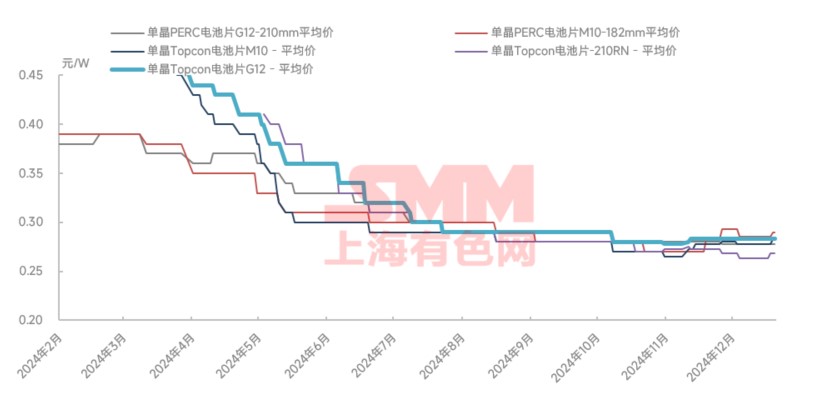
We expect the likelihood of solar cell production cuts in February 2025 to be relatively low, with production levels likely to remain largely stable. On the price side, strong cost support is expected. Although no demand increase is anticipated in February, the strong cost support for batteries suggests prices may remain stable with an upward trend.

Declaración de Fuente de Datos: Excepto la información disponible públicamente, todos los demás datos son procesados por SMM basándose en información pública, comunicación de mercado y confiando en el modelo de base de datos interna de SMM. Son solo para referencia y no constituyen recomendaciones para la toma de decisiones.

Para cualquier consulta o para obtener más información, por favor contacte: lemonzhao@smm.cn
Para más información sobre cómo acceder a nuestros informes de investigación, contacte con:service.en@smm.cn
Noticias relacionadas
[SMM Noticias FV] ¡A 4.700 metros de altitud! Se ha completado el mayor proyecto fotovoltaico del curso medio y bajo del río Yarlung Zangbo en el Tíbet.
hace 17 horas
[SMM Noticias FV] ¡A 4.700 metros de altitud! Se ha completado el mayor proyecto fotovoltaico del curso medio y bajo del río Yarlung Zangbo en el Tíbet.
Leer más
[SMM Noticias FV] ¡A 4.700 metros de altitud! Se ha completado el mayor proyecto fotovoltaico del curso medio y bajo del río Yarlung Zangbo en el Tíbet.
[SMM Noticias FV] ¡A 4.700 metros de altitud! Se ha completado el mayor proyecto fotovoltaico del curso medio y bajo del río Yarlung Zangbo en el Tíbet.
Recientemente, la Fase I de 850 MW del proyecto fotovoltaico de Luobusha en el condado de Qusum, Tíbet, construido por PowerChina, superó con éxito la aceptación de finalización, proporcionando un apoyo importante para aliviar las tensiones entre la oferta y la demanda energética regional y fortalecer la barrera de suministro energético de la meseta. El proyecto fotovoltaico de Luobusha en el condado de Qusum, Tíbet, cubre un área de aproximadamente 4.289,59 mu, con una capacidad instalada total de 850 MW. Es el primer lote de proyectos fotovoltaicos comerciales clave en la Base de Energía Limpia de Yazhong en el Tíbet y el mayor proyecto de generación de energía fotovoltaica limpia en los tramos medio e inferior del río Yajiang. El proyecto se desarrolla en cuatro fases, con la Fase I de 200 MW y una elevación media de 4.700 metros. Chengdu Engineering Corporation, filial de PowerChina, se encargó de la construcción de la subestación elevadora de 220 kV, el área fotovoltaica de 50 MW, la línea de transmisión de 20,74 km y la ampliación de la subestación del lado opuesto; Sinohydro Bureau 9 se encargó de la construcción del área del campo fotovoltaico de 150 MW, instalando un total de 348.000 módulos fotovoltaicos, junto con 64 transformadores tipo caja y 704 inversores.
hace 17 horas
[SMM Noticias FV] El Departamento de Energía de EE. UU. (DOE) invierte 12 millones de dólares para desarrollar tecnología fotovoltaica espacial
hace 17 horas
[SMM Noticias FV] El Departamento de Energía de EE. UU. (DOE) invierte 12 millones de dólares para desarrollar tecnología fotovoltaica espacial
Leer más
[SMM Noticias FV] El Departamento de Energía de EE. UU. (DOE) invierte 12 millones de dólares para desarrollar tecnología fotovoltaica espacial
[SMM Noticias FV] El Departamento de Energía de EE. UU. (DOE) invierte 12 millones de dólares para desarrollar tecnología fotovoltaica espacial
El 31 de agosto, el Departamento de Energía de EE. UU. (DOE) anunció una nueva oportunidad de financiación para I+D en energía fotovoltaica espacial por un total de hasta 12 millones de dólares. El anuncio establece claramente sus objetivos: reducir el coste de las células y módulos solares para aplicaciones espaciales, ampliar la capacidad de fabricación nacional en EE. UU. y avanzar en los prototipos hacia una validación por terceros en entornos espaciales o casi espaciales.
hace 17 horas
[SMM Noticias FV] Creando un referente europeo | Se pone en marcha oficialmente el proyecto de sistema de seguimiento de 221 MW de Chiko Solar Energy en Italia
hace 17 horas
[SMM Noticias FV] Creando un referente europeo | Se pone en marcha oficialmente el proyecto de sistema de seguimiento de 221 MW de Chiko Solar Energy en Italia
Leer más
[SMM Noticias FV] Creando un referente europeo | Se pone en marcha oficialmente el proyecto de sistema de seguimiento de 221 MW de Chiko Solar Energy en Italia
[SMM Noticias FV] Creando un referente europeo | Se pone en marcha oficialmente el proyecto de sistema de seguimiento de 221 MW de Chiko Solar Energy en Italia
Recientemente, Xin Hengyuan Energy lanzó oficialmente su proyecto de referencia de soportes de seguimiento de 221 MW. Este proyecto es un proyecto individual clave emprendido por la empresa en la región europea, y representa un avance crítico en la expansión estratégica de la compañía hacia mercados fuera de China. Impulsa significativamente el desarrollo de energía baja en carbono a nivel local e inyecta un fuerte impulso a la transición hacia la energía verde en la región.
hace 17 horas
Chinese New Year Break Plan for 2025 Released, Solar Cell Production Cuts by 13.3% [SMM Survey] - Shanghai Metals Market (SMM)