

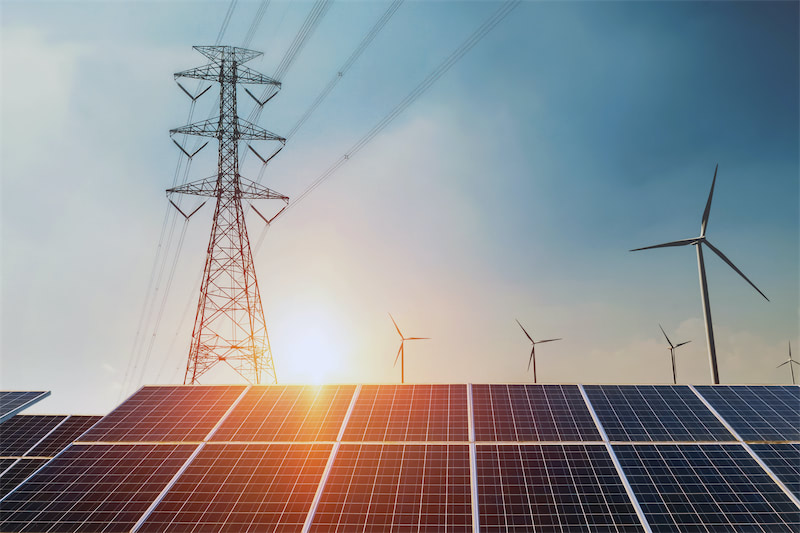
Uzbekistan is actively advancing its energy transition, aiming to become a model for energy transformation in Central Asia. President Shavkat Mirziyoyev of Uzbekistan announced that the country plans to increase the share of renewable energy in total power generation to 54% by 2030, up from the originally targeted 40%, with an additional 19,000 MW of installed capacity. This ambitious goal is expected to be achieved through the commissioning of 18 solar and wind power plants with a total capacity of 3,400 MW and ESS with a capacity of 1,800 MW by 2025. The total power generation is projected to reach 12 billion kWh, equivalent to the annual electricity consumption of 5 million households, while reducing harmful gas emissions by 6.5 million mt.
Uzbekistan's energy transition plan has garnered extensive support and participation from the international community. The total investment in the 18 new energy projects amounts to $3.7 billion, covering a wide range of types, including solar, wind, ESS, and small hydropower plants. Notably, the Andijan and Fergana regions have established the country's first 300 MW utility ESS, marking a significant milestone in Uzbekistan's energy technology sector. Additionally, six power plants constructed in collaboration with internationally renowned energy companies have a total capacity of 2.5 GW, with a combined investment of $3.5 billion.
The implementation of these projects is expected to add 9.5 billion kWh of annual power production, save 2.5 billion m³ of natural gas, and reduce harmful emissions by 4.6 million mt annually. This will significantly improve the energy supply chain, providing more stable and cleaner energy to over 4 million households. Uzbekistan's energy transition plan not only contributes to optimizing its energy structure and environmental protection but also offers vast opportunities for international energy cooperation, promoting energy connectivity under the Belt and Road Initiative.
Uzbekistan also plans to further liberalize its electricity market, aiming to establish a competitive wholesale electricity market by the end of next year and introduce public-private partnerships in energy distribution, attracting $4 billion in investments for network modernization. Moreover, Uzbekistan has expanded international cooperation in the green energy sector, signing agreements under the COP-29 framework with Kazakhstan, Azerbaijan, and Saudi Arabia to jointly export "green energy" to Europe. A unified platform has also been launched to ensure the stability of the regional energy system.
The year 2025 has been declared Uzbekistan's Year of Environmental Protection and Green Economy, with the government focusing on "green" technologies, water conservation, and afforestation to address global warming and the increasing frequency of natural disasters. This series of actions demonstrates Uzbekistan's strong commitment to green development and environmental protection, as well as its active role in global sustainable development.
[SMM Analysis] Uzbekistan's Renewable Energy Facility Construction: ESS Installations Expected to Reach 18 GW by 2030
Uzbekistan is actively advancing its energy transition, aiming to become a model for energy transformation in Central Asia.
Data Source Statement: Except for publicly available information, all other data are processed by SMM based on publicly available information, market communication, and relying on SMM‘s internal database model. They are for reference only and do not constitute decision-making recommendations.
For any inquiries or to learn more information, please contact: lemonzhao@smm.cn
For more information on how to access our research reports, please contact:service.en@smm.cn
Related News

18 hours ago
Beijing Launches 500-kV Power Project in Fengtai, Boosting Grid Resilience and Industrial Growth
Read More
Beijing Launches 500-kV Power Project in Fengtai, Boosting Grid Resilience and Industrial Growth
On January 28th, the construction of the 500-kilovolt power transmission and transformation project in Fengtai, Beijing officially started. This project is the first newly-built 500-kilovolt power grid project in Beijing during the 15th Five-Year Plan period. It will significantly enhance the resilience and power receiving capacity of the southern Beijing power grid and provide reliable power support for Beijing to continuously optimize the investment structure and vigorously develop high-end, precise, and cutting-edge industries.
The 500-kilovolt power transmission and transformation project in Fengtai, Beijing is a key project of Beijing's power grid during the 15th Five-Year Plan period and one of the "3 100" key projects in Beijing this year. It is constructed and managed by the State
18 hours ago
18 hours ago
Shaanxi-Anhui UHV DC Project's 500-kV AC System at Hezhou Station Begins Operation After Trial Run
Read More
Shaanxi-Anhui UHV DC Project's 500-kV AC System at Hezhou Station Begins Operation After Trial Run
On February 1st, the 500-kilovolt AC system of the Hezhou Converter Station, the receiving-end station of the ±800-kilovolt UHV DC power transmission project from northern Shaanxi to Anhui, was officially put into operation after a 24-hour trial run.
18 hours ago
18 hours ago
750-kV Power Line Connecting Northern to Central Shaanxi Fully Operational
Read More
750-kV Power Line Connecting Northern to Central Shaanxi Fully Operational
On February 2nd, the 750-kilovolt power transmission and transformation project of the third passageway from northern Shaanxi to central Shaanxi was fully connected. The project starts from the 750-kilovolt Shuofang Substation in Shenmu City in the north and ends at the 750-kilovolt Bailuyuan Substation in Lantian County in the south. It has newly built a 1,271-kilometer line, passing through 18 counties (districts) in 4 cities including Yulin, Yan'an, Weinan and Xi'an.
18 hours ago
Related News
Beijing Launches 500-kV Power Project in Fengtai, Boosting Grid Resilience and Industrial Growth
Feb 07, 2026 20:47
Shaanxi-Anhui UHV DC Project's 500-kV AC System at Hezhou Station Begins Operation After Trial Run
Feb 07, 2026 20:44
750-kV Power Line Connecting Northern to Central Shaanxi Fully Operational
Feb 07, 2026 20:44
In January, national passenger car producers' new energy wholesale estimates reached 900,000 units, up 1% YoY.
Feb 06, 2026 19:40