SMM December 26 News,
Introduction: In 2024, the sodium-ion battery market underwent significant transformations. SMM recently conducted a systematic review and summary of these market changes, focusing this issue on the development of the overseas sodium-ion battery industry.
As an emerging energy storage technology, sodium-ion batteries have gained rapid attention in recent years. Similar to the lithium battery market, the sodium-ion battery market is also a globalized market.
SMM estimates that by 2030, global demand for sodium-ion batteries is expected to exceed 160 GWh, while in 2025, the demand is projected to reach 5 GWh.
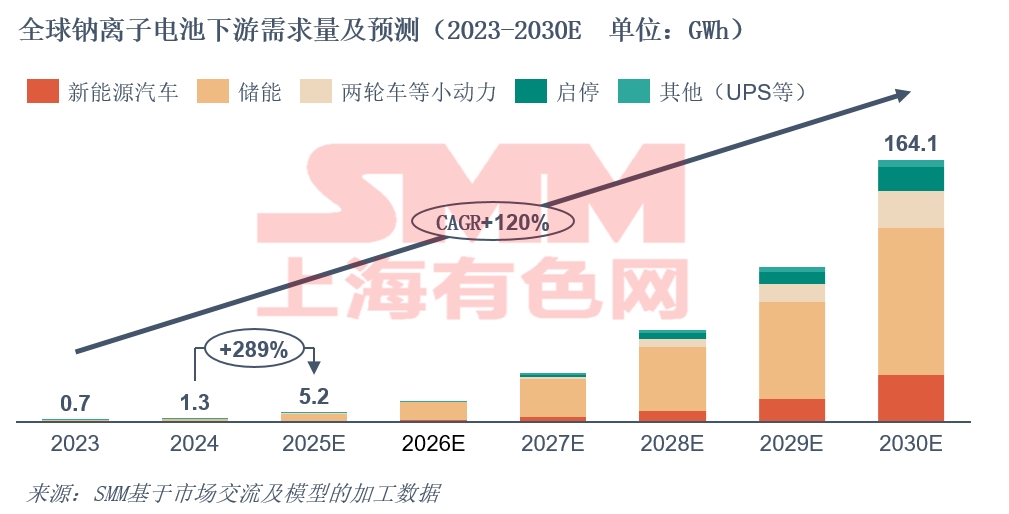
China has already established a leading position in the global lithium battery market and is now actively advancing in the sodium-ion battery market. Leveraging its experience and innovation, China aims to lead the global market once again. Internationally, facing competitive pressure in the lithium battery sector, overseas companies are eager not to miss the next potential market opportunity and are accelerating their deployment of sodium-ion battery technology—positioning themselves at the starting line.
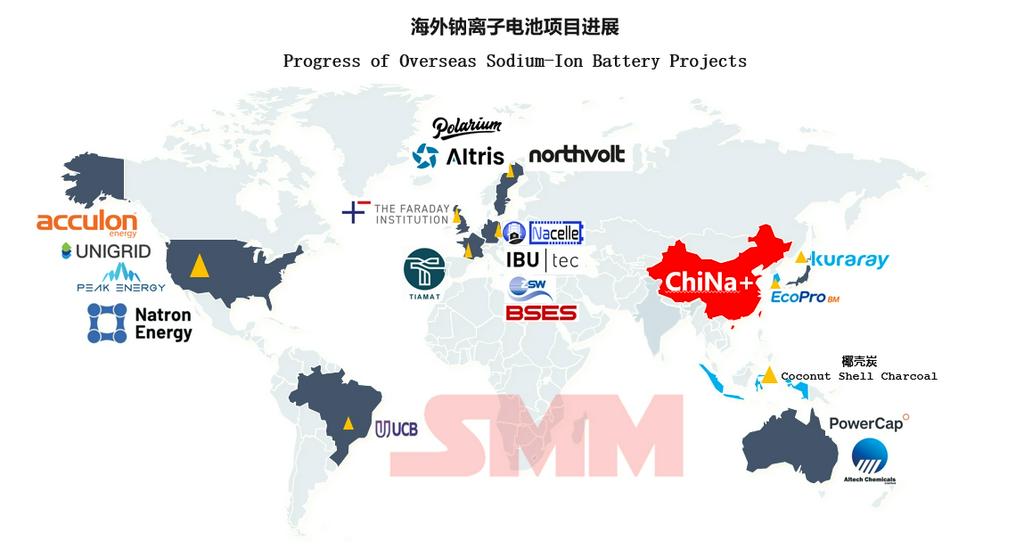
In the US, emerging companies like Natron Energy are focusing on developing sodium-ion batteries, with an emphasis on large-scale energy storage and EV transportation. Meanwhile, research institutions such as Stanford University and the University of California are exploring the potential of sodium-ion batteries in power grid energy storage.
In Europe, the European Battery Alliance is pooling resources from multiple countries and enterprises to promote the commercialization of sodium-ion battery technology. For instance, France's Sodium-ion Battery Project is dedicated to developing and applying sodium-ion batteries in EVs and energy storage systems.
In Japan, several research institutions are actively developing sodium-ion batteries, aiming to use them as substitutes for lithium batteries, particularly focusing on renewable energy storage technologies.
In Canada, some startups are attempting to commercialize sodium-ion batteries, driving further development in renewable energy and electric transportation sectors.
Overall, projects and research worldwide are progressing in parallel, accelerating the R&D and application of sodium-ion battery technology, striving to secure a place in the future energy storage market.
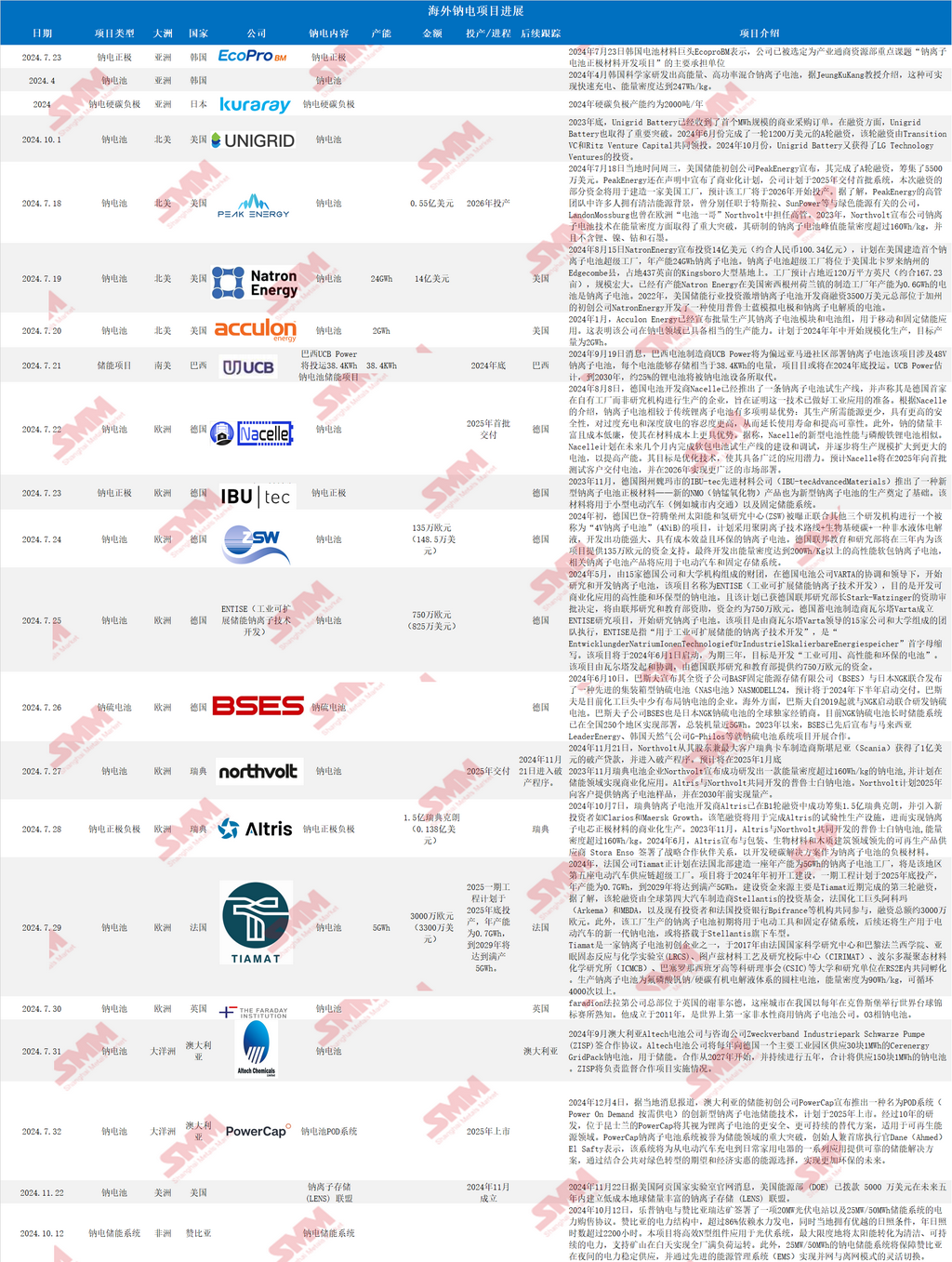
The overseas sodium-ion battery deployment is as follows (partial):
Several domestic companies have also established overseas operations. For example, Ronbay Technology has made significant progress in its capacity deployment in Europe. Its wholly-owned subsidiary, JS Europe, successfully completed the acquisition and transfer of assets from Poland's JM company. Ronbay's European base is planned to accommodate 105,000 mt of ternary cathode materials, 100,000 mt of phosphates, and 50,000 mt of sodium-ion battery capacity , with a total investment expected to exceed 16 billion yuan.
Currently, many sodium-ion battery products manufactured in China are being exported overseas, including start-stop sodium-ion batteries and sodium-ion energy storage systems. By 2025, demand for sodium-ion technology in high-latitude regions overseas is expected to grow significantly.
[Sodium-Ion Battery Going Global: Lepu Sodium-Ion Battery Signs Energy Storage System Agreement with Zambia's Ruida Mine] On October 12, 2024, Lepu Sodium-Ion Battery signed a power purchase agreement for a 20 MW PV power plant and a 25 MW/50 MWh energy storage system with Zambia's Ruida Mine. In Zambia's power structure, over 86% relies on hydropower, and the region benefits from excellent solar conditions, with annual sunshine hours exceeding 2,200. This project applies high-efficiency N-type modules in the PV system to maximize the conversion of solar energy into clean, sustainable electricity, supporting the mine's full-load operation during the day. Additionally, the 25 MW/50 MWh sodium-ion energy storage system will ensure stable power supply at night and enable flexible switching between grid-connected and off-grid modes through an advanced energy management system (EMS).
[Sodium-Ion Battery: Highstar's Overseas Expansion] On September 25, 2024, Highstar announced on its official account that it had signed a strategic cooperation agreement with Queensland University of Technology (QUT) in Australia and Xcel Sodium Technology. According to the agreement, the three parties will collaborate deeply on the R&D and commercialization of sodium-ion battery technology. Meanwhile, Highstar participated in the AMSCA-2024 conference hosted by QUT. At this event, Highstar, QUT, Xcel Sodium Technology, and researchers, scientists, and experts from around the world gathered to share knowledge and discuss the latest advancements in advanced material synthesis, properties, and application fields. [Sodium-Ion Battery and LFP Going Global: Ronbay's European Base Includes 100,000 mt of Phosphates and 50,000 mt of Sodium-Ion Battery Capacity] Ronbay Technology is accelerating its capacity deployment in Europe, achieving significant progress in its global strategy. Recently, Ronbay's wholly-owned subsidiary, JS Europe, successfully completed the acquisition and transfer of assets from Poland's JM company. Phase I of Ronbay's Poland project is expected to commence construction in H2 2024, with equipment procurement and installation planned for completion in 2025, and production expected to begin in early 2026. Once the project reaches full production, it will add 20,000 mt/year of ternary cathode material production capacity, with an estimated annual output value exceeding 3.8 billion yuan. Additionally, Ronbay's European base is planned to accommodate 105,000 mt of ternary cathode materials, 100,000 mt of phosphates, and 50,000 mt of sodium-ion battery capacity. The base will also include precursor and recycling industries, with a total investment expected to exceed 16 billion yuan. [SMM Sodium-Ion Battery Analysis: Overseas Projects Progressing Rapidly, Sodium-Ion Battery Market Remains Globalized] On August 8, German battery developer Nacelle launched a sodium-ion battery pilot production line, claiming to be the first in Germany to produce in its own factory rather than a research institution, aiming to demonstrate the technology's readiness for industrial application. Nacelle plans to deliver batteries to its first test customers in 2025 and achieve broader market deployment in 2026.
[SMM Sodium-Ion Battery Analysis] Overseas Projects Progressing Rapidly, Sodium-Ion Battery Market Remains Globalized
[Sodium-Ion Battery Overseas: Germany's Nacelle Launches Sodium-Ion Battery Pilot Production Line] On August 8, 2024, German battery developer Nacelle launched a sodium-ion battery pilot production line, becoming the first in Germany to produce in its own factory rather than a research institution. Nacelle's new-type sodium-ion battery performance is similar to LFP
batteries. Nacelle plans to complete the construction and commissioning of a pouch battery pilot production line in the coming months and gradually scale up production to larger batteries to increase capacity. Its goal is to optimize the technology for broad application potential. Nacelle plans to deliver batteries to its first test customers in 2025 and achieve broader market deployment in 2026. [Overseas Sodium-Ion Battery: BASF Subsidiary BSES and Japan's NGK Release Container-Type Sodium-Sulfur Battery (NAS Battery)] On June 10, BASF announced that its wholly-owned subsidiary, BASF Stationary Energy Storage GmbH (BSES), and Japan's NGK jointly released a new container-type sodium-sulfur battery (NAS battery), model NAS MODEL L24, scheduled for delivery in H2 2024. [Sodium-Ion Battery Overseas: Sweden's Altris Invents Wood-Based Sodium-Ion Battery] Swedish sodium-ion battery developer Altris, one month after Natron Energy's mass production of sodium-ion batteries, discovered a way to make lithium-free batteries more sustainable. Altris partnered with Stora Enso to use carbon extracted from wood pulp as anode material. The company uses Prussian White to manufacture cathodes, free of rare and problematic minerals, similar to Natron's Prussian Blue.
[Sodium-Ion Battery: Changyi Sodium-Ion Battery Secures Three-Wheeler Battery Order for 5,000 Units Totaling 15,000 kWh] In June 2024, Changyi Sodium-Ion Battery continued to secure new projects in sodium-ion battery end-use applications during 2024Q2. Shortly after the May 27 announcement of three-wheelers equipped with 1.8 kWh (60V/30AH) sodium-ion batteries being exported overseas, Changyi Sodium-Ion Battery secured another order for 5,000 three-wheelers, each equipped with a 3 kWh (60V/50AH) sodium-ion battery pack, totaling 15,000 kWh.
[Pylontech Sodium-Ion Battery Business Progress: Sodium-Ion Batteries to Transition from Pilot to Mass Production in 2024] Pylontech disclosed its 2024 "Quality Improvement and Efficiency Enhancement" action plan, indicating that sodium-ion battery products will transition from pilot to mass production, and sodium-ion energy storage system products will achieve MWh-level demonstrations. The "Sodium Replacing Lead" business module will achieve batch shipments at the 100 MWh level. ① Overseas Market: Sodium-ion battery products have passed relevant certifications from TÜV Rheinland in Germany and have reached testing agreements with numerous customers, laying the groundwork for energy storage applications with different process routes. Custom energy storage products for the US market have achieved phased results. ② Domestic Market: In H2 2023, a 200 kWh industrial and commercial energy storage integrated cabinet product based on prismatic aluminum-shell batteries was launched, with large-scale shipments already achieved in multiple regions domestically.
[Enow New Energy Secures First Overseas Hard Carbon Order] In January 2024, Enow New Energy secured a hard carbon procurement order from France's Tiamat and maintained close ties with other overseas battery cell companies.
SMM New Energy Research Team
Cong Wang 021-51666838
Xiaodan Yu 021-20707870
Rui Ma 021-51595780
Ying Xu 021-51666707
Disheng Feng 021-51666714
Yujun Liu 021-20707895
Yanlin Lü 021-20707875
Zhicheng Zhou 021-51666711