Why Would Japanese Smelters Negotiate Another BM Figure with Antofagasta? [SMM Analysis]

Published: Dec 25, 2024 17:01
[SMM Analysis: Why Did Japanese Smelters Negotiate a Separate BM Figure with Antofagasta?] However, after the negotiation results between Chinese smelters and Antofagasta were finalized, the negotiation results between Japanese smelters and Antofagasta are also imminent. According to market rumors, one Japanese smelter, with an annual trade volume of approximately 50,000 mt of ore with Antofagasta, is highly likely to follow the result of $21.25. Another Japanese smelter, with an annual trade volume of 300,000-400,000 mt of ore with Antofagasta, was the first to reach an agreement with Antofagasta at $25. The last Japanese smelter, with an annual trade volume of over 300,000 mt of ore with Antofagasta, is still in negotiations and is demanding a BM figure above $30 for next year.

》View SMM Copper Prices, Data, and Market Analysis

》Subscribe to View SMM Historical Spot Metal Prices

       During the month, Jiangxi Copper Corporation, China Copper, Tongling Nonferrous Metals, and Jinchuan Group finalised the 2025 copper concentrate long-term contract TC benchmark at $21.25/mt and 2.125¢/lb. The 2024 copper concentrate TC long-term contract benchmark was set at $80/mt and 8.0¢/lb.

       However, following the conclusion of negotiations between Chinese smelters and Antofagasta, the negotiation results between Japanese smelters and Antofagasta are also imminent. According to market rumors, one Japanese smelter, with an annual trade volume of approximately 50,000 mt with Antofagasta, is likely to follow the $21.25 result. Another Japanese smelter, with an annual trade volume of 300,000-400,000 mt with Antofagasta, was among the first to agree on a $25 benchmark. The last Japanese smelter, with an annual trade volume of over 300,000 mt with Antofagasta, is still in negotiations and is demanding a benchmark above $30 for next year.

       Historically, the benchmark figures quoted by Antofagasta/Freeport to smelters in China, Japan, and South Korea have remained largely consistent, with minimal differences. However, due to the significant supply-demand gap for copper concentrates next year, the forms and outcomes of long-term contracts have become more diverse. Since the last century, Japan and South Korea, with their advanced economies in Asia, had the largest demand for copper concentrates annually. As a result, Japan became the primary negotiator with Antofagasta/Freeport each year. With the subsequent economic growth of China and the expansion of its nonferrous metals industry, China replaced Japan as the primary negotiator with Antofagasta/Freeport. For a long period in the 21st century, smelters in Japan and South Korea had to accept the benchmark results negotiated between China and Antofagasta/Freeport. So why is there such a strong subjective stance from Japanese and South Korean smelters in this year's negotiations with Antofagasta?

       Japanese and South Korean smelters have long recognized the scarcity of domestic resources, which cannot meet the demands of their industrial development. As a result, smelting enterprises in Japan and South Korea began investing in mines in regions such as the Americas and Australia early on. However, instead of participating in mine dividends, they secured mining rights to address the issue of insufficient domestic resources.
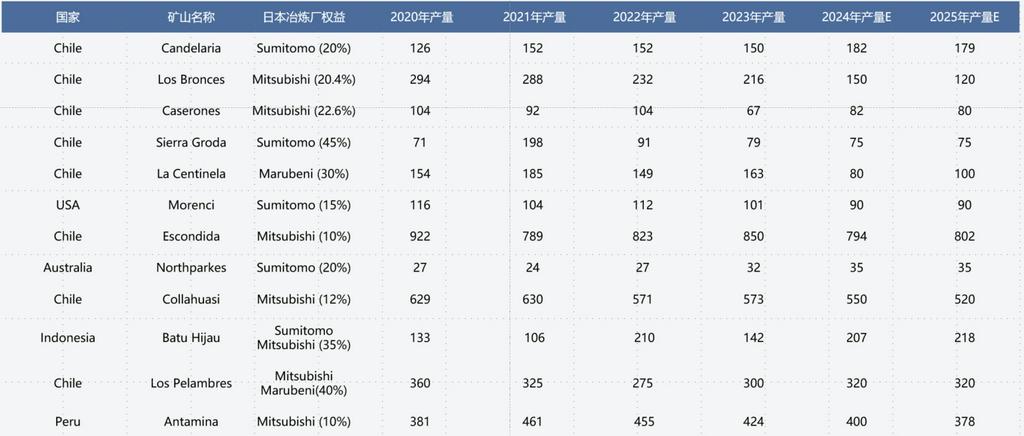
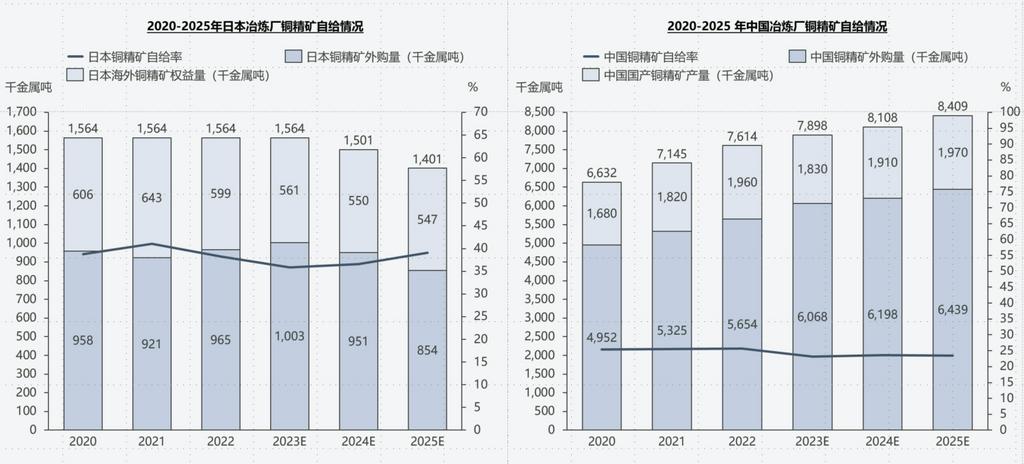
       Comparing the raw material self-sufficiency rates of China and Japan, it is evident that Japan's copper concentrate self-sufficiency rate can be maintained at 40%-50%, while China's rate is only around 25%. In other words, the raw material structure of Chinese smelters is far more dependent on external sources compared to Japanese smelters. Therefore, Japanese smelters, compared to their Chinese counterparts, have greater leverage to negotiate a benchmark figure with Antofagasta when facing significant supply shortages in the future.
》Click to View the SMM Copper Industry Chain Database


Data Source Statement: Except for publicly available information, all other data are processed by SMM based on publicly available information, market communication, and relying on SMM's internal database model. They are for reference only and do not constitute decision-making recommendations.

For any inquiries or for more information, please contact: lemonzhao@smm.cn
For more information on how to access our research reports, please contact:service.en@smm.cn
Related News
Kamoa-Kakula Begins Receiving 30 MW Baseload Power as Solar-Battery Facility Reaches Commercial Operation
5 hours ago
Kamoa-Kakula Begins Receiving 30 MW Baseload Power as Solar-Battery Facility Reaches Commercial Operation
Read More
Kamoa-Kakula Begins Receiving 30 MW Baseload Power as Solar-Battery Facility Reaches Commercial Operation
CrossBoundary Energy’s solar photovoltaic and battery energy storage system serving the Kamoa-Kakula copper complex in the Democratic Republic of Congo reached commercial operation on August 12, 2026, and is now supplying 30 MW of continuous baseload power to Kamoa Copper. The milestone comes 16 months after Kamoa Copper signed a power purchase agreement with CrossBoundary Energy in April 2025, marking the transition of the project from commissioning into commercial operation.​ The facility comprises 233 MWp of solar photovoltaic capacity and a 123 MVA/526 MWh battery energy storage system, designed to provide at least 30 MW of firm power to the mining complex. The battery system allows electricity generated during daylight hours to be stored and dispatched when solar generation falls, enabling the project to provide continuous power rather than intermittent daytime supply. CrossBoundary Energy said the project is the first operational solar-plus-battery facility of its type and scale in Africa to provide baseload power.​ The new power supply forms part of Kamoa-Kakula’s broader efforts to strengthen electricity reliability at the operation. Kamoa Copper, which is jointly owned by Ivanhoe Mines, Zijin Mining Group and the DRC government, has been developing additional solar and battery capacity alongside upgrades to the DRC grid as it seeks to reduce exposure to power interruptions and reliance on diesel-generated electricity.​ The start of commercial operations represents a meaningful power-supply milestone for Kamoa-Kakula, where electricity reliability remains important to maintaining stable mining and processing operations. The new 30 MW firm renewable supplyshould provide an additional source of continuous power alongside existing grid and backup generation, while reducing reliance on diesel. The development is particularly relevant as Kamoa-Kakula continues to manage operational and infrastructure constraints, making improved power availability an important factor in supporting more stable copper production.
5 hours ago
[SMM Analysis] Copper Concentrate Tightness Spreads to Scrap Market—Why Are Copper Scrap Prices Staying High?
10 hours ago
[SMM Analysis] Copper Concentrate Tightness Spreads to Scrap Market—Why Are Copper Scrap Prices Staying High?
Read More
[SMM Analysis] Copper Concentrate Tightness Spreads to Scrap Market—Why Are Copper Scrap Prices Staying High?
[SMM Analysis] Copper Concentrate Tightness Spreads to Scrap Market—Why Are Copper Scrap Prices Staying High?
[SMM Analysis: opper Concentrate Tightness Spreads to Scrap Market—Why Are Copper Scrap Prices Staying High?] Tight copper concentrate supply and deeply negative TCs are pushing smelters and fabricators toward recycled feedstock. Low global inventories, slow scrap generation and shortages of compliant material in China are supporting high payabilities. SMM expects import demand to remain firm, although any release of accumulated tax-excluded scrap in China could pressure prices.
10 hours ago
Sinomine’s Kitumba Copper Project Enters Final Commissioning Push After Successful Primary Crusher Trial
12 hours ago
Sinomine’s Kitumba Copper Project Enters Final Commissioning Push After Successful Primary Crusher Trial
Read More
Sinomine’s Kitumba Copper Project Enters Final Commissioning Push After Successful Primary Crusher Trial
Sinomine Resource Group (002738.SZ) reported further construction progress at its integrated Kitumba copper mining, processing and metallurgical project in Zambia. As of August 2026, the project’s 38-km water pipeline had been fully commissioned, while the primary crushing plant successfully completed its first integrated trial run with ore. The core supporting infrastructure and front-end crushing system are now ready for commissioning, marking the project’s entry into the final stage of construction. Kitumba is designed to process 3.5 million tonnes of ore annually, with a metallurgical capacity of 35,000 tonnes of copper cathode per year. At steady state, the project is expected to produce an average of 33,000 tonnes of copper cathode and 55,000 tonnes of copper concentrate annually. It has a designed operating life of 15 years and is expected to produce a total of 570,200 tonnes of contained copper over that period.
12 hours ago