

Car Exports Hit Record High with Rapid Growth
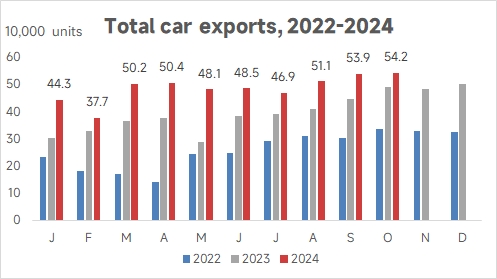
China's automotive industry continues to show strong growth in the international market. According to the latest data from CAAM, domestic car exports in October surged to 542,000 units, up 11.1% YoY. In the first ten months of this year, cumulative exports reached 4.855 million units, up 23.8% YoY. This achievement undoubtedly injects new momentum into the global expansion of China's automotive industry.
Data Source: CAAM, SMM
Traditional Fuel Vehicles Still Shine, NEVs Steadily Increase
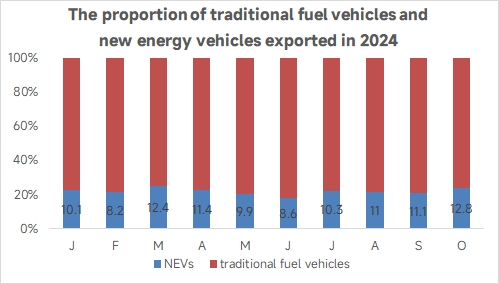
A deeper analysis of the export structure reveals that traditional fuel vehicles continue to perform well. In the first ten months of this year, traditional fuel vehicle exports reached 3.798 million units, up 29.7% YoY. With the domestic fuel vehicle market being increasingly squeezed, exports have become a new growth path for automakers. Cui Dongshu, Secretary General of the Passenger Car Association, also analyzed that this year's main drivers are the enhanced competitiveness of Chinese products, slight growth in European and US markets, and the complete replacement of international brands by Chinese cars in the Russian market, especially the increased competitiveness of Chinese fuel vehicle exports.
Meanwhile, NEV exports are also steadily increasing. Despite the interference from the EU's new energy policy adjustments, China's NEV exports in the first ten months still reached 1.058 million units, up 6.5% YoY. This reflects the continuous expansion capability and increasing brand recognition of Chinese NEVs in overseas markets. As the scale advantage of Chinese NEVs becomes apparent and market expansion demands grow, more Chinese-made NEV brands are going global, with their recognition in overseas markets continuously improving. Although there have been some recent disturbances, the growth rate remains rapid, and the development prospects are promising.
Data Source: CAAM, SMM
Russia Becomes Largest Export Destination, Accounting for Nearly 30% of the Market
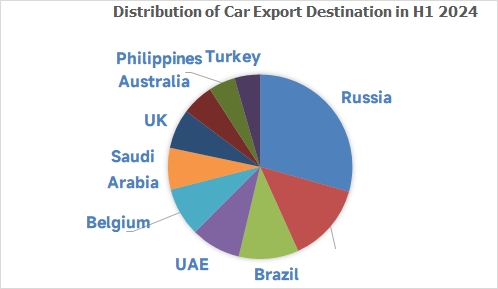
In terms of export destinations, Russia has become the largest export destination for Chinese cars with an astonishing growth rate. In H1 of this year, China's car exports to Russia reached 478,000 units, ranking first and accounting for 29% of the total car export market. Mexico, Brazil, the UAE, and Belgium also showed strong growth momentum, becoming important growth points for Chinese car exports. Specifically, Russia's fuel vehicle market contributed significantly this year, along with notable fuel vehicle exports to Mexico and the UAE. Additionally, Mexico and Brazil stood out in the export growth of plug-in hybrid models, while Belgium, Thailand, and the UK showed strong performance in pure electric vehicle exports.
Data Source: CAAM, SMM
BYD Leads in Export Growth, Chery Ranks First in Total Exports
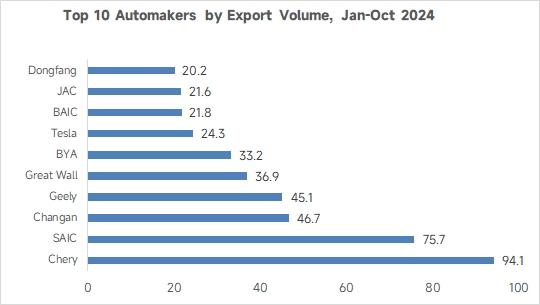
Among the top ten automakers in terms of vehicle exports, seven achieved positive growth. In terms of growth rate, BYD was the fastest-growing automaker in the first ten months, exporting 332,000 units, up 79.6% YoY, followed by BAIC, which exported 218,000 units, up 63.2% YoY.
In terms of total exports for the first ten months, Chery ranked first with a total export volume of 941,000 units, including 109,000 units in October alone, accounting for 20.2% of total car exports. As one of the earliest Chinese automakers to explore overseas markets, exports have become an important part of Chery's sales. Notably, Russia, Brazil, and the Middle East, which are the largest contributors to the growth of Chinese car exports, are the main markets where Chery has established its presence.
Data Source: CAAM, SMM
Accelerating Overseas Localization While Expanding Vehicle Exports
According to an SMM survey, while expanding vehicle exports, Chinese automakers should also accelerate the localization of production in overseas markets. If Chinese automakers do not achieve localized production in many regions, high tariffs will result in lower competitiveness and profitability, and other countries will not allow unrestricted sales of Chinese-made cars locally. Therefore, globalization cannot be solved solely by electrification; each region has different market demands, and globalization requires producing products that meet local needs.
According to a survey by Global Auto Trade Network, Chinese automakers have built and put into operation full-process manufacturing plants in nine countries, with an annual production capacity of 1.2 million units as of 2023. Chinese automakers such as BYD, Chery, Changan, Great Wall, GAC, and SAIC have announced new or expansion projects for ten overseas factories in countries like Thailand, Indonesia, and Brazil. Meanwhile, brands like BYD and Volvo are actively promoting their expansion plans in Europe, with BYD building a factory in Hungary and planning a new factory in Turkey to enter the EU market. XPeng Motors and Geely's high-end EV brand Zeekr have also indicated that they are considering localizing production.
At the recent Guangzhou International Auto Show, several Chinese automakers also admitted that relying solely on export trade is not sustainable in the long run. The true path to globalization requires direct investment in overseas factories, along with the comprehensive "going global" of logistics, finance, after-sales service, and the entire supply chain.



