[SMM Analysis] Is China's reduction of export tax rebates good or bad for the lithium battery industry?

Published: Nov 18, 2024 20:23
Source: SMM
According to the announcement by the Ministry of Finance and the State Administration of Taxation, starting from November 2024, the export tax rebate rate for lithium batteries will be reduced from 13% to 9%. This policy adjustment aims to guide domestic price recovery by lowering export tax rebates, alleviate international trade accusations, and encourage the cultivation of internationally competitive products.

According to the announcement by the Ministry of Finance and the State Administration of Taxation, starting from November 2024, the export tax rebate rate for lithium batteries will be reduced from 13% to 9%. This policy adjustment aims to guide domestic price recovery by lowering export tax rebates, alleviate international trade accusations, and encourage the cultivation of internationally competitive products.

The reduction in export tax rebates will mainly impact the lithium battery industry in the following aspects:

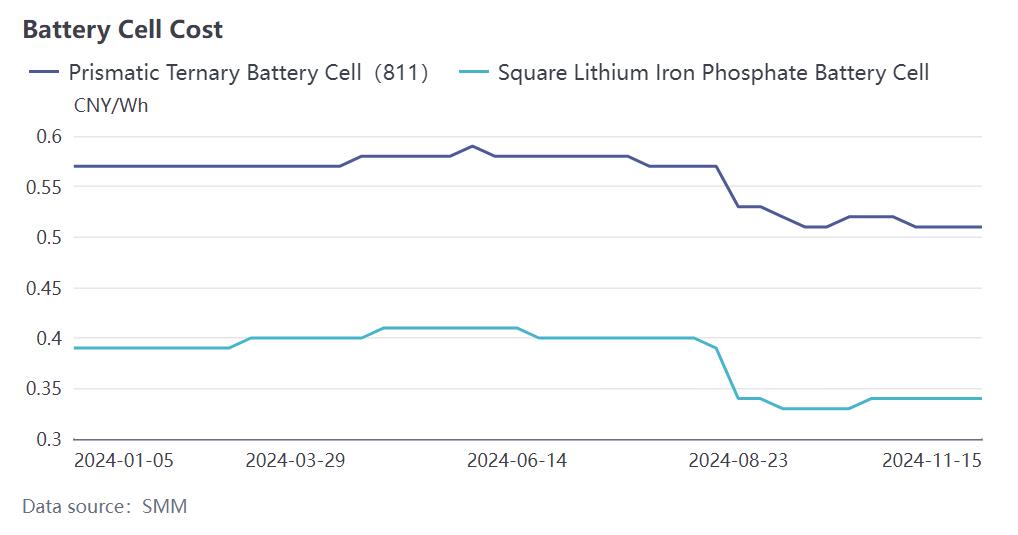
Cost increase: The reduction in the export tax rebate rate means an increase in export costs for lithium battery companies. For example, each percentage point reduction in the export tax rebate rate is equivalent to an approximately 1 percentage point increase in Ordinary Trade export costs. This year, under the influence of declining raw material costs and price wars, battery cell prices have been falling. According to SMM data, the current cost of prismatic ternary battery cells is 0.51 yuan/Wh, and the cost of prismatic LFP battery cells is 0.34 yuan/Wh. With the subsequent reduction in the export tax rebate rate, lithium battery companies will need to bear higher export costs, which may further compress their profit margins. According to customs data, from January to September 2024, China's export value of lithium-ion batteries reached $43.687 billion. If the export tax rebate rate is reduced from 13% to 9%, Chinese lithium battery companies will see a reduction of $1.747 billion in export tax rebate income.


Decline in market competitiveness: Due to the reduction in export tax rebates, the export prices of lithium battery products will rise, which may lead to a decline in the competitiveness of companies in the international market. However, lowering the export tax rebate rate can redirect the benefits from price competition to domestic circulation, thereby reducing domestic fiscal subsidies for overseas inflation and alleviating the national fiscal burden. Nevertheless, trade frictions and raw material price fluctuations remain major risk factors for the lithium battery industry. Therefore, while adjusting the export tax rebate policy, lithium battery companies also need to pay attention to these external environmental changes and flexibly adjust their business strategies to ensure stable development during capacity reduction and transformation and upgrading processes.

Industry capacity reduction: The reduction in export tax rebates is also seen as a means to accelerate industry capacity reduction. By lowering rebates, the government hopes to eliminate companies that survive on price wars and encourage mid-to-high-end manufacturing to move away from excessive reliance on price competition, shifting towards healthy competition centered on technological innovation and product upgrades. This will help reduce surplus capacity and promote the healthy development of the industry.

Data Source Statement: Except for publicly available information, all other data are processed by SMM based on publicly available information, market communication, and relying on SMM‘s internal database model. They are for reference only and do not constitute decision-making recommendations.

For any inquiries or to learn more information, please contact: lemonzhao@smm.cn
For more information on how to access our research reports, please contact:service.en@smm.cn
Related News
Beijing Launches 500-kV Power Project in Fengtai, Boosting Grid Resilience and Industrial Growth
15 hours ago
Beijing Launches 500-kV Power Project in Fengtai, Boosting Grid Resilience and Industrial Growth
Read More
Beijing Launches 500-kV Power Project in Fengtai, Boosting Grid Resilience and Industrial Growth
On January 28th, the construction of the 500-kilovolt power transmission and transformation project in Fengtai, Beijing officially started. This project is the first newly-built 500-kilovolt power grid project in Beijing during the 15th Five-Year Plan period. It will significantly enhance the resilience and power receiving capacity of the southern Beijing power grid and provide reliable power support for Beijing to continuously optimize the investment structure and vigorously develop high-end, precise, and cutting-edge industries. The 500-kilovolt power transmission and transformation project in Fengtai, Beijing is a key project of Beijing's power grid during the 15th Five-Year Plan period and one of the "3 100" key projects in Beijing this year. It is constructed and managed by the State
15 hours ago
Shaanxi-Anhui UHV DC Project's 500-kV AC System at Hezhou Station Begins Operation After Trial Run
15 hours ago
Shaanxi-Anhui UHV DC Project's 500-kV AC System at Hezhou Station Begins Operation After Trial Run
Read More
Shaanxi-Anhui UHV DC Project's 500-kV AC System at Hezhou Station Begins Operation After Trial Run
On February 1st, the 500-kilovolt AC system of the Hezhou Converter Station, the receiving-end station of the ±800-kilovolt UHV DC power transmission project from northern Shaanxi to Anhui, was officially put into operation after a 24-hour trial run.
15 hours ago
750-kV Power Line Connecting Northern to Central Shaanxi Fully Operational
15 hours ago
750-kV Power Line Connecting Northern to Central Shaanxi Fully Operational
Read More
750-kV Power Line Connecting Northern to Central Shaanxi Fully Operational
On February 2nd, the 750-kilovolt power transmission and transformation project of the third passageway from northern Shaanxi to central Shaanxi was fully connected. The project starts from the 750-kilovolt Shuofang Substation in Shenmu City in the north and ends at the 750-kilovolt Bailuyuan Substation in Lantian County in the south. It has newly built a 1,271-kilometer line, passing through 18 counties (districts) in 4 cities including Yulin, Yan'an, Weinan and Xi'an.
15 hours ago