[SMM Analysis] Is China's reduction of export tax rebates good or bad for the lithium battery industry?

Published: Nov 18, 2024 20:23
Source: SMM
According to the announcement by the Ministry of Finance and the State Administration of Taxation, starting from November 2024, the export tax rebate rate for lithium batteries will be reduced from 13% to 9%. This policy adjustment aims to guide domestic price recovery by lowering export tax rebates, alleviate international trade accusations, and encourage the cultivation of internationally competitive products.

According to the announcement by the Ministry of Finance and the State Administration of Taxation, starting from November 2024, the export tax rebate rate for lithium batteries will be reduced from 13% to 9%. This policy adjustment aims to guide domestic price recovery by lowering export tax rebates, alleviate international trade accusations, and encourage the cultivation of internationally competitive products.

The reduction in export tax rebates will mainly impact the lithium battery industry in the following aspects:

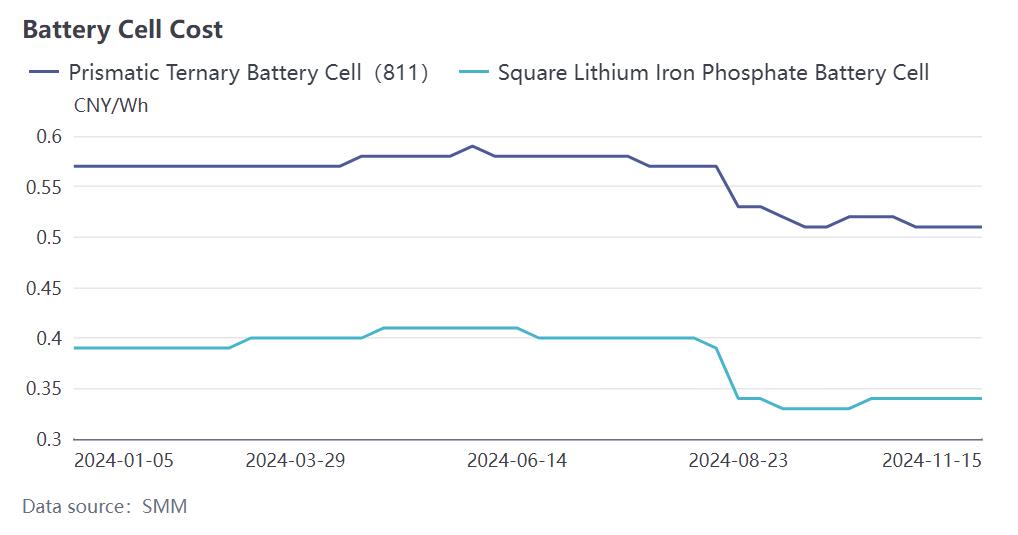
Cost increase: The reduction in the export tax rebate rate means an increase in export costs for lithium battery companies. For example, each percentage point reduction in the export tax rebate rate is equivalent to an approximately 1 percentage point increase in Ordinary Trade export costs. This year, under the influence of declining raw material costs and price wars, battery cell prices have been falling. According to SMM data, the current cost of prismatic ternary battery cells is 0.51 yuan/Wh, and the cost of prismatic LFP battery cells is 0.34 yuan/Wh. With the subsequent reduction in the export tax rebate rate, lithium battery companies will need to bear higher export costs, which may further compress their profit margins. According to customs data, from January to September 2024, China's export value of lithium-ion batteries reached $43.687 billion. If the export tax rebate rate is reduced from 13% to 9%, Chinese lithium battery companies will see a reduction of $1.747 billion in export tax rebate income.


Decline in market competitiveness: Due to the reduction in export tax rebates, the export prices of lithium battery products will rise, which may lead to a decline in the competitiveness of companies in the international market. However, lowering the export tax rebate rate can redirect the benefits from price competition to domestic circulation, thereby reducing domestic fiscal subsidies for overseas inflation and alleviating the national fiscal burden. Nevertheless, trade frictions and raw material price fluctuations remain major risk factors for the lithium battery industry. Therefore, while adjusting the export tax rebate policy, lithium battery companies also need to pay attention to these external environmental changes and flexibly adjust their business strategies to ensure stable development during capacity reduction and transformation and upgrading processes.

Industry capacity reduction: The reduction in export tax rebates is also seen as a means to accelerate industry capacity reduction. By lowering rebates, the government hopes to eliminate companies that survive on price wars and encourage mid-to-high-end manufacturing to move away from excessive reliance on price competition, shifting towards healthy competition centered on technological innovation and product upgrades. This will help reduce surplus capacity and promote the healthy development of the industry.

Data Source Statement: Except for publicly available information, all other data are processed by SMM based on publicly available information, market communication, and relying on SMM‘s internal database model. They are for reference only and do not constitute decision-making recommendations.

For any inquiries or to learn more information, please contact: lemonzhao@smm.cn
For more information on how to access our research reports, please contact:service.en@smm.cn
Related News
[Lithium Battery: 13 Enterprises Plan To Increase Capital In Sunwoda Power]
13 hours ago
[Lithium Battery: 13 Enterprises Plan To Increase Capital In Sunwoda Power]
Read More
[Lithium Battery: 13 Enterprises Plan To Increase Capital In Sunwoda Power]
[Lithium Battery: 13 Enterprises Plan To Increase Capital In Sunwoda Power]
On May 25, the board of directors of Sunwoda reviewed and approved a proposal regarding the capital increase and share expansion of its subsidiary, Sunwoda Power. It agreed that 13 enterprises—including Gongrong Financial Investment, Yuanzhi Gongrong, Nongyin Investment, Zhongyou Investment, Jinyan Business Management, Deyang Investment Holdings, Regional Synergy Fund, Zhigu Investment, United Winners Laser, Yinghe Technology, Jiaxing Jixin, Yip's Chemical, and Luohu High-Tech Investment—would jointly invest a total of 1.6798 billion yuan to increase the capital of Sunwoda Power. These enterprises will collectively hold 6.30% of Sunwoda Power's shares, while Sunwoda's equity stake in Sunwoda Power will change from 29.00% to 27.18%.
13 hours ago
【SMM New Energy News】MIIT Issues 2026 Auto Standardization Guidelines to Advance EV and Battery Standards
May 26, 2026 18:50
【SMM New Energy News】MIIT Issues 2026 Auto Standardization Guidelines to Advance EV and Battery Standards
Read More
【SMM New Energy News】MIIT Issues 2026 Auto Standardization Guidelines to Advance EV and Battery Standards
On May 26, the MIIT released its 2026 automotive standardization work priorities, focusing on expanding NEV standards. For power batteries, the ministry will accelerate safety standards for dismantling and crushing, and promote standards for battery dimensions and thermal management systems. Research will also deepen into battery cycle life, safety and performance evaluation, labeling, recycling, and BMS. Additionally, guidelines emphasize reviewing standards for chassis battery swapping, V2G, and automated charging.
May 26, 2026 18:50
【Domestic Dynamics: Sunwoda 50,000-Ton Battery Recycling Phase I Begins Production】
May 26, 2026 16:21
【Domestic Dynamics: Sunwoda 50,000-Ton Battery Recycling Phase I Begins Production】
Read More
【Domestic Dynamics: Sunwoda 50,000-Ton Battery Recycling Phase I Begins Production】
【Domestic Dynamics: Sunwoda 50,000-Ton Battery Recycling Phase I Begins Production】 Tengzhou Sunwoda's Phase I lithium-ion battery recycling project has commenced full production in 2026. Spanning 200 acres, the facility fills a critical downstream gap in the regional new energy supply chain. ​Operating on a closed-loop model, its 1.1-km automated line can process 50,000 tons of waste batteries annually—equivalent to recycling 60,000 EVs. ​The highly automated line integrates dismantling, pyrolysis, crushing, and restoration, achieving a 98.5% core element recovery rate to produce high-value black mass. ​By converting waste into lithium, nickel, and cobalt, the project resolves local material shortages and enhances regional supply chain security.
May 26, 2026 16:21
[SMM Analysis] Is China's reduction of export tax rebates good or bad for the lithium battery industry? - Shanghai Metals Market (SMM)