Interpretation of Aluminum Industry-Related Content in the "Guidelines for Equipment Renewal and Technological Transformation in Key Industrial Sectors"

Published: Sep 29, 2024 10:32
Source: SMM
On September 20, to thoroughly implement the new development concept and promote high-quality development of the manufacturing industry, the General Office of the Ministry of Industry and Information Technology officially issued the "Guidelines for Equipment Renewal and Technological Transformation in Key Industrial Sectors" (hereinafter referred to as the "Guidelines").

On September 20, to thoroughly implement the new development concept and promote high-quality development of the manufacturing industry, the General Office of the Ministry of Industry and Information Technology officially issued the "Guidelines for Equipment Renewal and Technological Transformation in Key Industrial Sectors" (hereinafter referred to as the "Guidelines"). It sets clear development goals and specific paths for the non-ferrous metal industry, aiming to achieve a green, low-carbon transformation and intelligent upgrade through equipment renewal and technological transformation.
It mentions striving to achieve by 2027 a 5% reduction in carbon emissions per mt of aluminum, saving 200 kWh, phasing out prebaked anode aluminum electrolytic cells below 200 kA, with over 35% of aluminum capacity and over 55% of copper, lead, and zinc smelting capacity reaching energy efficiency benchmark levels. All capacity below the energy efficiency baseline will be phased out, significantly reducing emissions of sulfur dioxide and nitrogen oxides. The numerical control rate of key processes in large-scale non-ferrous metal enterprises will reach over 75%, and the capability for independent equipment assurance and the level of digital and intelligent applications will be significantly improved. Changes in aluminum smelting equipment and capacity must first comply with the relevant capacity replacement policies.
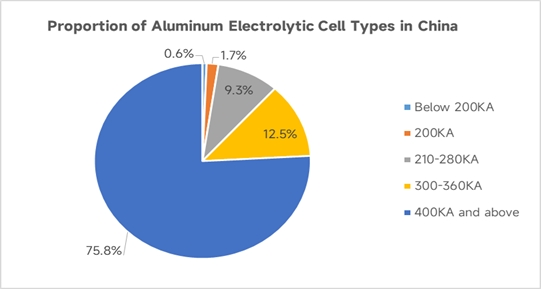
The document intensively proposes target figures for energy saving and carbon reduction in the aluminum industry, overlapping with previous related policies, so they will not be repeated here. The recent "Guidelines" highlight the elimination of prebaked anode electrolytic cells below 200 kA. The guidelines do not specify whether 200 kA is included, so we will assume it is included for argument's sake. In recent years, with the development of domestic aluminum production technology, China has not only become the world's largest aluminum producer but also mastered advanced production technology. Since the 1990s, when China independently developed the 300 kA prebaked anode electrolytic cell technology, producers of large electrolytic cells have become increasingly widespread domestically. The 400-600 kA electrolytic cells have become the main domestic electrolytic technology. According to SMM data, the current domestic existing capacity of aluminum is about 45.37 million mt, with approximately 1.07 million mt of capacity below 200 kA, accounting for about 2.4% of the total domestic aluminum existing capacity, mainly consisting of 200 kA type electrolytic cells.


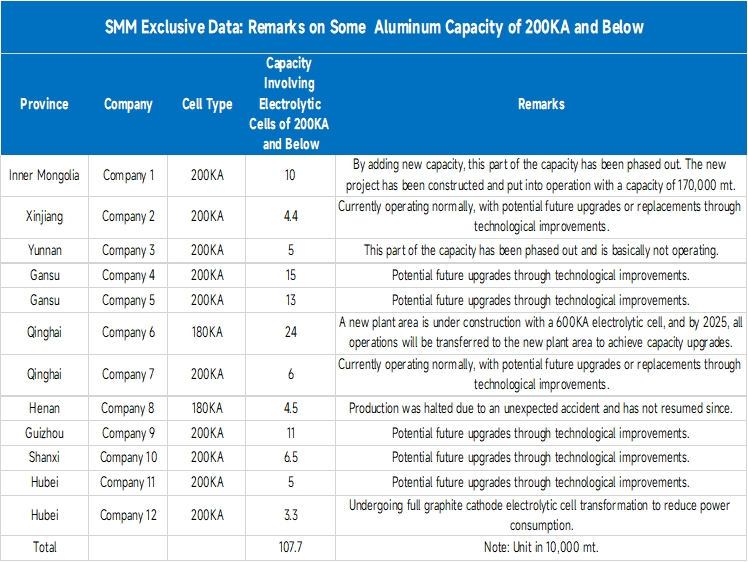
The capacity of these aluminum smelters is mainly distributed in Qinghai, Gansu, Guizhou, and other regions. According to SMM's research, some companies are preparing to relocate and upgrade this part of the small cells by building new aluminum smelters to replace outdated cells. Other companies are responding to potential future policy changes by upgrading existing cells to improve current efficiency and reduce power consumption. Relevant information is as follows:


Brief Comment: Analysis of the research data shows that the domestic aluminum capacity of 200KA and below accounts for a small proportion, and most companies have plans for technological upgrades, thus having limited impact on short-term production. The domestic goals for energy saving and carbon reduction in aluminum are mainly achieved by optimizing the industry's power structure, improving current efficiency, and reducing power consumption. This goal requires joint efforts from upstream raw material supply, improvements in aluminum smelting technology, and energy saving in aluminum processing. Simply eliminating the small proportion of cells has limited effect.


Data Source Statement: Except for publicly available information, all other data are processed by SMM based on publicly available information, market communication, and relying on SMM‘s internal database model. They are for reference only and do not constitute decision-making recommendations.

For any inquiries or to learn more information, please contact: lemonzhao@smm.cn
For more information on how to access our research reports, please contact:service.en@smm.cn
Related News
Fed Governor Milan Pushes for Over 100 Basis Points Cut, Contradicts Barkin on Caution
22 hours ago
Fed Governor Milan Pushes for Over 100 Basis Points Cut, Contradicts Barkin on Caution
Read More
Fed Governor Milan Pushes for Over 100 Basis Points Cut, Contradicts Barkin on Caution
Federal Reserve Governor Milan pointed out that it is necessary for the US Fed to cut interest rates by more than 100 basis points this year. At the same time, he is very much looking forward to the performance of Kevin Warsh as Fed Chairman. However, Richmond Fed President Barkin emphasized that monetary policy must remain cautious until inflation fully pulls back to the target level, thereby ensuring the stability of the labour market.
22 hours ago
Democratic Senators Demand Delay in Fed Nomination Amid Criminal Investigation
22 hours ago
Democratic Senators Demand Delay in Fed Nomination Amid Criminal Investigation
Read More
Democratic Senators Demand Delay in Fed Nomination Amid Criminal Investigation
All 11 Democratic members of the US Senate Banking Committee jointly sent a letter to the committee's chairman, Tim Scott, requesting that all nomination processes for the prospective Fed Chairman, Kevin Warsh, be postponed until the criminal investigation into current Fed Chairman Powell and other board members is concluded. However, Scott stated that Warsh's confirmation was a done deal.
22 hours ago
Fed to Keep Large Banks' Capital Levels Unchanged, Postpones Stress Test Reforms Until 2027
22 hours ago
Fed to Keep Large Banks' Capital Levels Unchanged, Postpones Stress Test Reforms Until 2027
Read More
Fed to Keep Large Banks' Capital Levels Unchanged, Postpones Stress Test Reforms Until 2027
The US Fed has announced that it will maintain the capital levels of large banks unchanged during the upcoming stress test cycle (corresponding to the 2026 cycle). At the same time, the US Fed is planning multidimensional reforms to this annual test, aiming to enhance its transparency. The US Fed's Vice Chair for Supervision, Bowman, revealed that adjustments to the stress capital buffer requirements for large banks will be postponed until 2027. This move is intended to provide the US Fed with sufficient time to evaluate potential flaws that may be exposed in its testing models when assessing banks' financial conditions under simulated economic downturn scenarios.
22 hours ago