The silica market in 2024 is also not very promising. Prices of metallurgical-grade silica for downstream silicon metal have slightly declined across various production areas. Coupled with the impact of regional mineral resource planning targets, from 2024 onwards, the number of cancellation of mining licenses for small domestic silica mines will increase, while new silica mining licenses are increasingly being issued to large mines.
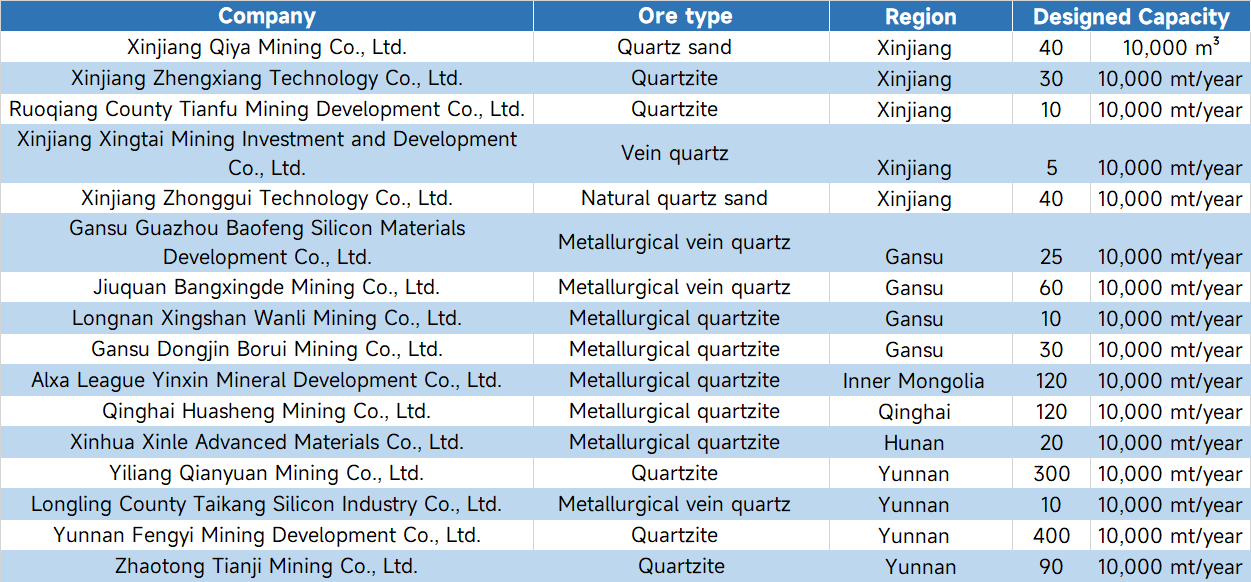
The following chart shows the statistics of newly issued silica mining licenses in China for 2024:
The following chart shows the statistics of canceled silica mining licenses in China for 2024:
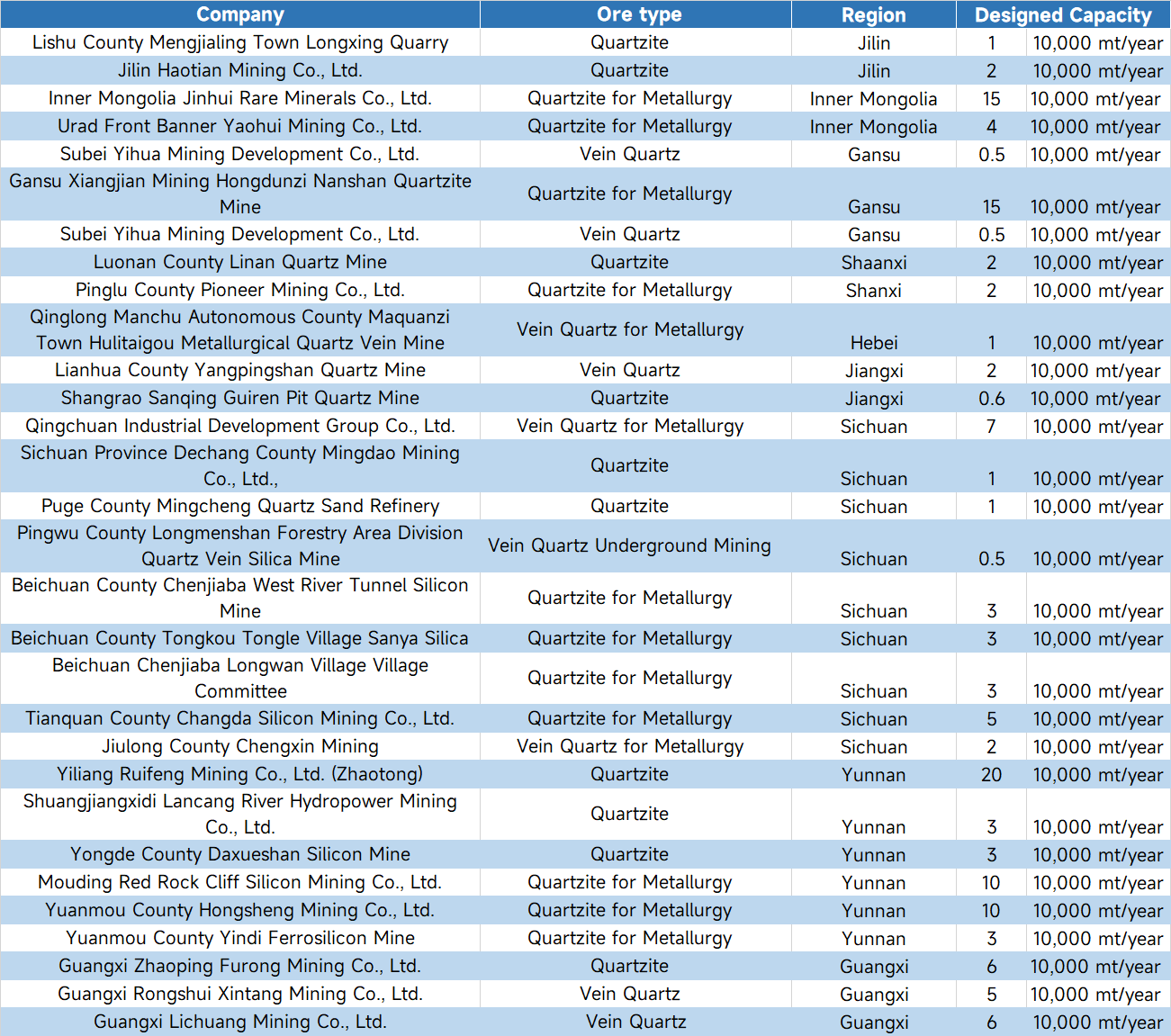
Comparing the two charts, it is not difficult to see that the trend of silica mine development is gradually leaning towards larger scales. Comparing the data on the designed production scale of canceled silica mining in China in 2023, we see that in recent years, the primary focus has been on canceling small mines with annual extraction volumes of ≤50,000 mt, which represents an increasing proportion YoY of all canceled mines. As of now, in 2024, small mines account for 76% of canceled silica mining licenses, while large mines with annual extraction volumes of over 100,000 mt account for only 14%.
The designed capacity of newly issued silica mining licenses also reflects this trend. As of now, among newly issued silica mining licenses in China for 2024, only one has an annual designed production scale of less than 100,000 mt, while the rest are all large or super-large silica mines.
A careful observation of the statistics of newly issued mining licenses reveals that many familiar enterprise names appear, all equipped with downstream silicon-related capacity, such as Xinjiang Qiya, Xinjiang Zhonggui, Gansu Baofeng, Qinghai Huasheng, Longling Taikang, and Gansu Dongjin. The trend towards an integrated silicon industry layout is becoming increasingly evident.
According to an SMM survey, some silicon enterprises equipped with silica capacity not only consume it internally but also sell it externally for profit. Due to the low mining cost of silica, though the value per ton is not high, there is still profit potential. In the current challenging profitability situation of the silicon metal segment, some profits from the raw material segment can help reduce losses in the downstream segment to some extent.
However, currently, most regional governments strictly control silica resources. In certain regions, the Ministry of Natural Resources has not approved any new silica mining licenses in the past two years, leading to a concentration of newly issued mining licenses in policy-favorable areas. For instance, the annual mining target for silicon raw materials in Xinjiang is set to 5 million mt for 2025, further enhancing the local silicon industry chain.

![[SMM Analysis] Futures Lack Momentum to Rise Further, Pre-Holiday Demand Stalls, and Stainless Steel Social Inventory Accumulation Intensifies](https://imgqn.smm.cn/usercenter/HBsPu20251217171723.jpeg)