Global Copper Cathode Stocks: Increasing or Decreasing Post-Price Swings?

Published: Sep 03, 2024 17:43 (GMT+8)
Source: SMM
Copper prices have been rising since March 13 following a series of news about "possible production cuts by Chinese smelters." During this period, geopolitical factors, the US dollar trend, favourable macro front in China, and the COMEX short squeeze event pushed copper prices to a historical high in May. As bullish funds retreated from high levels and downstream operations suffered under high copper prices, leading to negative feedback on consumption, copper prices began to decline gradually from June. In early August, the market briefly traded on recession logic, with LME copper falling to $8,714/mt, then rebounding slightly to $9,200/mt. From June to August, during the continuous decline in copper prices, SMM copper cathode social inventory showed a significant destocking trend, but global visible inventory continued to build up.

Copper prices have been rising since March 13 following a series of news about "possible production cuts by Chinese smelters." During this period, geopolitical factors, the US dollar trend, favourable macro front in China, and the COMEX short squeeze event pushed copper prices to a historical high in May. As bullish funds retreated from high levels and downstream operations suffered under high copper prices, leading to negative feedback on consumption, copper prices began to decline gradually from June. In early August, the market briefly traded on recession logic, with LME copper falling to $8,714/mt, then rebounding slightly to $9,200/mt. From June to August, during the continuous decline in copper prices, SMM copper cathode social inventory showed a significant destocking trend, but global visible inventory continued to build up.

Please note that in this article, the visible inventories of the three major global exchanges are SHFE + LME + COMEX; the total global researchable inventory (hereinafter referred to as the total global inventory) is SMM China's domestic and bonded copper cathode social inventory + SMM China's smelter copper cathode inventory + SMM China's consumer copper cathode inventory + LME + COMEX.
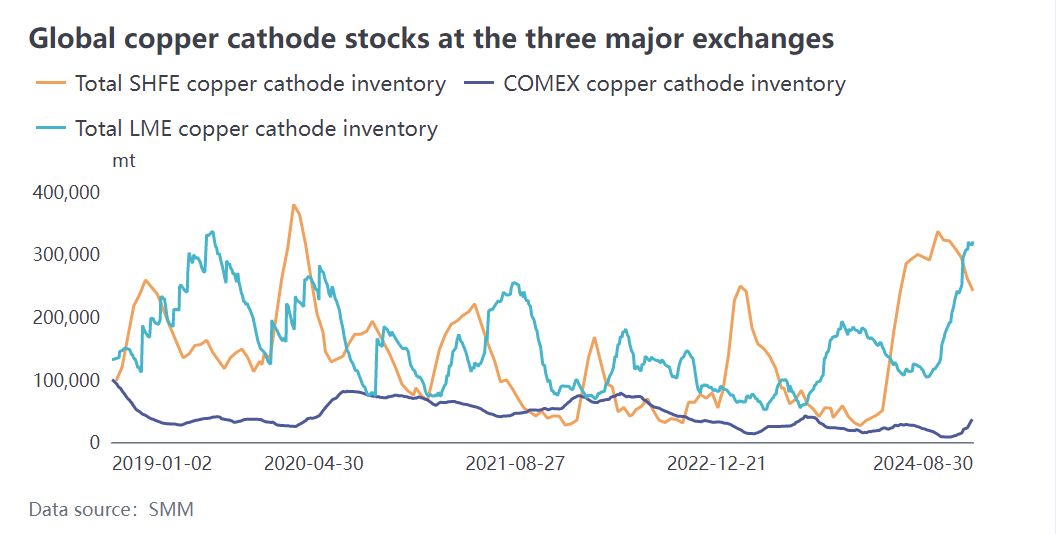
First, let's observe the trends in visible inventories at the world's three major exchanges. Since returning from the Chinese New Year, SHFE inventories have continued to rise as smelters delivered most of their supplies to the delivery inventory, leading to an increase in stocks. During this period, LME and COMEX inventories remained at historically low levels. Subsequently, copper prices have been rising continuously since March 13, and the SHFE copper futures structure has turned into a contango structure, with spot copper showing a significant discount. The high copper prices have reduced downstream purchasing demand, and holders have maintained delivery actions from the 2403 contract to the 2406 contract, making it difficult for SHFE inventories to decrease.

However, after April, copper cathode saw export opportunities, and smelters actively prepared for export actions. According to customs data, China exported 326,100 mt of copper cathode from April to July, with the cumulative value reaching a historical high. Subsequently, LME copper inventories began to increase continuously, with the most significant growth in Asia, undoubtedly due to the high proportion of exports from China, while inventories in Europe and the US did not increase but rather decreased.

According to SMM data, the visible inventories of the three major exchanges were 330,155 mt on February 23 and 597,300 mt on July 26, an increase of 221,416 mt over five months. (Since global copper stocks data is only updated until the end of July, the comparison here is made up to the end of July. As of August 23, the total visible inventories of the three major exchanges globally were 597,300 mt, continuing to maintain stockpiling.)
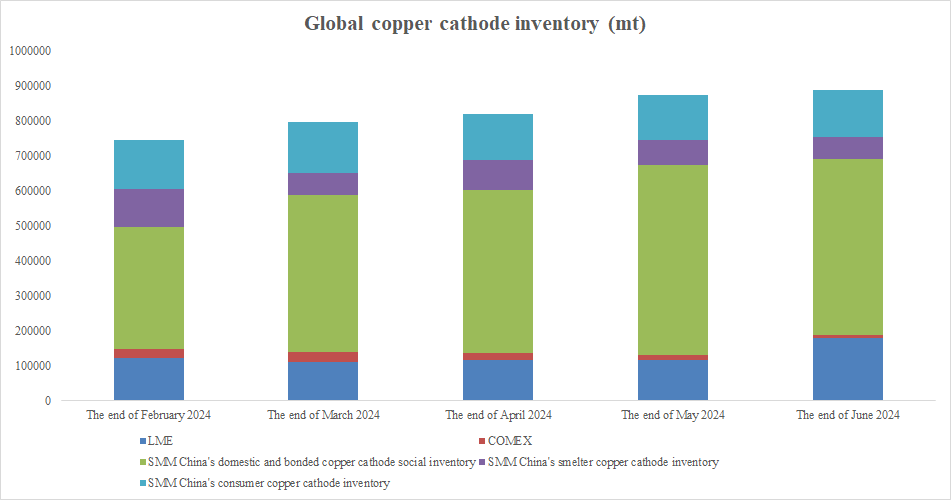
Let's look at the SMM's research on global inventory data. SMM's domestic and bonded copper cathode stocks in China declined due to effects such as exports, downstream restocking after copper prices fell, and substitution between refined and scrap copper. Additionally, as the import window opened, bonded area stocks gradually flowed into domestic trade for digestion, thus showing a decline. The in-plant inventory of Chinese smelters also declined after the slowdown in exports and the expectation of production cuts. According to SMM data, global copper cathode stocks at the end of July were 891,939 mt, an increase of 145,514 mt from 746,425 mt at the end of February. The increase was smaller than the increase in inventories at the world's three major exchanges, indicating that the destocking in China's social inventory was due to consumption and supply, not just export transfers.

In summary, the global copper cathode inventory buildup for 2024 is basically confirmed. When observing inventory changes, it is necessary to break down and analyze each indicator in detail. Currently, the destocking trend in China continues, with signs of convergence in the domestic contango structure and occasional openings of the import window. With market expectations for the September-October peak season and supply disruptions, it is expected that China's inventory will continue to decrease, and the global inventory buildup will also slow down.

Data Source Statement: Except for publicly available information, all other data are processed by SMM based on publicly available information, market communication, and relying on SMM's internal database model. They are for reference only and do not constitute decision-making recommendations.

For any inquiries or for more information, please contact: lemonzhao@smm.cn
For more information on how to access our research reports, please contact:service.en@smm.cn
Related News
Price spread between futures contracts narrows, hold back from selling intensifies, spot premiums may stop falling and stabilize [SMM Copper Morning Meeting Minutes]
13 mins ago
Price spread between futures contracts narrows, hold back from selling intensifies, spot premiums may stop falling and stabilize [SMM Copper Morning Meeting Minutes]
Read More
Price spread between futures contracts narrows, hold back from selling intensifies, spot premiums may stop falling and stabilize [SMM Copper Morning Meeting Minutes]
SMM Morning Meeting Summary: LME copper: Opened at $14,645.5/mt, peaked at $14,657/mt, bottomed at $14,549/mt, and closed at $14,555.5/mt, down 0.45%. Trading volume was 11,400 lots, with open interest at 264,000 lots, an increase of 2,818 lots from the previous trading day, driven by bearish position building. The most-traded SHFE copper 2611 contract: Opened at 110,950 yuan/mt, peaked at 111,020 yuan/mt, bottomed at 110,610 yuan/mt, and closed at 110,730 yuan/mt, down 0.15%. Trading volume was 16,300 lots, with open interest at 195,000 lots, a decrease of 922 lots from the previous trading day, driven by bullish position reduction.
13 mins ago
Copper futures see slight correction as macro and fundamentals intertwine [SMM Copper Morning Comment]
28 mins ago
Copper futures see slight correction as macro and fundamentals intertwine [SMM Copper Morning Comment]
Read More
Copper futures see slight correction as macro and fundamentals intertwine [SMM Copper Morning Comment]
28 mins ago
Centinela Strike Could Cut November Copper Output by Half, Unions Say
11 hours ago
Centinela Strike Could Cut November Copper Output by Half, Unions Say
Read More
Centinela Strike Could Cut November Copper Output by Half, Unions Say
A workers’ strike at Antofagasta’s Centinela copper mine in Chile could reduce the operation’s November copper production by around 50% if the work stoppage continues, according to union representatives. The strike began on October 7 after two unions rejected further negotiations with Antofagasta Minerals following the failure of government-mediated talks to produce an agreement. The labour groups represent more than half of Centinela’s critical mine operators and more than 60% of equipment maintenance workers. The unions said the initial operational impact is expected to worsen gradually because mining and mine-development activities have been affected, while a large volume of waste rock still needs to be removed. They expect the full effect of the strike to become more visible in November, when production could fall by as much as half. Antofagasta has said it continues to maintain its production guidance despite the strike and declined to comment on the unions’ estimate of the potential November production impact. The dispute centres on differences in pay and benefits between union groups. Labour representatives are seeking equivalent benefits for employees regardless of union affiliation, while Antofagasta has said bargaining schedules have been separated since 2020 and wage adjustments have been negotiated at different times. The union estimate of a potential 50% decline in November production materially increases the supply significance of the Centinela strike compared with the initial work stoppage. However, the estimate has not been confirmed by Antofagasta, which continues to maintain its production guidance. The scale of any actual copper loss will therefore depend on the duration of the strike, the extent of disruption to mining and maintenance activities, and whether negotiations resume before November.
11 hours ago