In July, domestic tin ore imports continued to rise, with imports from the Democratic Republic of the Congo and Australia reaching historical highs [SMM Analysis].

Published: Aug 20, 2024 18:28 (GMT+8)
Source: SMM
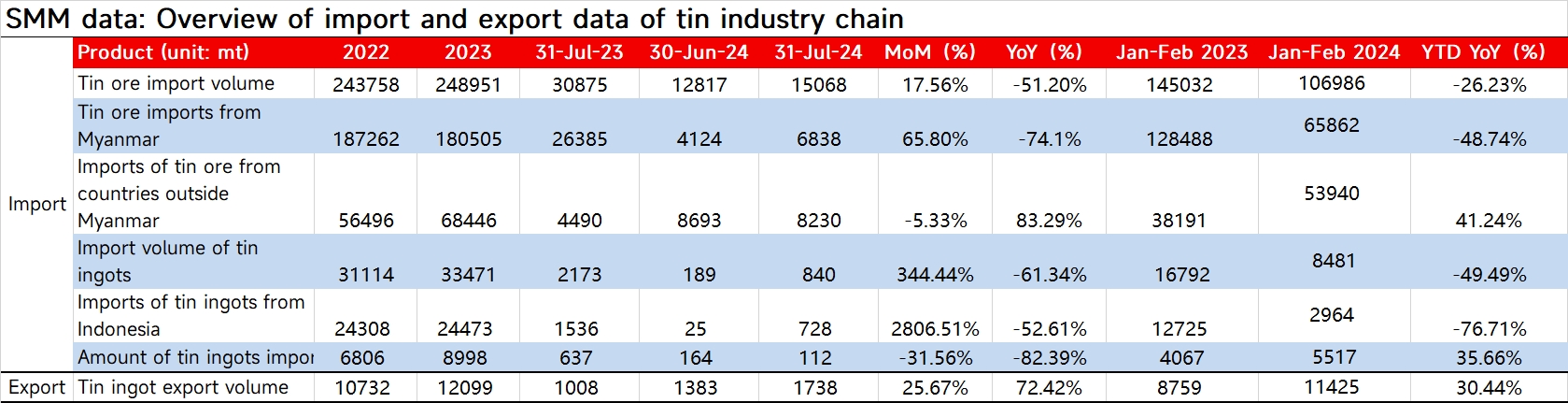
In July, domestic tin ore imports were 15,000 mt (metal content approximately 6,429 mt), up 17.56% MoM, down 51.20% YoY, and increased by 1,270 mt compared to June. The cumulative imports from January to July were 106,000 mt, down 26.23% YoY. In July, domestic tin ingot imports were 840 mt, up 344.44% MoM, down 61.34% YoY. The cumulative imports from January to July were 8,481 mt, down 49.49% YoY.

In July, domestic tin ore imports were 15,000 mt (metal content approximately 6,429 mt), up 17.56% MoM, down 51.20% YoY, and increased by 1,270 mt compared to June. The cumulative imports from January to July were 106,000 mt, down 26.23% YoY. In July, domestic tin ingot imports were 840 mt, up 344.44% MoM, down 61.34% YoY. The cumulative imports from January to July were 8,481 mt, down 49.49% YoY.

In July, domestic tin ore imports showed an upward trend, mainly due to increased imports from Myanmar and the Democratic Republic of Congo (DRC), while imports from other countries remained stable. Specifically, tin ore imports from Myanmar in July were 6,800 mt (metal content approximately 2,025 mt), showing an increase compared to June 2024. Although the authorities in Wa State, Myanmar, have not provided a clear timeline for the resumption of tin ore production, market analysis and forecasts suggest that Myanmar's tin ore imports will remain relatively low in Q3. Meanwhile, tin ore imports from the DRC and Australia are also on the rise. Since the suspension of production in Myanmar, the share of tin ore imports from Africa and other regions in the total domestic imports has continued to increase, and this trend is expected to persist, stabilizing at a high level for some time. Historical data analysis shows that tin ore imports from the DRC and Australia have reached historical highs, partially alleviating the market supply gap caused by Myanmar's mining ban.

On the other hand, with the intermittent opening of the tin ingot import profit window, domestic tin ingot imports have started to show an upward trend. According to the latest data, tin ingot imports in July increased to 840 mt, with imports from Indonesia reaching 727 mt. Considering the recent brief reopening of the tin ingot import profit window and factors such as shipping schedules, some imported tin ingots are expected to arrive in the domestic market in August. However, due to the limited and unstable opening time of the import profit window, tin ingot imports are unlikely to recover to the levels of the same period last year.

Additionally, domestic tin ingot exports in July also showed an upward trend, with specific data at 1,738 mt, up 25.67% MoM and 72.42% YoY. The cumulative exports from January to July 2024 reached 11,425 mt, up 30.44% YoY. However, considering the recent closure of the export window, tin ingot exports are expected to decline in the future.


Data Source Statement: Except for publicly available information, all other data are processed by SMM based on publicly available information, market communication, and relying on SMM's internal database model. They are for reference only and do not constitute decision-making recommendations.

For any inquiries or for more information, please contact: lemonzhao@smm.cn
For more information on how to access our research reports, please contact:service.en@smm.cn
Related News
【Flash | Coherent’s PhotonLink Sets the Stage for a Commercial Indium Phosphide (InP) Ramp】
4 hours ago
【Flash | Coherent’s PhotonLink Sets the Stage for a Commercial Indium Phosphide (InP) Ramp】
Read More
【Flash | Coherent’s PhotonLink Sets the Stage for a Commercial Indium Phosphide (InP) Ramp】
Coherent launched PhotonLink, an integrated optics platform for AI infrastructure incorporating Indium Phosphide (InP) lasers, silicon photonics, detectors and optical modules. The company disclosed more than 10 CPO engagements, over 10 NPO engagements and more than five chip-to-chip connectivity projects, with anchor customers and long-term agreements secured for both CPO and NPO. Revenue is expected to begin ramping in Q4 2026. Coherent has shipped over 300 million InP lasers and is expanding its 6-inch InP manufacturing capacity to support the ramp. The customer pipeline provides a clearer commercial demand signal for InP devices and upstream materials, although additional capacity and indium consumption were not disclosed.
4 hours ago
Institutions: iPhone 18 Pro series first-week sales in China up 12% YoY
Sep 30, 2026 18:09 (GMT+8)
Institutions: iPhone 18 Pro series first-week sales in China up 12% YoY
Read More
Institutions: iPhone 18 Pro series first-week sales in China up 12% YoY
According to Counterpoint Research's China Smartphone Weekly Sales Tracker, China's weekly smartphone sales have maintained a double-digit YoY decline since July. Affected by rising storage costs, consumer demand remains weak, but with the arrival of the September new product launch cycle, the market is expected to see a MoM recovery. Sales of the iPhone 18 Pro series in its first three days of availability (accounting for only three days of Week 38) were up 12% YoY compared with the first-week sales of the iPhone 17 Pro series. Driven by this strong start, Apple topped the weekly sales chart in Week 38, capturing a 33% share of China's smartphone market.
Sep 30, 2026 18:09 (GMT+8)
AI Server Growth Demand Supports Q4 Memory Contract Price Uptrend; Consumer-Side Pressure Persists
Sep 30, 2026 18:08 (GMT+8)
AI Server Growth Demand Supports Q4 Memory Contract Price Uptrend; Consumer-Side Pressure Persists
Read More
AI Server Growth Demand Supports Q4 Memory Contract Price Uptrend; Consumer-Side Pressure Persists
According to TrendForce's latest memory industry research, in Q4 2026, DRAM manufacturers will continue to allocate advanced process capacity to high-performance products for server applications, maintaining an overall undersupply situation. However, the contract price uptrend is slowing down, with Conventional DRAM expected to increase by 10%–15% QoQ. The NAND Flash market is showing a dual-track development of AI acceleration and low consumer demand that nonetheless drives price increases, with overall contract prices expected to rise by 15%–20% QoQ.
Sep 30, 2026 18:08 (GMT+8)