In July, domestic tin ore imports continued to rise, with imports from the Democratic Republic of the Congo and Australia reaching historical highs [SMM Analysis].

Published: Aug 20, 2024 18:28
Source: SMM
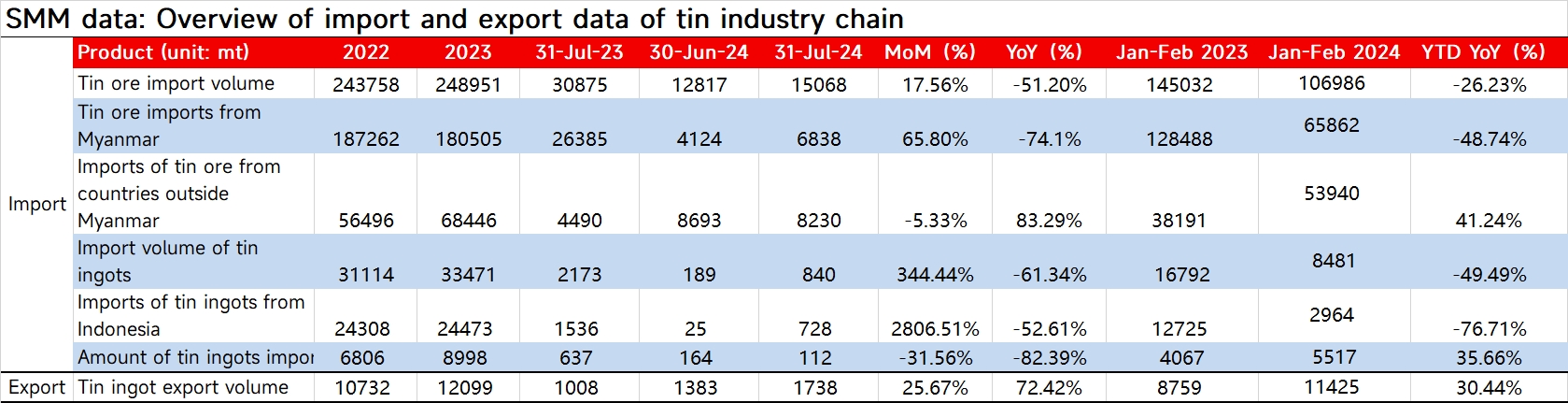
In July, domestic tin ore imports were 15,000 mt (metal content approximately 6,429 mt), up 17.56% MoM, down 51.20% YoY, and increased by 1,270 mt compared to June. The cumulative imports from January to July were 106,000 mt, down 26.23% YoY. In July, domestic tin ingot imports were 840 mt, up 344.44% MoM, down 61.34% YoY. The cumulative imports from January to July were 8,481 mt, down 49.49% YoY.

In July, domestic tin ore imports were 15,000 mt (metal content approximately 6,429 mt), up 17.56% MoM, down 51.20% YoY, and increased by 1,270 mt compared to June. The cumulative imports from January to July were 106,000 mt, down 26.23% YoY. In July, domestic tin ingot imports were 840 mt, up 344.44% MoM, down 61.34% YoY. The cumulative imports from January to July were 8,481 mt, down 49.49% YoY.

In July, domestic tin ore imports showed an upward trend, mainly due to increased imports from Myanmar and the Democratic Republic of Congo (DRC), while imports from other countries remained stable. Specifically, tin ore imports from Myanmar in July were 6,800 mt (metal content approximately 2,025 mt), showing an increase compared to June 2024. Although the authorities in Wa State, Myanmar, have not provided a clear timeline for the resumption of tin ore production, market analysis and forecasts suggest that Myanmar's tin ore imports will remain relatively low in Q3. Meanwhile, tin ore imports from the DRC and Australia are also on the rise. Since the suspension of production in Myanmar, the share of tin ore imports from Africa and other regions in the total domestic imports has continued to increase, and this trend is expected to persist, stabilizing at a high level for some time. Historical data analysis shows that tin ore imports from the DRC and Australia have reached historical highs, partially alleviating the market supply gap caused by Myanmar's mining ban.

On the other hand, with the intermittent opening of the tin ingot import profit window, domestic tin ingot imports have started to show an upward trend. According to the latest data, tin ingot imports in July increased to 840 mt, with imports from Indonesia reaching 727 mt. Considering the recent brief reopening of the tin ingot import profit window and factors such as shipping schedules, some imported tin ingots are expected to arrive in the domestic market in August. However, due to the limited and unstable opening time of the import profit window, tin ingot imports are unlikely to recover to the levels of the same period last year.

Additionally, domestic tin ingot exports in July also showed an upward trend, with specific data at 1,738 mt, up 25.67% MoM and 72.42% YoY. The cumulative exports from January to July 2024 reached 11,425 mt, up 30.44% YoY. However, considering the recent closure of the export window, tin ingot exports are expected to decline in the future.

Data Source Statement: Except for publicly available information, all other data are processed by SMM based on publicly available information, market communication, and relying on SMM‘s internal database model. They are for reference only and do not constitute decision-making recommendations.

For any inquiries or to learn more information, please contact: lemonzhao@smm.cn
For more information on how to access our research reports, please contact:service.en@smm.cn
Related News
[SMM Tin News Flash: China's EV Exports Grew 68.1% in the First Four Months of This Year, Industrial Robot Exports Grew 30%]
May 9, 2026 17:24
[SMM Tin News Flash: China's EV Exports Grew 68.1% in the First Four Months of This Year, Industrial Robot Exports Grew 30%]
Read More
[SMM Tin News Flash: China's EV Exports Grew 68.1% in the First Four Months of This Year, Industrial Robot Exports Grew 30%]
[SMM Tin News Flash: China's EV Exports Grew 68.1% in the First Four Months of This Year, Industrial Robot Exports Grew 30%]
Data released by the General Administration of Customs today showed that in the first four months of this year, China's total goods trade import and export value reached 16.23 trillion yuan, up 14.9% YoY, maintaining a strong growth momentum. In the first four months, China exported 5.92 trillion yuan worth of electromechanical products, up 17.6%, accounting for 63.5% of China's total exports. Among them, exports of green and low-carbon products such as EVs, lithium batteries, and wind turbines grew 68.1%, 43.2%, and 40.7% respectively, while industrial robot exports grew 30%. (CCTV)
May 9, 2026 17:24
Data: SHFE, DCE market movement (May 08)
May 8, 2026 15:56
Data: SHFE, DCE market movement (May 08)
Read More
Data: SHFE, DCE market movement (May 08)
The following table shows the ferrous and nonferrous metals movement on the SHFE and DCE on 08 May , 2026
May 8, 2026 15:56
Global Tech Giants Court SK Hynix with Investment, Financing Proposals for Memory Chips
May 8, 2026 09:34
Global Tech Giants Court SK Hynix with Investment, Financing Proposals for Memory Chips
Read More
Global Tech Giants Court SK Hynix with Investment, Financing Proposals for Memory Chips
As major global technology companies rush to buy memory chips, SK Hynix is being actively courted by these companies, which have proposed plans to invest in its new production lines and finance the purchase of expensive manufacturing equipment. According to six people familiar with the matter, the company's clients have presented multiple partnership proposals to the South Korean chipmaker, including investing in the construction of dedicated memory production lines. Three other people familiar with the matter said another proposal involves clients providing financing for equipment purchases, such as ASML's extreme ultraviolet lithography machines. These machines are used to etch circuits on wafers and are worth hundreds of millions of dollars. The chipmaker is reportedly cautious about accepting financial commitments from clients, as such deals could make it beholden to specific buyers and force it to supply chips at lower prices in exchange for longer-term, more stable revenue guarantees.
May 8, 2026 09:34