[SMM Data] Operating Rate of LiPF6 Decreased in July 2024

Published: Aug 12, 2024 17:27
Source: SMM
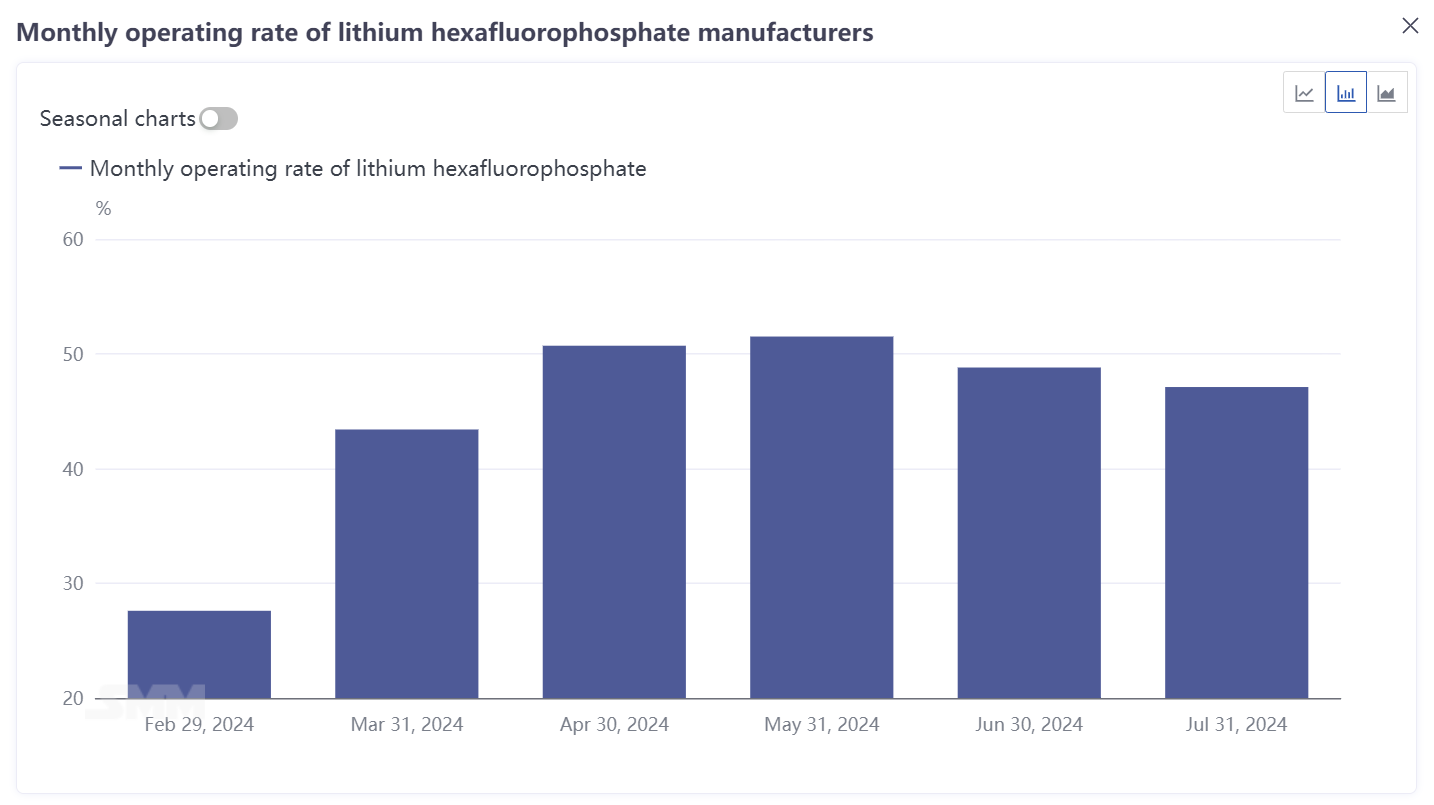
[SMM Data: LiPF6 Operating Rate in July] The operating rate of LiPF6 in July 2024 was approximately 47.1%. The operating rate is expected to increase in August.

In July, the production of LiPF6 reached 14,300 mt, with an overall operating rate of approximately 47.1%, which was about 1.7 percentage points lower than in June. The growth rate of demand in the end-user market slowed down in July, leading to weaker overall demand and a decrease in the operating rate of LiPF6 factories. Looking ahead to August, end-user demand is expected to rise, thereby driving an increase in the demand for LiPF6. The operating rate is projected to reach around 55.8%.

Data Source Statement: Except for publicly available information, all other data are processed by SMM based on publicly available information, market communication, and relying on SMM's internal database model. They are for reference only and do not constitute decision-making recommendations.

For any inquiries or for more information, please contact: lemonzhao@smm.cn
For more information on how to access our research reports, please contact:service.en@smm.cn
Related News
[SMM Analysis] Chile's SQM Exceeds Q2 Profit Projections Amid Tighter Lithium Supply-Demand, Sales Up 59% QoQ
4 hours ago
[SMM Analysis] Chile's SQM Exceeds Q2 Profit Projections Amid Tighter Lithium Supply-Demand, Sales Up 59% QoQ
Read More
[SMM Analysis] Chile's SQM Exceeds Q2 Profit Projections Amid Tighter Lithium Supply-Demand, Sales Up 59% QoQ
[SMM Analysis] Chile's SQM Exceeds Q2 Profit Projections Amid Tighter Lithium Supply-Demand, Sales Up 59% QoQ
On August 20th, SQM, the world's second-largest lithium producer, posted a net profit of $660 million for the three months ended June, well above estimates of $553.9 million and up more than 600% year-on-year, driven by a combination of stronger realized prices and a sharp increase in shipped volumes. Revenue for the quarter reached $2.47 billion, above the $2.29 billion expected. Lithium carbonate equivalent (LCE) sales volumes jumped 59% quarter-on-quarter, reflecting both stronger downstream offtake and SQM's ability to move higher volumes through its Atacama-based supply chain. Average realized lithium prices rose from the roughly $17.8/kg posted in Q1, in line with the company's earlier guidance. In May 2026, SQM raised its full-year lithium sales volume growth guidance to approximately 15%, up from around 10% previously, citing robust downstream demand. SQM CEO Ricardo Ramos said pricing strength in the second quarter came in line with the company's earlier outlook, supported by market demand that outperformed expectations. Upstream, SQM's lithium output remains anchored in brine extraction from the Atacama salt flat, one of the world's largest and lowest-cost lithium resource bases. The company continues to advance its extraction partnership with state copper miner Codelco in the Atacama, a structural move aimed at securing long-term upstream resource access and supporting future volume growth beyond current capacity. Midstream, the sharp rise in sales volumes points to sustained conversion throughput at SQM's lithium carbonate and hydroxide processing facilities, with conversion capacity running at levels sufficient to absorb the quarter's brine output growth without a corresponding buildup in unconverted inventory a signal that processing capacity has kept pace with upstream extraction. Downstream, Chile's national lithium export value nearly tripled in H1 2026 versus a year earlier, reflecting the combined effect of stronger pricing, higher shipment volumes, and sustained demand pull from battery and cathode material producers. The scale of the export increase suggests port and logistics capacity along Chile's export corridors absorbed the higher volumes without material bottlenecks this cycle, supporting the view that current constraints on lithium supply chain growth sit more on the demand and pricing side than on physical logistics. The results mark a continued rebound for global lithium markets following a prolonged downturn driven by oversupply and softer than expected EV demand growth. SMM View: The scale of SQM's volume rebound alongside price gains suggests Chilean lithium supply is being absorbed by the market faster than anticipated at the start of the year, indicating the global oversupply overhang from the prior downturn has meaningfully narrowed. With upstream extraction, midstream conversion, and downstream export logistics all scaling in tandem this quarter, Chile's lithium supply chain currently appears to have spare capacity to respond to further demand upside without near-term bottlenecks.
4 hours ago
[SMM Analysis] DRC Advances $2B Musompo Battery Precursor Zone to Strengthen Africa's Lithium-Ion Supply Chain
4 hours ago
[SMM Analysis] DRC Advances $2B Musompo Battery Precursor Zone to Strengthen Africa's Lithium-Ion Supply Chain
Read More
[SMM Analysis] DRC Advances $2B Musompo Battery Precursor Zone to Strengthen Africa's Lithium-Ion Supply Chain
[SMM Analysis] DRC Advances $2B Musompo Battery Precursor Zone to Strengthen Africa's Lithium-Ion Supply Chain
The Democratic Republic of Congo is advancing plans to establish a major battery precursor manufacturing hub in Lualaba province, positioning itself within the lithium-ion battery materials supply chain as the country seeks to move beyond raw mineral exports. The government approved the Musompo Special Economic Zone as a priority project in February 2026, marking a step toward integrating DRC's mineral base into the cathode-active-material stage of the battery value chain. From Minerals to Lithium-Ion Battery Materials: Musompo is designed to produce nickel-manganese-cobalt (NMC) precursor materials the cobalt- and nickel-bearing intermediate that is combined with a lithium source (typically lithium carbonate or lithium hydroxide) to produce NMC cathode-active material, one of the two dominant lithium-ion battery chemistries alongside LFP. The 900-hectare industrial zone reflects the DRC's broader strategy to capture value at the precursor stage rather than exporting cobalt in raw or intermediate form to Asian cathode producers. Scale and Investment Timeline: The zone is expected to attract approximately $2 billion in private investment once fully developed, with initial construction requiring more than $200 million. Metric, the 900-hectare project was approved as a priority project in February 2026 to produce NMC battery precursor materials, carrying an estimated construction cost of over $200 million and expected to draw approximately $2 billion in private investment while creating around 25,000 direct and 60,000 indirect jobs. DRC's Role in the Lithium Battery Materials Chain: Global lithium-ion battery demand continues to expand on the back of EV adoption and energy storage growth, sustaining strong demand for both NMC and LFP cathode inputs. While DRC itself is not a lithium producer, its cobalt supply position gives it direct relevance to the NMC segment of the lithium battery materials market, which competes with LFP (increasingly supplied by lithium chemical producers rather than cobalt) for cell manufacturing share. Historically, the precursor and cathode-active-material stages of this chain where cobalt, nickel and lithium chemicals are converted into battery-ready materials have been concentrated outside Africa, primarily in China. Musompo is intended to shift part of that midstream capacity onto the continent. Africa's Lithium and Battery Materials Chain Remains Underdeveloped: Africa's raw lithium and cobalt resource base remains far ahead of its downstream battery materials capacity. Zimbabwe has advanced spodumene concentrate production and is moving toward early-stage beneficiation, while Zambia and the DRC are pursuing regional cooperation on battery mineral value addition. Musompo adds a precursor-stage node to this emerging landscape, though it does not itself close the loop with a domestic lithium chemical supply any NMC precursor output would still require lithium carbonate/hydroxide sourced externally, likely from Chinese refiners given current African lithium projects largely export spodumene concentrate rather than converting it locally. Conclusion: Musompo represents a meaningful step in the DRC's push to capture more value from the lithium-ion battery supply chain, specifically on the NMC precursor side. Its success depends on execution: power availability and infrastructure buildout in Lualaba remain the primary constraints, and its impact on the broader African lithium battery materials picture will be limited unless paired with progress on domestic lithium conversion capacity elsewhere on the continent e.g., Zimbabwe, Mali. SMM View: Musompo strengthens the cobalt/nickel side of Africa's NMC precursor capacity but does not directly address the continent's lithium conversion gap spodumene concentrate from Zimbabwe, Mali and Namibia is still overwhelmingly exported for offshore conversion into lithium chemicals. The more consequential development for Africa's lithium battery materials value chain will be whether beneficiation projects on the lithium side (rather than the cobalt side) can achieve similar SEZ-backed investment momentum.
4 hours ago
Zhang Xue Visits Ampace Today, Says Zhang Xue Electric Motorcycle Could Enter Mass Production as Early as Next Year
5 hours ago
Zhang Xue Visits Ampace Today, Says Zhang Xue Electric Motorcycle Could Enter Mass Production as Early as Next Year
Read More
Zhang Xue Visits Ampace Today, Says Zhang Xue Electric Motorcycle Could Enter Mass Production as Early as Next Year
[Zhang Xue Visits Ampace Today, Says Zhang Xue Electric Motorcycle Could Enter Mass Production as Early as Next Year] ZXMOTO founder Zhang Xue visited Ampace for a field trip and exchange on August 20. Zhang Xue stated that the Zhang Xue electric motorcycle could enter mass production as early as next year. In May of this year, Ampace and ZXMOTO had already begun discussions on specific collaboration plans. Ampace is a lithium battery enterprise jointly established by CATL and ATL.
5 hours ago