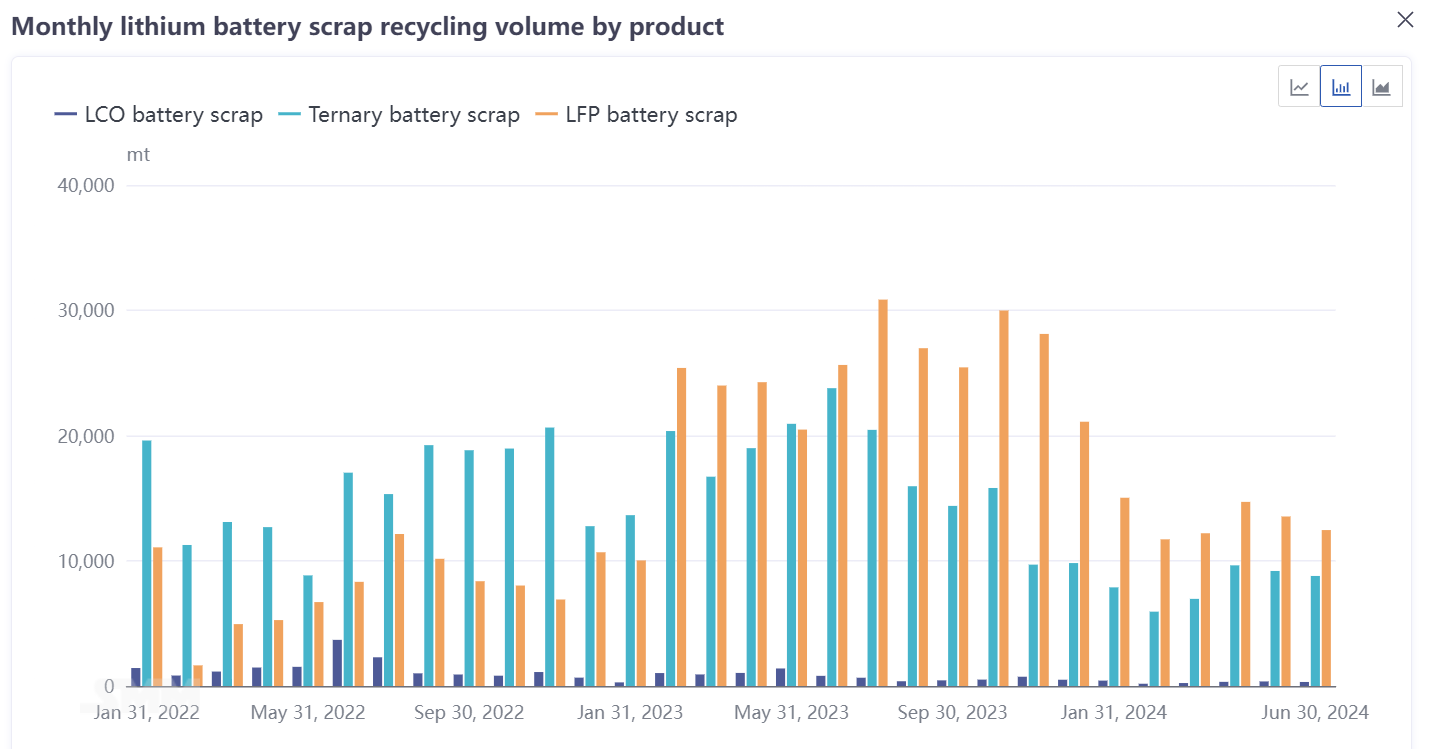
According to SMM research, from January to June 2024, the total supply of lithium battery recycling materials in China (converted to black powder terms) was 129,000 tons, a year-on-year decrease of 33% compared to the 249,000 tons in the same period last year. Looking at the types of raw materials, the total amount of ternary waste material recycled (converted to black powder terms) was 48,400 tons from January to June 2024, a 59% decrease year-on-year from 114,000 tons in the same period last year. In terms of lithium iron phosphate waste materials, the total amount of recycled waste materials (converted to black powder terms) was 79,600 tons, a decrease of about 40% year-on-year. For cobalt acid lithium waste materials, the total amount of recycled waste materials (converted to black powder terms) was 2,000 tons, a 65% decrease year-on-year.
Looking at the recycling volume in the first half of the year, at the beginning of the year, the overall transaction in the recycling market was relatively light, and most companies were generally less motivated to produce due to the long-term inversion of the industry's black powder coefficient. Moreover, due to the industry's pessimistic expectations for some downstream product prices at that time, most hydrometallurgical factories were unwilling to transact black powder at a high coefficient and were more inclined to receive goods after the festival. The market had almost no bulk transactions of black powder or extreme pieces, and a few transactions were also affected by logistics stagnation or the need to pick up by chartered vehicles. More companies started to take leave about two weeks before the Spring Festival and gradually resumed after the Lantern Festival, with the industry's overall operation being low. As a result, the overall recycling volume of ternary, lithium iron phosphate, and cobalt acid lithium waste materials in January-February was to some extent lower than in Q4 of 2023.
From March to April, the recycling market inquired and transacted gradually became active. The overall purchase volume of waste materials in the industry also showed a trend of increasing month by month. With the environmental protection incident in Jiangxi after the Spring Festival causing the resumption of work and production of some local lithium salt and recycling companies to be poor, the growth of the lithium salt supply side was slow. Coupled with the price war in the new energy automobile market after the festival, models led by low-priced lithium iron phosphate were popular, driving the demand for electric cells and salt ends, and the prices of nickel and lithium salts rose slightly. To some extent, this has driven the powder mill's determination to support prices, and the waste material prices continued to rise. Faced with the high waste material prices, some hydrometallurgical factories chose to process on behalf of others to earn processing fees, and a few manufacturers chose to maintain low flow speed operation of the production line, and the industry's transaction price center moved up.
From May to June, the industry's waste recycling gradually retreated after reaching a peak in April, and showed a downward trend month by month from May to June. The main reason is that since May, the three main types of salts downstream of the recycling have shown different degrees of oversupply, and there are signs of weakening demand. Among them, the price of lithium carbonate was under pressure in May, while the price of nickel sulfate rose slightly due to cost inversion and the rise in the price of raw materials. The price of cobalt sulfate was also boosted due to some rumors of unexpected growth in the demand for electric cobalt. To some extent, this has caused the powder mill to continue to firmly support the price mentality. The continuous low recycling economy has also led to a polarization in the operation of large and small hydrometallurgical factories. Large enterprises that use or have processing orders can still operate, while some small enterprises that bear their own profits and losses have mostly stopped production or use other raw materials, and the total amount of industry recycling has fallen.