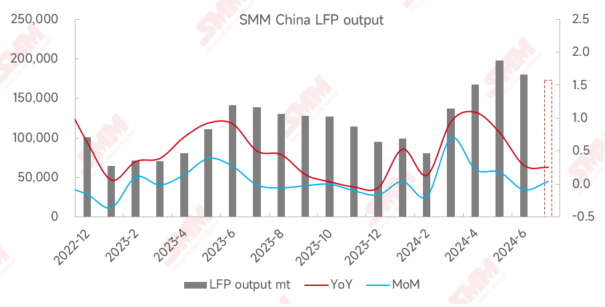
According to SMM statistics, from January to June 2024, the total production of LFP reached 861,530 mt, a significant YoY increase of 60%. Overall, after the traditional market off-season in January and February, LFP production saw a notable recovery in March and April, peaked in May, and began to decline in June due to downstream inventory reduction.
1. Early 2024: Initial Rise Followed by Decline
In January and February 2024, the industry demand was full of expectations due to the new year. Orders were advanced in January due to the Chinese New Year holiday in February. Downstream demand in the motive power sector slightly recovered, while the energy storage sector remained flat. Market sentiments were mixed between pessimism and expectations of a rebound, leading to limited improvement in LFP demand. Most companies reduced or halted production for the Chinese New Year holiday in February, resulting in a decline in LFP production. After the holiday, the NEV price war started early, and the energy storage sector was boosted by the 330 grid connection information, leading to a recovery in market activity compared to pre-holiday levels. However, many battery cell companies delayed their resumption of work, causing a slight slowdown in LFP deliveries.
In March and April 2024, LFP companies gradually recovered their orders, with significant order increases for leading companies, leading to increased supply. The NEV price war continued to escalate in March, significantly stimulating demand in the NEV market, while the energy storage market also gradually recovered. The pace of deliveries by battery cell manufacturers accelerated significantly. LFP cathode material plants were confident in market demand, with a strong momentum to boost production in Q2, and market demand continued to increase.
In May 2024, LFP companies had good operating conditions, with leading companies nearing full production. Some second and third-tier LFP cathode material plants were ramping up capacity while exploring new customers to gain additional orders. The energy storage market contributed significantly to demand growth in May, while the growth rate of demand in the NEV market slowed. Downstream battery cell manufacturers also shifted some LFP orders from the motive power sector to the energy storage sector, keeping the total LFP demand on an upward trend in May.
In June 2024, LFP production and supply declined significantly. Leading companies that had boosted production earlier in Q2 saw a decrease in output in June, primarily focusing on inventory reduction. June was also a critical period for downstream end-users and battery cell companies to reduce inventory, leading to fewer orders for upstream cathode material plants. Battery cell manufacturers placed orders cautiously, and the LFP industry gradually entered the off-season.
2. Supply Surplus and Inevitable Price War
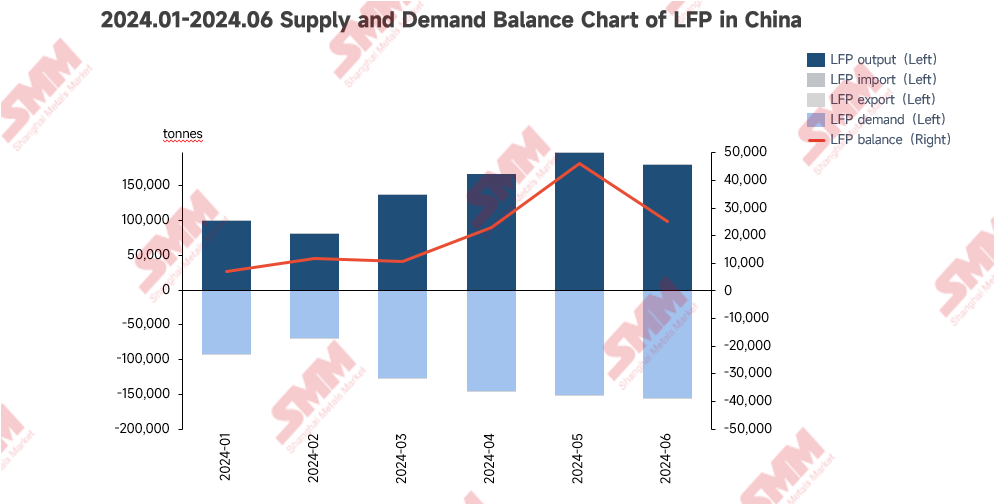
From the supply-demand balance chart of LFP cathodes from January to June 2024, it is evident that the monthly supply of LFP cathodes exceeded the demand for LFP battery cells. Despite favorable factors such as the NEV price war, new model promotions, energy storage market grid connections, and the recovery of overseas demand, LFP capacity and production surged in the first half of the year. However, NEV companies' battery cell procurement orders often did not match actual vehicle sales. NEV companies typically prepared slightly more battery cell orders to avoid being unprepared in case of a sales surge. This led to inventory accumulation of vehicles or battery cells, requiring time to deplete, resulting in a supply surplus from NEV companies to battery cells and from battery cells to cathodes. Consequently, a price war was inevitable when production exceeded demand.
3. Concentrated Leading Capacity but Difficult to Increase Revenue
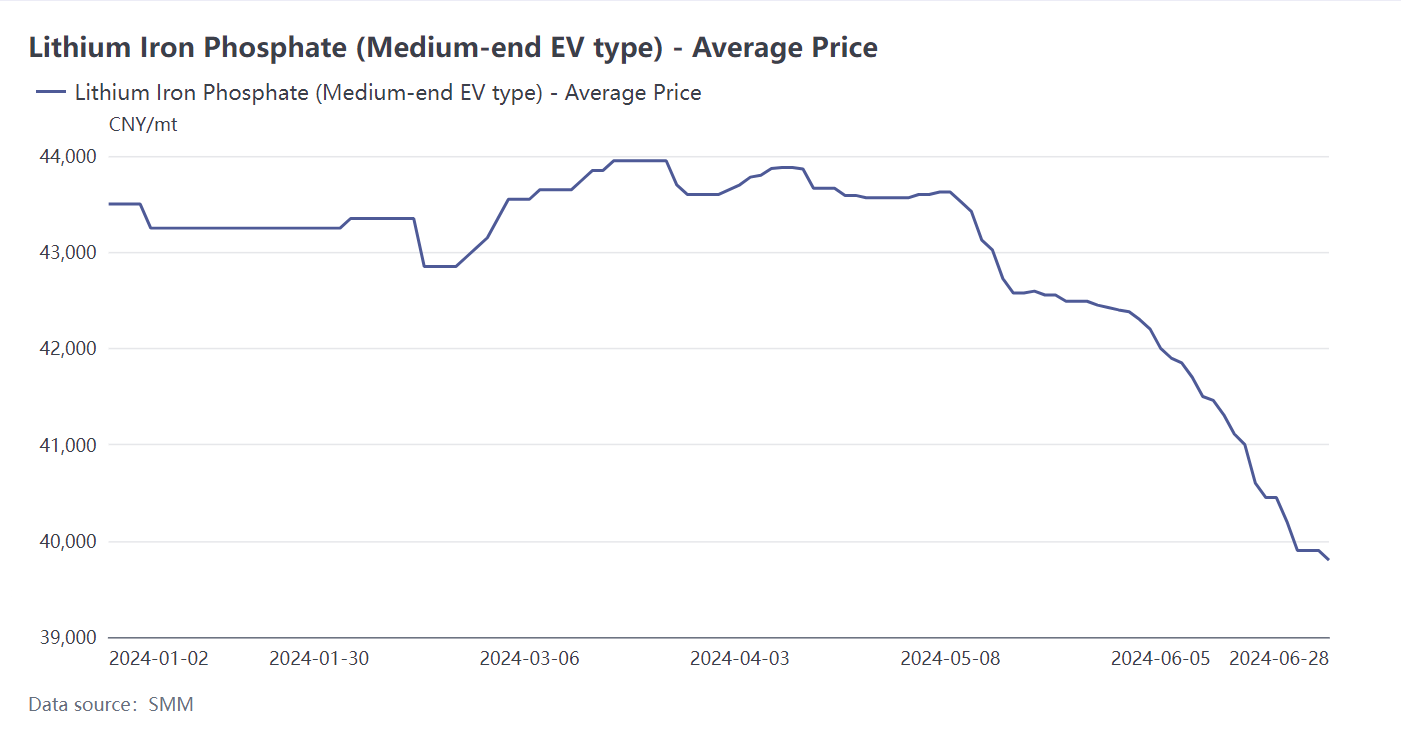
In LFP pricing, the price of lithium carbonate is relatively fixed in the formula. As lithium carbonate prices declined, LFP prices followed suit. Cathode material plants and battery cell manufacturers mainly negotiated LFP processing fees. Leading battery cell companies typically conducted semi-annual and annual tenders, with strict cost control, leading to new LFP companies competing for market share with low prices. The processing fees in these tenders often hit rock bottom, surprising the market. Leading LFP companies, with large capacity and advantages in products, costs, and technology, as well as stable financial and supply chains, were in a better position than smaller companies and could negotiate higher processing fees, offering better long-term development prospects in a competitive environment.
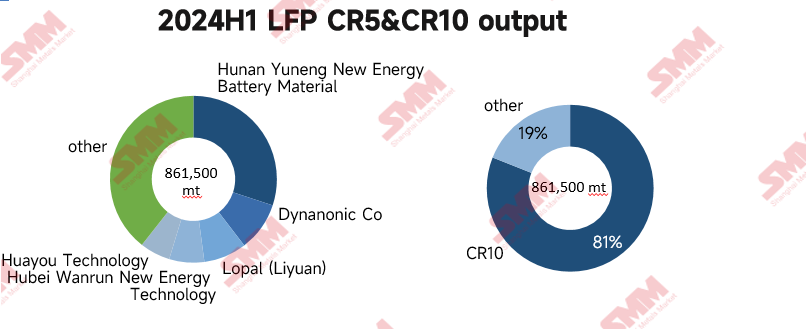
In terms of market structure, Hunan Yuneng's market share remained far ahead, followed by Shenzhen Dynanonic, Changzhou Liyuan, Hubei Wanrun, and Youshan Technology. The CR5 market share was 61%, and the CR10 market share was 81%, indicating high market concentration, with major capacity and shipments concentrated among leading companies. Due to significant pressure from losses, many LFP cathode material plants, despite having sufficient capacity, operated at low rates to avoid substantial losses.
Currently, the long-term cost and profit of LFP are inverted. Although the H1 earnings results of listed companies are not yet available, the Q1 reports indicate that the LFP industry is facing significant challenges, intense competition, and heavy burdens. The primary goal of companies at this stage is to survive in the future market environment. However, opportunities and challenges coexist. SMM believes that LFP companies will focus on cost, supply chain, management, and technological R&D, with some companies also looking overseas. The iterative update of LFP material technology is gradually being recognized overseas, forming a strong competitive edge with low cost and strong technology in multiple directions and fields.

![[SMM Analysis] Chinese New Year Off-Season “Reset,” Sodium-Ion Battery Industry Chain Recovery Poised to Begin](https://imgqn.smm.cn/usercenter/IpglC20251217171727.jpg)