The new blast furnace production capacity in H2 2024 is still increasing, and the ironmaking capacity is increasing

Published: Jul 18, 2024 15:19
Source: SMM
In H1 2024, steel consumption remained sluggish, with overall demand continuing to run weak. Some steel mills' blast furnaces continued to be shut down, dragging down the pig iron output for the entire H1.

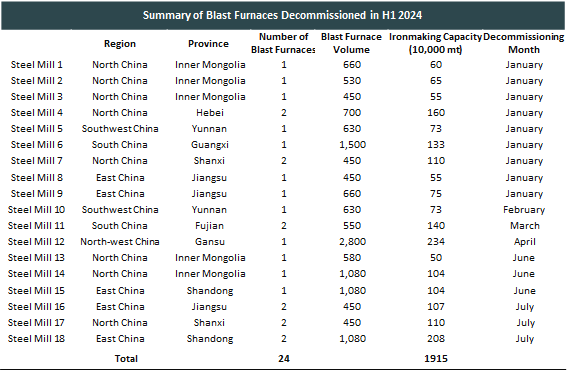
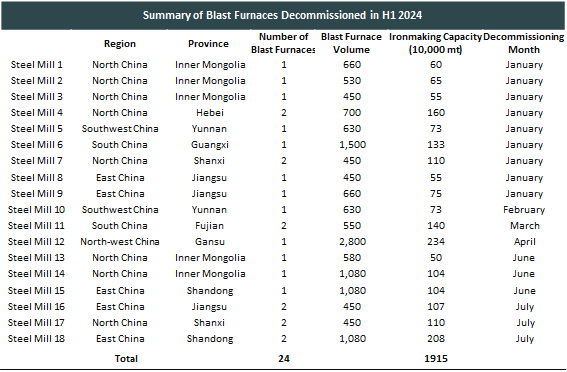
In H1 2024, steel consumption remained sluggish, with overall demand continuing to run weak. Some steel mills' blast furnaces continued to be shut down, dragging down the pig iron output for the entire H1. However, some steel mills went against the trend. According to the SMM survey, as of now, twelve new blast furnaces have been put into operation nationwide, with a total ironmaking capacity of 18.97 million mt. The new blast furnaces, with a volume of all above 1,200 m³, are mainly concentrated in North and East China, with relatively fewer in other regions. Synchronously, 24 blast furnaces have been decommissioned, with a total ironmaking capacity of 19.15 million mt. Most of the decommissioned blast furnaces are small ones with a volume of below 1,000 m³. The specific situation is as follows:

According to the blast furnace production plans tracked by SMM, there are still 15 new blast furnaces scheduled to be put into operation in H2 2024, with a total ironmaking capacity of 19.75 million mt. The volume of these blast furnaces is mostly concentrated in the range of 1200-2000 m³, mainly in Central China, North China, and Southwest China. The specific situation is as follows:
Based on the blast furnace replacement in H1, the requirements for blast furnace capacity replacement have become stricter this year. When new blast furnaces are put into operation, the old capacity being replaced must be withdrawn in advance or simultaneously, and simultaneous production of new and old capacities is not allowed. Therefore, when new blast furnaces are put into operation in H2, the old capacity will also be withdrawn simultaneously. According to SMM tracking data, 15 blast furnaces will be withdrawn in H2 2024, with a total ironmaking capacity of 13.09 million mt.

According to existing statistics, some production plans in 2024 still cannot be completed on time. It is estimated that the new ironmaking capacity in 2024 will be about 38.72 million mt, while the eliminated ironmaking capacity will be about 32.24 million mt. SMM will continue to track China's actual blast furnace capacity in 2024 in real-time.

Data Source Statement: Except for publicly available information, all other data are processed by SMM based on publicly available information, market communication, and relying on SMM‘s internal database model. They are for reference only and do not constitute decision-making recommendations.

For any inquiries or to learn more information, please contact: lemonzhao@smm.cn
For more information on how to access our research reports, please contact:service.en@smm.cn
Related News
Before the holiday, the black chain is unlikely to see a trend-driven market [SMM Steel Industry Chain Weekly Report].
16 hours ago
Before the holiday, the black chain is unlikely to see a trend-driven market [SMM Steel Industry Chain Weekly Report].
Read More
Before the holiday, the black chain is unlikely to see a trend-driven market [SMM Steel Industry Chain Weekly Report].
This week, ferrous metals were in the doldrums, with coking coal and coke staging a mid-week rise. At the beginning of the week, financial markets experienced sharp fluctuations, dragging down sentiment in the ferrous chain and leading to a pullback in futures. Mid-week, Indonesia's cut to coke production quotas drove coking coal and coke futures to lead the gains, though the impact was more pronounced on thermal coal, while coking coal's rise was largely sentiment-driven and short-lived. In the latter part of the week, finished products continued their seasonal inventory buildup, and support from the raw material side weakened, causing the entire ferrous chain to pull back. In the spot market, with the Chinese New Year holiday approaching, purchasing activity slowed down further, with end-users only making limited, as-needed purchases at low prices.
16 hours ago
MMi Daily Iron Ore Report (February 6)
16 hours ago
MMi Daily Iron Ore Report (February 6)
Read More
MMi Daily Iron Ore Report (February 6)
Today, the DCE iron ore futures continued to hit bottom today, with the most-traded contract I2605 closing at 760.5 yuan/mt, down 1.23% from the previous trading day. Spot prices fell by 5–10 yuan/mt compared to the previous trading day.
16 hours ago
[SMM Chromium Daily Review] Inquiries and Transactions Weakened, Chromium Market Showed Mediocre Performance Before the Holiday
17 hours ago
[SMM Chromium Daily Review] Inquiries and Transactions Weakened, Chromium Market Showed Mediocre Performance Before the Holiday
Read More
[SMM Chromium Daily Review] Inquiries and Transactions Weakened, Chromium Market Showed Mediocre Performance Before the Holiday
[SMM Chromium Daily Review] Inquiries and Transactions Weakened, Chromium Market Showed Mediocre Performance Before the Holiday
[SMM Chrome Daily Review: Trading and Inquiries Weakened, Chrome Market Showed Mediocre Performance Before the Holiday] February 6, 2026: Today, the ex-factory price of high-carbon ferrochrome in Inner Mongolia was 8,500-8,600 yuan/mt (50% metal content), flat MoM from the previous trading day...
17 hours ago