As we all know, With the annual increase in global renewable energy, energy storage has gone through rapid development in recent years. But now, Challenges and opportunities coexist in the entire industry.
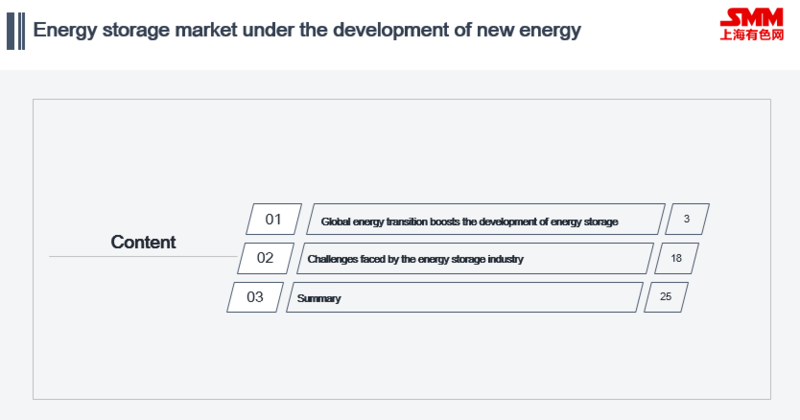
First the essay is talk about the development of energy storage market, then move to the challenges faced by the industry. With the annual increase in global renewable energy power, energy storage has gone through rapid development in recent years.
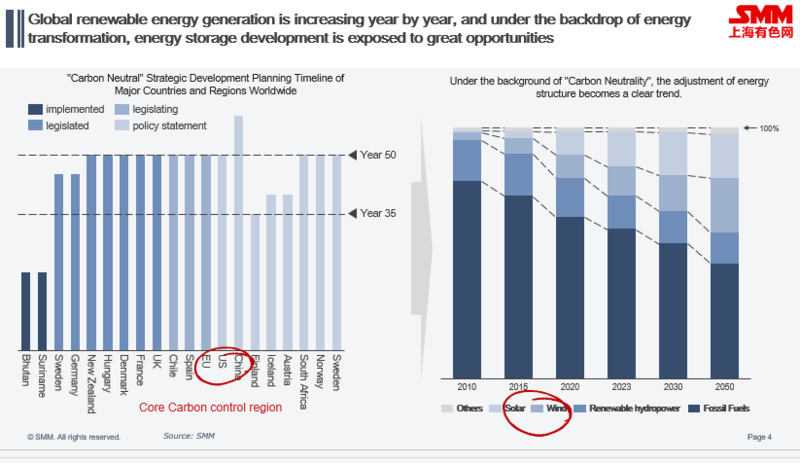
We can see from the right diagram. Currently, global renewable energy (such as solar and wind power)accounts for nearly 25%. With the "Carbon Neutral" goal, we predict that by 2030, the proportion of renewable energy will rise to about 35%, and by 2050, it will reach nearly 50%.
However, the fluctuation and randomness of renewable energy will increase the pressure on
the power grid system. under that situation, energy storage provides an effective way to deal with the problem . By installation of energy storage , It will improve the consumption level of renewable energies like wind and solar power, and serve as a key technology in transition from fossil energy to renewable one.
Therefore, the world is on its path to a clean, low-carbon energy system, that will propel the rapid development of energy storage
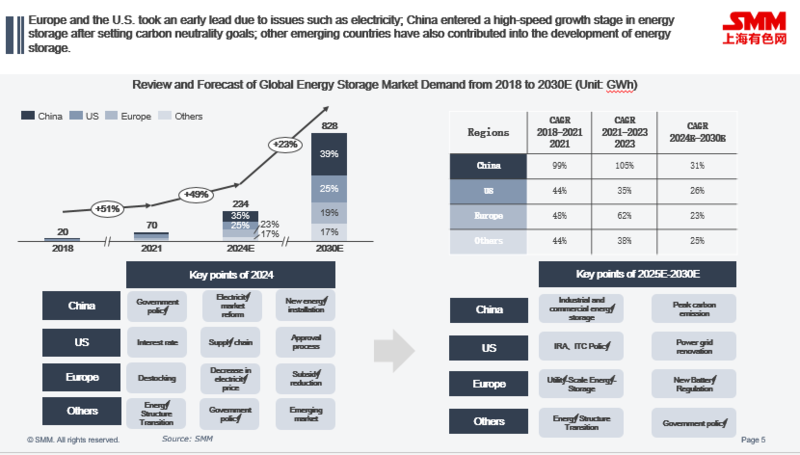
The current global energy storage market is primarily dominated by three major markets: China, US, and Europe. In last year, new energy storage installations in these three area combined over 80% of the global market share.
However, in the past year, the demand for energy storage did not meet the initial expectations set at the beginning of last year. For example, in the US market, due to factors such as interest rate increased by the federal government and supply chain shortage, some projects were delayed or canceled in 2023.
For the Europe, the keyword for the European market last year was "de-stocking." As energy storage support policies in some areas phased down and residential electricity prices decreased, the overall growth rate of the European energy storage market slowed.
At the left lower corner, here is the key word of different market in this year. And on the right side, is the key word for the future development.
We can see that despite short-term disruptive factors, the long-term positive development trend of energy storage remains unchanged.
We expect that by 2030, global energy storage market demand will exceed 800GWh. The Compound Annual Growth Rate from 2023 to 2030 is projected to be 23%.
The development of energy storage in China cannot be separated from the push of policy. Energy storage was first mentioned in the "Twelfth Five-Year" plan, where it was set as a development goal. During the "Thirteenth Five-Year" plan period, energy storage was identified as a strategic emerging industry that China focused on developing. During the "Fourteenth Five-Year" period, various provinces in China have successively introduced "new energy + storage" policy targets, clarifying the ratio and duration of storage deployment for photovoltaic and wind power installations. Under the mandatory storage policies, the power generation side of energy storage has experienced rapid development in the past two years. SMM forecasts that, in this year, the demand from the power generation and grid side will account for 82%, contributing to the main incremental growth.
In terms of user-side energy storage, China achieved a breakthrough from 0 to 1 in the industrial and commercial energy storage field last year. It is expected to continue growing in the future.
In the long term, as solar and wind power generation increase year by year, the need to accommodate unstable electricity will also rise. Therefore, it is expected that the share of long-duration energy storage will increase. In emerging growth areas, as the reform of the electricity market goes deeper, industrial and commercial enterprises will not only meet their own production electricity needs by deploying energy storage, but diversified business models will also boost the rapid growth of user-side industrial and commercial energy storage demand.
We estimate that by 2030, China’s energy storage market demand will be 321GWh, with a CAGR of 25% from 2024 to 2030.
Now, let’s take a deep look on the generation side of ESS in china.
Currently, energy storage on the power generation side in China is mainly used for Joint Frequency Regulation of Thermal Storage and Energy Storage Allocation for New Energy. The market size for joint frequency regulation with thermal storage is limited, and energy storage allocation for new energy has become the primary application scenario for the power generation side.
The left figure shows the current duration and proportion of energy storage allocation by provinces in china. We can see that, at present, a higher proportion of provinces set a combination of "new energy + storage" within the 10%-20% range, and the dominant energy allocation duration is currently 2 hours. In the future, this proportion will increase.
China has currently introduced a series of policies to push the development of energy storage on the power generation side from the initial stage of commercialization towards full market-oriented development. During the 14th Five-Year Plan, some areas have also clarified energy storage installation plans, as you guys can see at right diagram. It will drive rapid growth in energy storage.
Since the beginning of last year, one of the most significant changes we have observed is the wider disparity in electricity prices depending on the time of use across different provinces. According to SMM statistics, in 2023, over 19 provinces, cities, and regions in China had an average peak-to-valley electricity price difference exceeding 0.7 yuan/KWh.
This creates the fundamental condition for arbitrage based on the peak-valley price difference. They also help balance peak loads in the power grid and delay the investment needed for power line expansion.
Furthermore, the overall price reduction across the lithium battery industry chain last year has led to lower costs for energy storage systems, significantly improving the cost efficiency for commercial and industrial energy storage.
SMM forecasts that by 2030, the demand for commercial and industrial energy storage in china will reach about 26GWh.
As the second-largest market in the world, the United States has a mature electricity market。
Although last year, the growth of energy storage in the U.S. has slowed down due to factors such as federal interest rate increase, supply chain shortage like transformers, the long-term outlook remains positive.
On the policy side. Last year, we also witness the issued of the ITC policy. Under the longer duration of the law and more subsidy investment, it will stimulate the deployment of energy storage.
By 2030, the total market demand is anticipated to exceed 200GWh, still ranking as the second-largest energy storage market in the world.
The development of the us energy storage market is highly related to its electricity structure.
The Rocky Mountain separate the East and west of the united states. So the power systems across different states is isolated. Each states need its own energy storage.
Meanwhile, the US's energy structure is undergoing a rapid transformation. We can see from the left diagram. In 2022, new energy like wind and solar only account for 13%. We expect that, by 2030, wind and solar power will provide 33% of the country's electricity.
We can see from the middle diagram, it shows that different states in the US have set mandatory energy storage targets in the next 10 years. It’s a clear planning direction.
Given the outdated grid and the evolving energy structure, energy storage have become critical for both power generation and grid support in the US.
Household energy storage is also what we need to focus on . We can find from the diagram on top left corner that residential electricity prices is the highest across other sectors, rising from 12.55 cents/kWh in 2016 to 15.91 cents/kWh in the first half of 2023, increase by 16.5%.
Besides costly electricity, Americans face power outage risks. The diagram on the Left lower corner. It shows the that during last year’s summer's heatwaves, nearly two-thirds of the us was threatened by energy deficits. Facing these problem, the demand for pv systems with energy storage has risen.
Also on the policy side ,the ITC Policy first includes household energy storage in tax deduction benefits and enhances the base rate to 30%。 That will improve the economic framework of U.S. household energy storage.
Europe is the largest household energy storage market in the world.
In 2022, the outbreak of the Russia-Ukraine conflict drove up electricity prices in the short term and also resulted in power outages due to energy shortages.
Under the impact of high electricity prices and unstable power supply, the household energy storage market in Europe developed rapidly and has become the largest household energy storage market in the world.
For the energy structure, Europe is undergoing an energy transition. We expect that although the demand for new energy construction and energy storage facilities might slow down this year, it will continue to grow in the long term.
SMM predicts that by 2030, Europe's demand for storage will exceed 160 GWh, maintaining its position as the third-largest energy storage market in the world.
Let’s look at the energy structure of Europe. Over the past five years, nearly 50% to 60% of Europe's energy consumption has depended on the importation of fossil fuels.
The Europe’s dependence on external natural gas remains as high as 90% and its dependency on external oil reaches 97%.
From the Russia-Ukraine conflict, European realized that it should accelerate the proportion of electricity generated from its own renewable resources.
At the bottom of this side, we can also find that Countries such as the UK、Spain have successively released policies related to energy storage, stimulating the development of energy storage.
Let’s move to the BTM energy storage, after the Russia-Ukraine conflict in 2022 led to a sharp rise in natural gas prices and it lead to the increase of the electricity prices for residents in Europe.
last year, as the conflict mitigation , electricity prices for European residents have temporarily fallen.
However, the supply and demand balance is unable to keep natural gas prices low over the long term, and we can see from the left diagram, the current average electricity prices for residents in Europe remain more than three times higher than in other regions. The essential demand for household energy storage still here.
for more information, contact Gina Wen: ginawen@smm.cn