2023 Motive Power Battery Overseas Market Share Battle: CATL in Pursuit, BYD Surges Ahead

Published: Feb 19, 2024 15:48
According to data from South Korean research firm SNE Research, the global (excluding China) sales of electric vehicle (EV) batteries totaled approximately 319.4 GWh in 2023, marking a 43.2% increase compared to the same period in 2022. Notably, in the global (excluding China) ranking of electric vehicle battery installations, LG Energy Solution (LGES) maintained its top position, experiencing a growth of 32.9% compared to the same period in 2022, with installations reaching 88.6 GWh and a market share of 27.8%.

Recently, data from South Korean research institution SNE Research revealed that in 2023, the global (excluding China) sales of electric vehicle batteries amounted to approximately 319.4 GWh, marking a 43.2% increase compared to the same period in 2022.
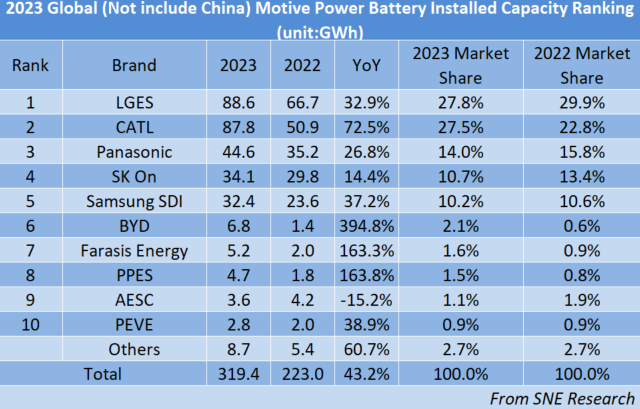
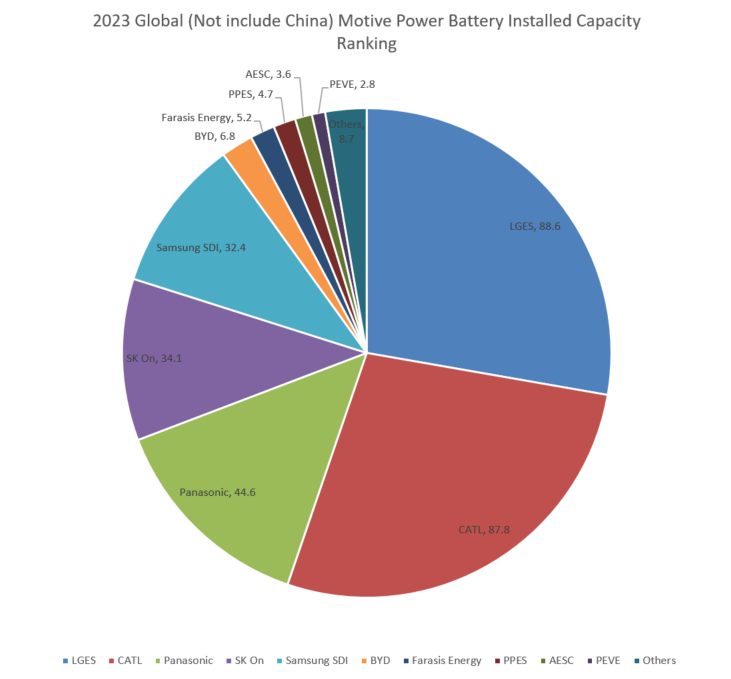
Worth noting is the ranking of electric vehicle battery installations globally (excluding China), with LG Energy Solution (LGES) maintaining the top spot. Compared to the same period in 2022, LGES experienced a growth of 32.9%, achieving an installation volume of 88.6 GWh and a market share of 27.8%.

In the global electric battery market outside of China, CATL follows closely behind LGES, securing the second position with a total installation volume of 87.8 GWh. CATL demonstrated continuous high growth of 72.5%, posing a significant threat to LGES's leading position with a market share of 27.5%.

SNE indicates that Chinese companies, including CATL, are experiencing higher growth rates in the global electric vehicle battery market than in the domestic market, rapidly expanding their global market share. CATL's batteries are installed in vehicles from major manufacturers such as BMW, MG, Mercedes-Benz, and Volvo, including Tesla Model 3/Y manufactured in China for export to Europe, North America, and Asia. Recently, CATL's batteries have been installed in Hyundai's new Kona and Kia Ray electric vehicles, further expanding the influence of Chinese companies in the domestic market.

Panasonic holds the third position in the rankings, with an installation volume of 44.6 GWh, showing a growth rate of 26.8% compared to the same period in 2022. In the global electric battery market (outside China) in 2023, Panasonic achieved a market share of 14%. As one of Tesla's main battery suppliers, Panasonic produces improved 2170 and 4680 batteries, aiming to increase its market share centered around Tesla in the future.

South Korean battery companies SK On and Samsung SDI rank fourth and fifth, with installation volumes of 34.1 GWh and 32.4 GWh, respectively. They experienced growth rates of 14.4% and 37.2% YoY, with market shares of 10.7% and 10.2%, respectively. SNE's analysis suggests that the growth of the three major South Korean battery companies is mainly attributed to strong sales of vehicles equipped with their respective batteries.

Chinese battery supplier BYD holds the sixth position, increasing its market share from 0.6% in 2022 to 2.1% in 2023, with overseas installation volume rising to 6.8 GWh, a remarkable 394.8% YoY increase. BYD is the company with the largest growth among the TOP 10 companies in the global new energy vehicle power battery market (excluding China).

Additionally, Chinese battery company EVE Energy rapidly increased its overseas battery market installations, achieving a growth rate of 163.3%. With an installation volume of 5.2 GWh, EVE Energy secured the seventh position with a market share of 1.6%.

Farasis Energy, with an installation volume of 3.6 GWh, also made it to the TOP 10 in the global market outside China in 2023, ranking ninth with a market share of 1.1%.

Toyota and Panasonic's joint ventures PPES and PEVE rank eighth and tenth, with installation volumes of 4.7 GWh and 2.8 GWh, respectively. Their market shares are 1.5% and 0.9%, with PPES experiencing a significant 163.8% YoY growth and PEVE growing by 38.9% in 2023 in the global electric battery market (outside China).
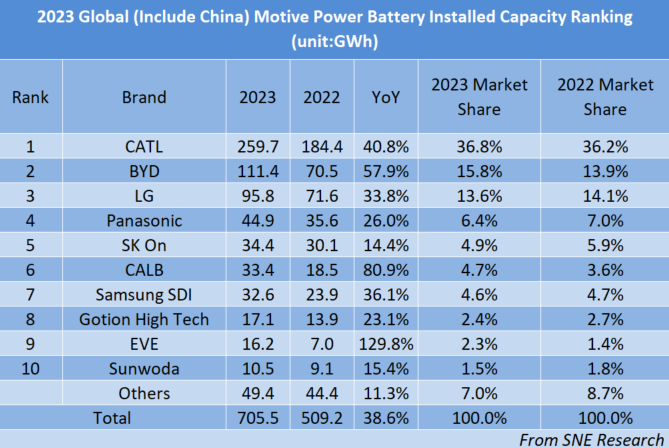
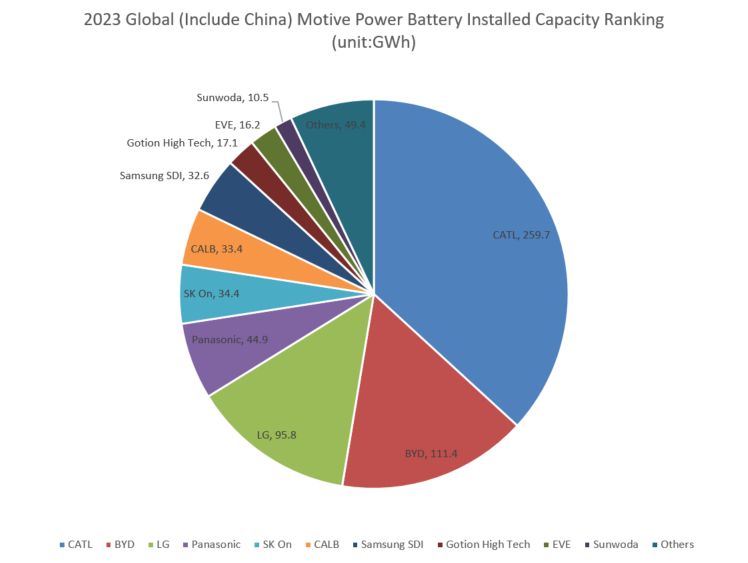
n addition to overseas electric vehicle (EV) battery installation data, SNE recently released the 2023 global (including the Chinese market) new energy vehicle power battery installation data. In 2023, the registered electric vehicle (EV, PHEV, HEV) battery installations worldwide reached approximately 705.5 GWh, a YoY increase of 38.6%. Examining the TOP 10 global power battery installers, Chinese companies secured 6 positions, with a market share of 63.5%, up from 59.6% in 2022. CATL and BYD combined still account for over half, reaching 52.6% market share.

SNE analysis indicates a significant slowdown in the growth rate of the global electric vehicle market in 2023, impacting the downstream secondary battery industry. Factors such as early adopters completing initial purchase demands, economic contraction due to high interest rates and prices, and a lack of charging infrastructure are identified as reasons slowing electric vehicle market demand growth. Although the slowdown in the electric vehicle market is expected to persist for some time, SNE anticipates that regulatory enforcement of IRA subsidies will strengthen from 2024, the number of models eligible for tax credits will decrease, and the maintenance of tax credits will depend on the results of the U.S. presidential election. Uncertainties have negatively impacted the demand for electric vehicles.

SNE believes that the electric vehicle market will shift towards a price-centric approach this year, intensifying competition among automakers to survive through price reductions. Attention is expected to be focused on battery technology development, competition, and strategies to stabilize the critical mineral supply chain.

If you have any questions regarding the industry data, or the news (e.g. how this can affect your business). Please feel free to reach out to me:

Robin He

SMM Li-ion Battery Materials Department

E: robinhe@smm.cn | T: +86-21-51595884

Data Source Statement: Except for publicly available information, all other data are processed by SMM based on publicly available information, market communication, and relying on SMM's internal database model. They are for reference only and do not constitute decision-making recommendations.

For any inquiries or for more information, please contact: lemonzhao@smm.cn
For more information on how to access our research reports, please contact:service.en@smm.cn
Related News
[SMM News] HiTech Minerals Produces Magnesium Oxide from McDermitt Lithium Project
3 hours ago
[SMM News] HiTech Minerals Produces Magnesium Oxide from McDermitt Lithium Project
Read More
[SMM News] HiTech Minerals Produces Magnesium Oxide from McDermitt Lithium Project
[SMM News] HiTech Minerals Produces Magnesium Oxide from McDermitt Lithium Project
On August 25th, Jindalee Lithium's subsidiary HiTech Minerals has successfully produced high-grade magnesium oxide from magnesium sulphate generated at its McDermitt lithium project in Oregon, marking a notable technical milestone ahead of Jindalee's planned merger with Constellation Acquisition Corporation, a SPAC backed by Antarctica Capital. Once the merger completes, McDermitt will sit under newly formed US Elemental, which plans to list on Nasdaq. The result builds on McDermitt's prior prefeasibility study, which had confirmed that magnesium can be co-extracted alongside lithium through sulphuric acid leaching but treated it purely as waste discarded as magnesium sulphate with no revenue credit attached. HiTech's new testwork changes that picture, showing the same stream can instead be converted into magnesium oxide, a feedstock used in primary magnesium metal production and in refractories. The company will now move to assess product specifications, scalability, and commercial viability, while Jindalee has separately commissioned independent market analysis to help shape its broader magnesium strategy. The timing is notable given that China supplies the large majority of the world's primary magnesium, a concentration that has fueled ongoing concern in the US over import exposure. Incoming US Elemental and Jindalee CEO Ian Rodger described the result as "strategically encouraging," pointing to its potential to help derisk the US magnesium supply chain. SMM View: The real significance here lies in project economics rather than the magnesium market itself. A stream that McDermitt previously discarded at cost now has a demonstrated pathway to becoming a saleable co-product and if it clears the specification, scale, and commercial hurdles HiTech has openly flagged as still outstanding, that pathway will meaningfully improve the project's overall economics.
3 hours ago
POSCO's 2nd Hombre Muerto Lithium Plant in Argentina Aims for Q4 2026 Completion, Adding 25,000 t/y Capacity
3 hours ago
POSCO's 2nd Hombre Muerto Lithium Plant in Argentina Aims for Q4 2026 Completion, Adding 25,000 t/y Capacity
Read More
POSCO's 2nd Hombre Muerto Lithium Plant in Argentina Aims for Q4 2026 Completion, Adding 25,000 t/y Capacity
POSCO Group's second lithium plant at the Hombre Muerto salt flat in Salta Province, northwestern Argentina, is targeted for completion in the fourth quarter of 2026, with an annual production capacity of approximately 25,000 tonnes. The company's first plant at the site began operations in 2024. POSCO holds mining rights across 287 km² of the salt flat, with an estimated resource of approximately 3 million tonnes of lithium, following a $280 million investment in 2018 and a further $65 million this year. Brine is drawn from up to 700 metres below ground, at a reported concentration of roughly 92g of lithium per 100L, then evaporated over approximately four months before phosphate compounds are added to precipitate lithium phosphate, which is processed into lithium hydroxide at a refinery on site. POSCO reported its first quarterly operating profit from the Argentine lithium business in Q2 2026 (April–June), at 11 billion Korean won ($8 million), which the company attributes to rebounding EV demand and rising lithium prices linked to increased ESS demand from AI data centers. POSCO Argentina head Park Hyun said that if the current trend continues, the company expects an operating profit margin above 30% next year a company projection, not a reported result. POSCO plans to add three further plants at the site by 2033, with the second plant now in its final construction phase. SMM View: The concrete, verifiable event here is a capacity addition a second 25,000 t/y lithium hydroxide plant reaching completion on a Q4 2026 timeline, adding to the roughly 3-million-tonne resource base POSCO holds at Hombre Muerto. That is a specific, dated increment to non-Chinese-owned brine-derived lithium hydroxide supply out of Argentina, distinct from the profitability commentary in the same report, which reflects a single quarter's result plus forward guidance from company management rather than a confirmed margin trend. The China supply-concentration figure cited in the source is the report's own framing rather than an independently verified current market share, and this article does not itself establish any effect on CIF China pricing or on Chinese lithium chemical capacity POSCO's hydroxide is refined and sold outside that pricing benchmark. The one durable, trackable data point going forward is whether Plant 2 commissions on the stated Q4 2026 timeline and reaches nameplate output, since that is what would actually confirm the capacity addition rather than the current construction-stage guidance.
3 hours ago
[SMM News] Namibia Commits N$952.1 Million to Rail Upgrades in 2026/27, Prioritizing Rail Over Roads
3 hours ago
[SMM News] Namibia Commits N$952.1 Million to Rail Upgrades in 2026/27, Prioritizing Rail Over Roads
Read More
[SMM News] Namibia Commits N$952.1 Million to Rail Upgrades in 2026/27, Prioritizing Rail Over Roads
[SMM News] Namibia Commits N$952.1 Million to Rail Upgrades in 2026/27, Prioritizing Rail Over Roads
On August 25th, Namibia allocated N$952.1 million to railway development in 2026/27, the largest share of the Works and Transport Ministry's infrastructure budget, ahead of N$771.4 million for roads. Of the rail sum, N$946 million goes to development, N$6.1million goes to operations. TransNamib is implementing the programme, per Ministry Director Moses Matatias, who called it government's flagship transport initiative. Targets: 1,000km of rail upgraded in 2026/27, rising to 1,360km by 2028/29, plus annual maintenance of 1,600km. Funding rises to N$1.17 billion in 2027/28 before easing to N$1.08 billion in 2028/29. Government also aims to complete 28% of the Railway Master Plan and review 80% of rail legislation. On roads: 2,300km of gravel upgraded to bitumen by 2026/27, plus 725km rehabilitated, within a combined N$1.72 billion road-and-rail budget. SMM View: This changes inland rail freight capacity, not port throughput the allocation covers track upgrades and maintenance, not port infrastructure. For mineral exporters, the 1,000km 2026/27 target is the concrete near-term marker, if delivered, it eases a current reliability constraint on inland transport, but today's release is a funding commitment, not added capacity. No freight volumes, transit times, or mineral-specific corridors are disclosed, so any cost impact on Namibian mineral logistics stays inferred. The multi-year funding rise through 2027/28 signals a sustained programme, making the 1,000km/1,360km delivery timeline the key thing to track.
3 hours ago