Introduction: The Third Belt and Road Forum for International Cooperation
Key events: The Third Belt and Road Forum for International Cooperation
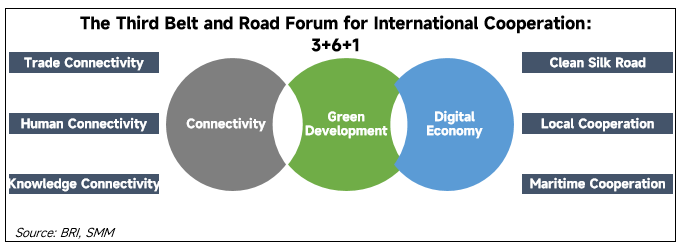
2023 marks the tenth anniversary of the Belt and Road Initiative, and the third forum for international cooperation will be held in Beijing from October 17th to 18th. The theme of this forum is "High-quality Belt and Road Cooperation: Together for Common Development and Prosperity", which includes an opening ceremony, three high-level forums, six thematic forums, and a Belt and Road Entrepreneurs Conference.
Based on the present and looking towards the future, this forum will become a new starting point in world history for building a larger scope, higher level, and more sustainable development for global prosperity through cooperation.
The Belt and Road Initiative: A China proposal, global response, and win-win for the world
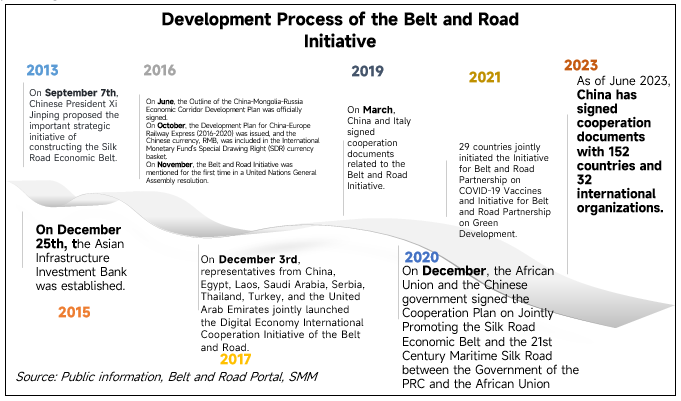
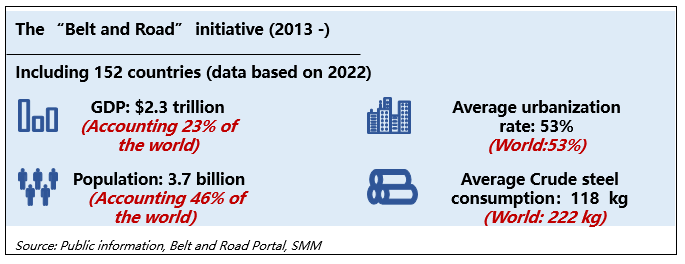
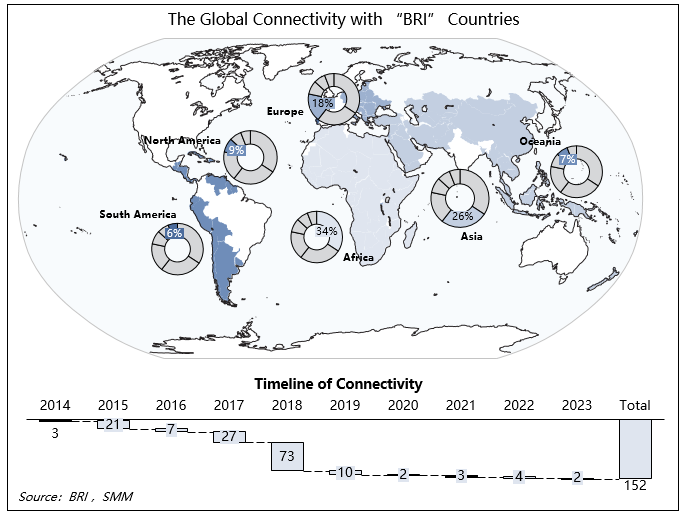
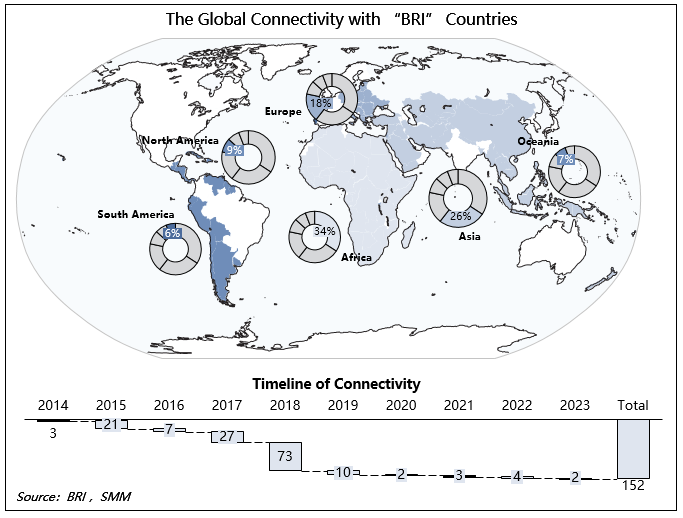
The Belt and Road Initiative consists of two parts: the Silk Road Economic Belt and the 21st-century Maritime Silk Road. In 2013, China proposed this important strategic initiative to strengthen infrastructure construction, trade cooperation, and cultural exchanges between Asia, Europe, Africa, and other regions in order to promote global economic development and cooperation. Over the past decade, China has signed over 200 cooperative documents with 152 countries and 32 international organizations across five continents, with the formation of over 3,000 cooperative projects leading to hundreds of billions USD in investment. The interconnected framework of "six corridors, six roads, multiple countries and multiple ports" has been basically established, and cooperation in areas such as rules and standards continues to deepen among the jointly building countries.

Current status: Building prosperity along the Belt and Road
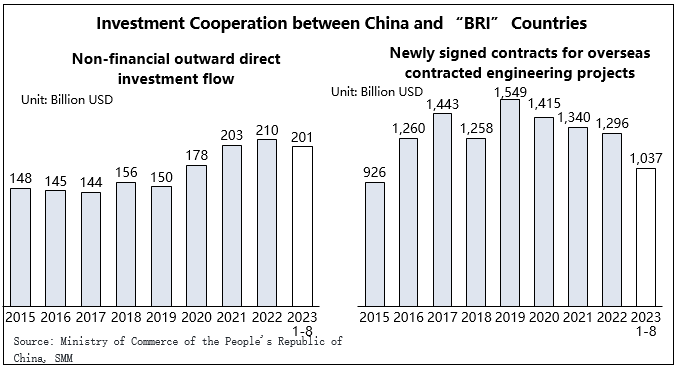
In terms of overall volume, China's non-financial outward direct investment and contracted projects have seen stable growth.
Non-financial outward direct investment flow: From January to June 2023, Chinese enterprises invested approximately $11.57 billion in non-financial sectors in countries along the Belt and Road, up 15.4% YoY. This accounted for 18.6% of the total investment during the same period. The main destinations for investment included Singapore, Vietnam, Laos, Indonesia, Pakistan, Thailand, Malaysia, the United Arab Emirates, Cambodia, and Kazakhstan.
Contracted projects for overseas contracted engineering: In 2022, Chinese enterprises signed 5,514 new contracts for overseas contracted projects in countries along the Belt and Road. The total contract value reached ¥871.84 billion yuan (equivalent to $129.62 billion USD), up 0.8% (but down 3.3% in USD terms). These contracts accounted for 51.2% of China's total newly signed contracts for overseas contracted projects during the same period. The completed turnover amounted to ¥571.31 billion yuan (equivalent to $84.94 billion USD), down 1.3% (or 5.3% in USD terms) and accounted for 54.8% of the total turnover.
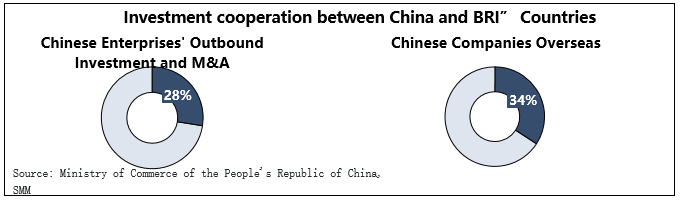
Outbound investment and M&A: In 2022, Chinese companies implemented 118 projects of investment and mergers & acquisitions in countries participating in the Belt and Road Initiative, with a transaction amount of $5.52 billion USD, accounting for 27.5% of the total M&A amount (compared to 11.1% in 2020 and 19.6% in 2021). Among them, Argentina, Singapore, Zimbabwe, South Korea, Kazakhstan, and Indonesia attracted Chinese investment and M&A deals with a scale exceeding $300 million USD.
Establishment of overseas enterprises: In 2022, Chinese investors established approximately 47,000 overseas enterprises in 190 countries and regions worldwide, with nearly 60% located in Asia. North America accounted for 13%, and Europe for 10.2%. Among these, around 16,000 were established in countries participating in the Belt and Road Initiative.
Outbound investment and M&A: In 2022, Chinese companies implemented 118 projects of investment and mergers & acquisitions in countries participating in the Belt and Road Initiative, with a transaction amount of $5.52 billion USD, accounting for 27.5% of the total M&A amount (compared to 11.1% in 2020 and 19.6% in 2021). Among them, Argentina, Singapore, Zimbabwe, South Korea, Kazakhstan, and Indonesia attracted Chinese investment and M&A deals with a scale exceeding $300 million USD.
Establishment of overseas enterprises: In 2022, Chinese investors established approximately 47,000 overseas enterprises in 190 countries and regions worldwide, with nearly 60% located in Asia. North America accounted for 13%, and Europe for 10.2%. Among these, around 16,000 were established in countries participating in the Belt and Road Initiative.
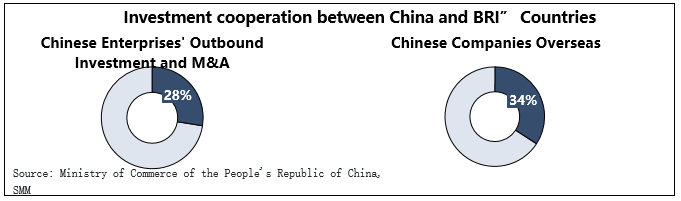
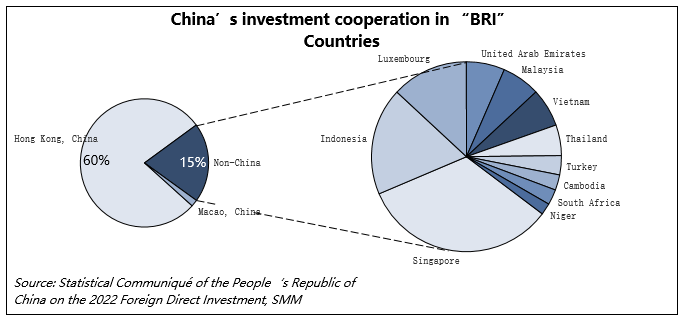
By Country: In 2022, the top 20 countries accounted for a significant proportion of the total non-financial outward direct investment flow, reaching 95.7%. Among these countries, 13 were along the Belt and Road Initiative, accounting for 76% of the total. Countries outside of China, Hong Kong, and Macau accounted for 15.3% of the total, with Southeast Asia and the Middle East being the main regions.
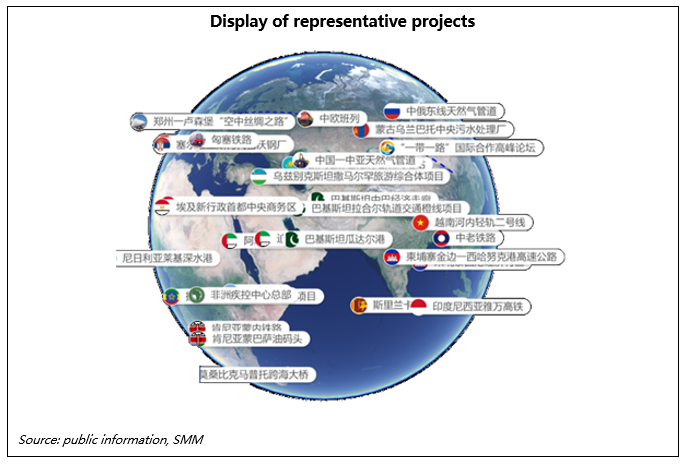
Representative projects
Stories about the Belt and Road Initiative and the Steel Industry
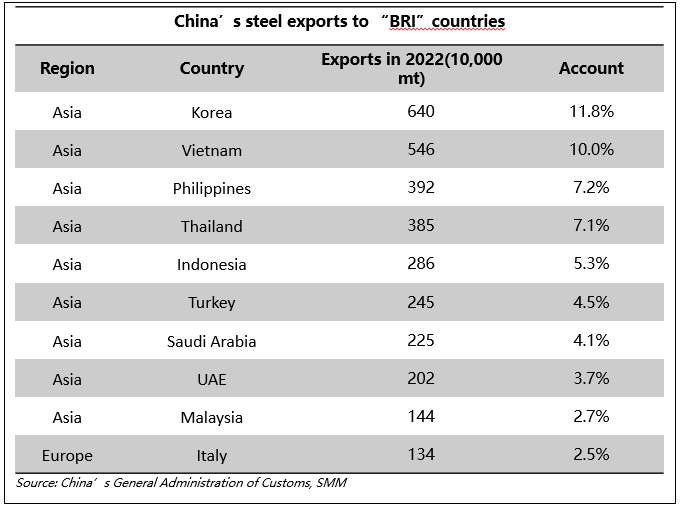
Belt and Road Initiative boosts direct trade demand for steel products
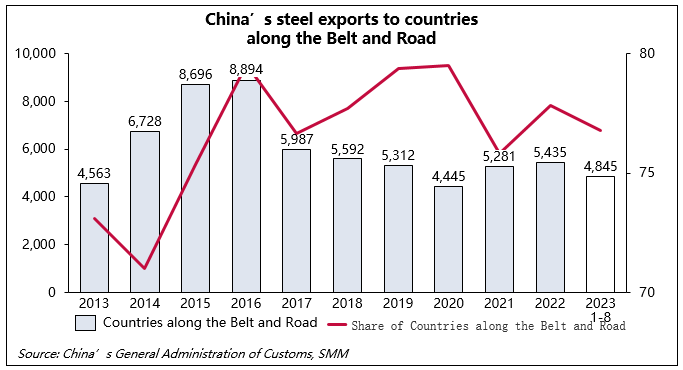
Countries along the Belt and Road have consistently been major destinations for China's steel exports, accounting for over 70% of China's total global exports. The main export countries are predominantly located in Asia. As a result, the Belt and Road Initiative has driven direct trade volume of steel products from China to reach approximately 50 million mt.
Belt and Road Initiative drives indirect demand for steel products
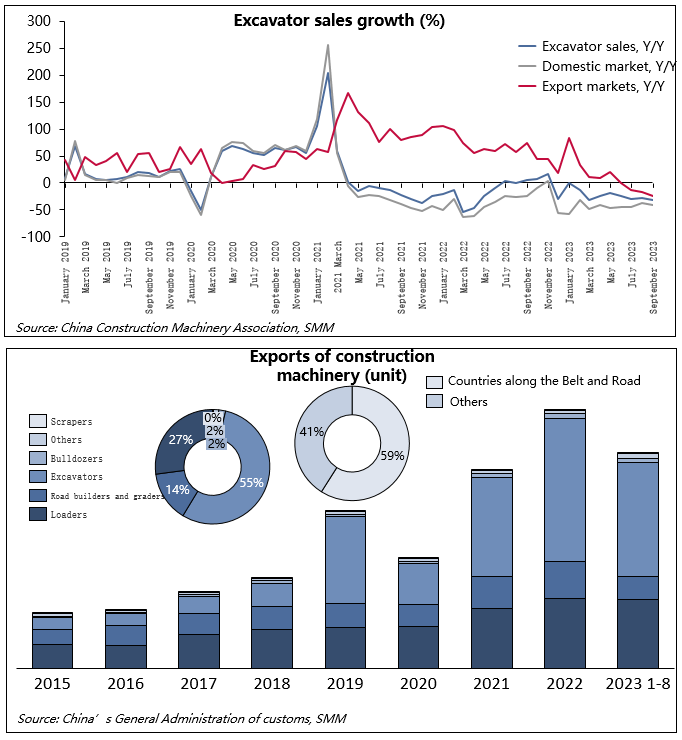
As China's investment in and contracted projects with countries along the Belt and Road mainly focus on infrastructure projects, with the energy and transportation sectors being the largest contributors, some countries account for over 80% of these investments. Therefore, the construction of these projects is closely aligned with the export of Chinese construction machinery.
Construction machinery is exported with Belt and Road projects. On the one hand, Chinese machinery companies follow these projects to provide equipment. On the other hand, with the increasing competitiveness of Chinese machinery equipment, companies bid for local projects or directly export, thus improving their market share. Since 2021, China's exports of engineering machinery have maintained a high growth rate, while domestic sales have been weak due to lower starts in the real estate industry, particularly in excavator sales. Although there has been a slight decline in excavator exports in the past two months, this is largely due to last year's high base. However, looking at the overall export of engineering machinery, although excavators have declined, other types of machinery equipment, especially cranes, have continued to show significant growth. Each machine of engineering machinery consumes about 20 mt of steel, and with the construction machinery demand brought by the Belt and Road Initiative, it is estimated that more than 6 million mt of steel will be consumed annually.
Steel investment projects along the Belt and Road
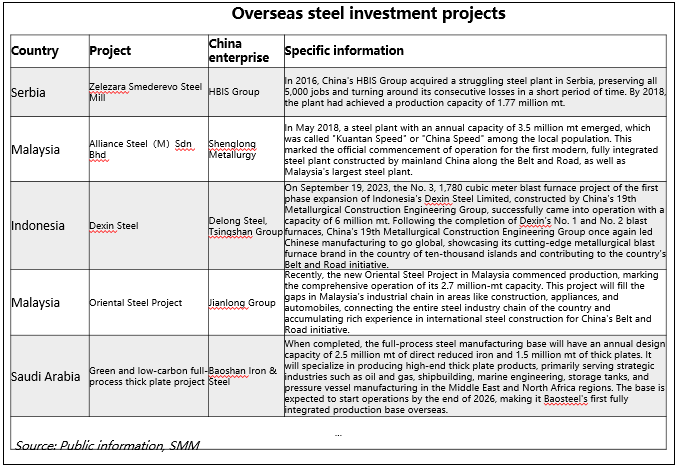
China's steel industry has shifted from a shortage to a relative surplus, and is entering a long-term process of capacity reduction. However, countries and regions along the Belt and Road have huge potential for per capita steel consumption, offering new possibilities for the development of China's steel industry. In recent years, China has invested in or contracted many steel projects in Belt and Road countries. According to incomplete statistics from SMM, there are more than 60 steel investment projects proposed by China in Belt and Road countries, and some of these projects have already successfully started production.
Can the Belt and Road Initiative resolve China's excess steel production capacity?
In the future, will the investment and contracted projects in countries along the Belt and Road be sustainable? Can the Belt and Road policy help resolve China's excess steel production capacity amidst the downward trend in the domestic real estate market? So far, China has signed over 200 cooperation documents for jointly building the Belt and Road with 152 countries and 32 international organizations. SMM has conducted research on hundreds of projects in Belt and Road countries as its focus, analyzing the direct and indirect demand for Chinese steel from these projects, as well as evaluating the investment projects of Belt and Road countries. If you are interested, please feel free to inquire!
![[SMM Steel] US Finalizes AD Review on Taiwan’s Corrosion-Resistant Steel Products](https://imgqn.smm.cn/usercenter/crVox20251217171717.jpg)
![[SMM Steel] Global Crude Steel Output Falls 1.9% YoY in April 2026](https://imgqn.smm.cn/usercenter/LMnqz20251217171717.jpg)
![[SMM Steel] Germany’s Steel Output Continues Recovering Despite Monthly Decline](https://imgqn.smm.cn/usercenter/UrrTG20251217171717.jpg)