Another Chinese steel mills made its way to overseas. For Chinese companies looking to invest overseas, what are critical factors to watch for?

Published: Oct 24, 2023 13:52 (GMT+8)
Source: SMM
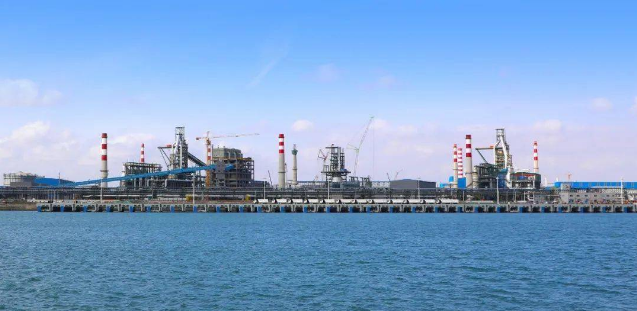
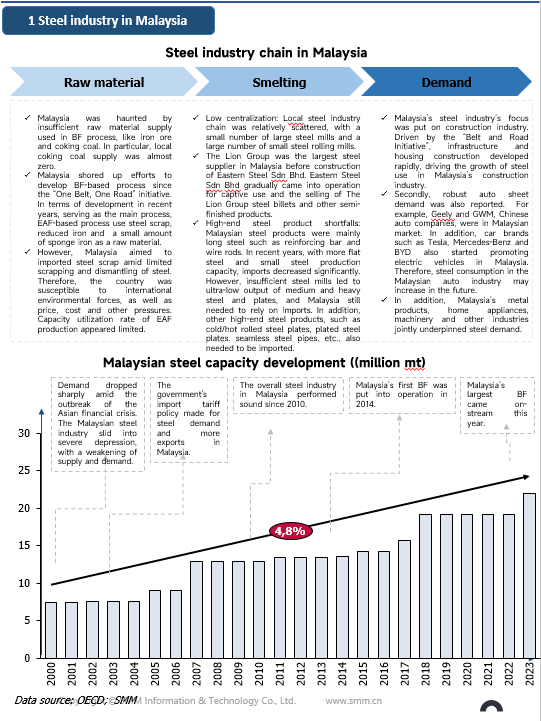
On October 9, Eastern Steel Sdn Bhd’s No. 2 blast furnace (1,380m³ capacity) , the largest BF in Malaysia, was officially put into operation, with an annual molten iron output of 1.7 million mt.

On October 9, Eastern Steel Sdn Bhd’s No. 2 blast furnace (1,380m³ capacity) , the largest BF in Malaysia, was officially put into operation, with an annual molten iron output of 1.7 million mt. At this point, the second phase project of the company was completely put into production, materializing Jianlong Group's plan to relocate capacity to Malaysia-based HRC market, thereby boosting steel demand throughout Southeast Asia. Meanwhile, it will also help transformation and upgrading of steel industry in the region where high-end steel products were insufficient.

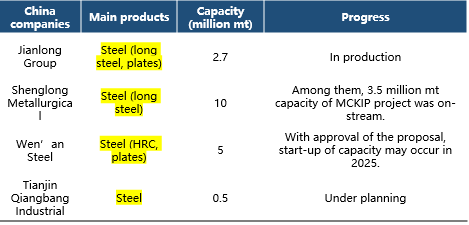
lIn addition, some capacity of Alliance Steel (M) Sdn. Bhd came on-stream in Malaysia. Moreover, Hebei Wen'an Steel's investment in the region is about to be launched.

Investment cases and progress of Chinese steel mills in Malaysia
There was growing list of overseas investments by Chinese steel mills in recent years. Driven by the “One Belt, One Road” initiative, Chinese companies preferred Malaysia, rather than other countries. And why was that?

First of all, multiple indicators showed that investment environment of Malaysia’s steel industry was highly attractive.

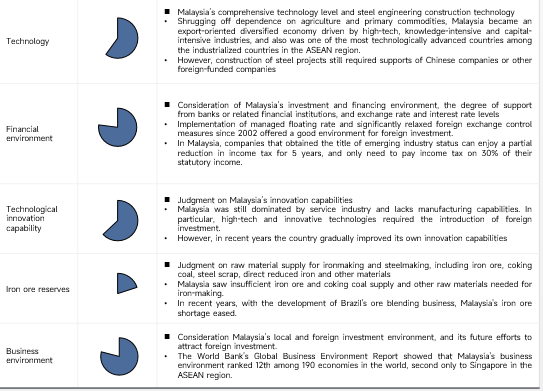
Overview of Malaysian Steel Industry Investment Environment Assessment
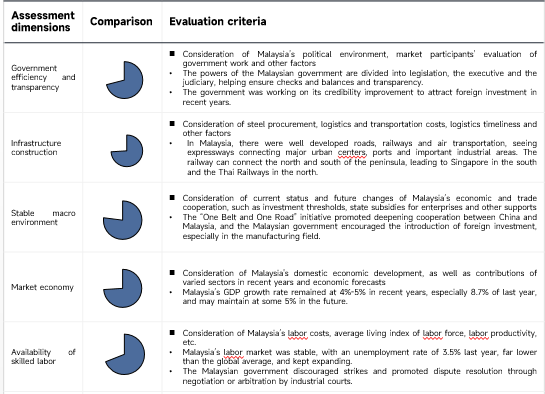
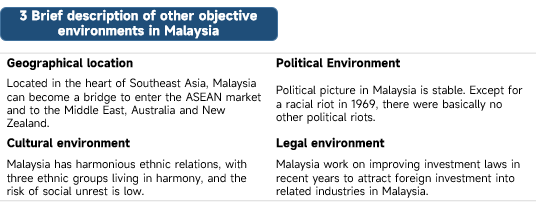
Overall, Malaysia boasts a stable political situation, complete financial market, outstanding geographical transportation advantages, and an international trade foundation, which provide opportunities to attract foreign investments.

However, It’s crucial for foreign investors to have knowledge of Malaysia’s supply and demand status of the steel industry chain.
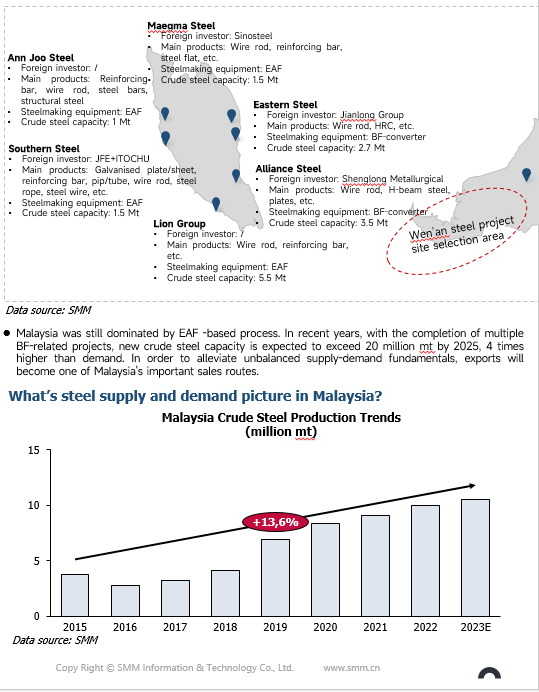
Major steel mills in Malaysia
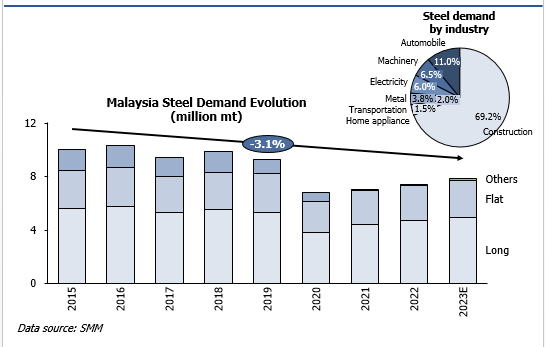
Malaysia's steel demand remained at around 7.4 million mt in 2022, and the downstream steel buyers were still heavy industries such as construction, auto, and machinery. Malaysia's annual consumption is expected to reach 15 million mt by 2025.

Malaysia mainly supplied long steel. Malaysia exported 5.3 million ton of long steel in 2022, lower than last year, but was still higher than ordinary steel capacity. In fact, steel market saw shrinking imports and a significant rise in exports since 2018 in Malaysia. Capacity gradually increased, while demand was far lower than output. Therefore, Malaysia became a "net exporter" of steel, which was a major reason for attracting foreign steel mills to invest. In the future, based on Malaysia, the steel sales market will not only expand its business in Malaysia, but will also in Southeast Asia and even the world.

In addition to export opportunities, is there still room for improvement in steel demand in Malaysia?

Malaysia’s population and per capita crude steel demand development
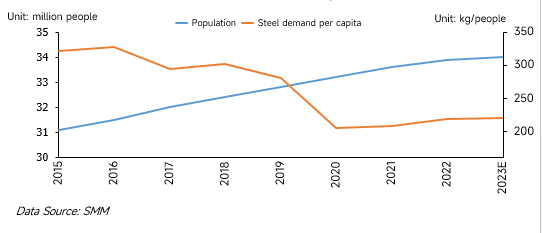
Comparison of per capita apparent consumption of finished steel in 2022 (kg/person)
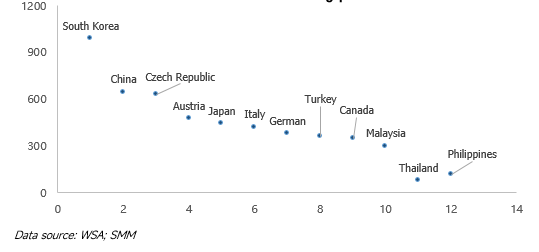
Compared with other countries in Southeast Asia such as the Philippines and Thailand, Malaysia's per capita steel consumption was above the average, but still lagged far behind developed countries and China. With downstream steel consumption and introduction of foreign investment in manufacturing industry, there will still be big room for steel demand to perk up.
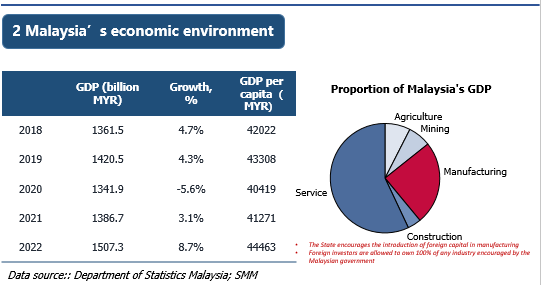
Malaysia's GDP grew by 8.7% YoY in 2022, reaching the highest economic growth rate since 2000. The hike was largely pinned on strong growth in local demand and exports, triggered by the smooth end of the pandemic last year.

Malaysia supported foreign investment, especially in manufacturing and high-tech industries. To balance regional development, the government encouraged investment in the emerging Iskandar Special Zone, the Northern Economic Corridor, the East Coast Economic Corridor, the Sabah Economic Corridor and the Sarawak Renewable Energy Corridor.

The Malaysian government's "Industry4WRD" proposed the goal of building Malaysia into a strategic partner for smart manufacturing, a high-tech industry investment destination, and a provider of high-tech solutions in the Asia-Pacific region by 2025.

The government made active efforts to reduce debt to safeguard national sovereignty and attract more foreign investment, thereby achieving stable GDP growth.

According to rational predictions of different institutions such as the Malaysian government, IMF and Bank Negara Malaysia, Malaysia’s GDP growth rate this year will still be able to stand at 4%-5%.
Tapping knowledge of global steel industry chain and regional markets, SMM can provide customers in the ferrous metal industry chain with a series of customized consulting services such as market research, cost research, due diligence, market entry strategy, and business transformation.

SMM ferrous metal-related consulting overseas research case display

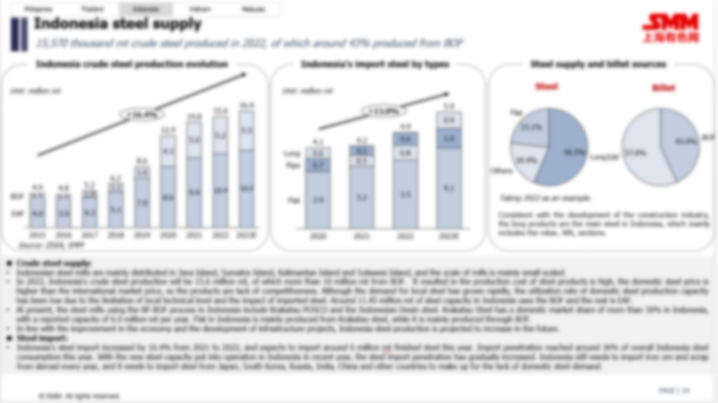
Research on Indonesian steel market and import opportunities
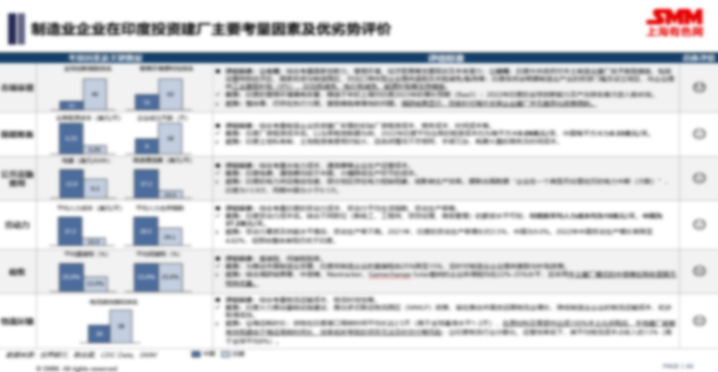
Main considerations and evaluations for manufacturing companies investing in and building factories in India
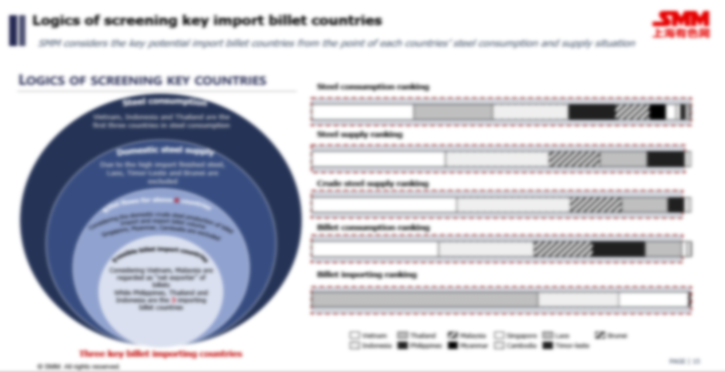
Research on market screening of steel billets launched by a global trading company in Southeast Asia
For more details, please contact:

Sun Jing

Project Manager

SMM Information & Technology Co., Ltd.

Mobile/WhatsApp: +86 15000619785

E-mail: sunjing@smm.cn | Web: www.smm.cn

9th FL in South Section, Building 9, Lujiazui Software Park, No. 20, Lane 91, E'Shan Road, Pudong New Area, Shanghai, 200127, China.


Data Source Statement: Except for publicly available information, all other data are processed by SMM based on publicly available information, market communication, and relying on SMM's internal database model. They are for reference only and do not constitute decision-making recommendations.

For any inquiries or for more information, please contact: lemonzhao@smm.cn
For more information on how to access our research reports, please contact:service.en@smm.cn
Related News
[SMM Steel] European HRC: Northern Prices Stabilize with Slight Gains as Quota Exhaustion Deepens Q1 Clearance Concerns
22 mins ago
[SMM Steel] European HRC: Northern Prices Stabilize with Slight Gains as Quota Exhaustion Deepens Q1 Clearance Concerns
Read More
[SMM Steel] European HRC: Northern Prices Stabilize with Slight Gains as Quota Exhaustion Deepens Q1 Clearance Concerns
[SMM Steel] European HRC: Northern Prices Stabilize with Slight Gains as Quota Exhaustion Deepens Q1 Clearance Concerns
[Europe] European mills are attempting to push offer prices higher for December production schedules. Although underlying demand remains subdued, concerns over tightening import availability and domestic operational disruptions are gradually taking center stage. In terms of pricing, Northwest European HRC ex-works prices ticked up slightly to 729 EUR/tonne EXW (~819 USD/tonne), while the Italian domestic price softened to 735 EUR/tonne EXW (~826 USD/tonne). A service center in Northern Europe noted that low-priced cargoes secured earlier are no longer attainable, with fresh mill offers climbing to 740–760 EUR/tonne DDP (~831–854 USD/tonne). In Southern Europe, mainstream mills broadly anchored delivered offers at 740 EUR/tonne DDP, though producers frankly admitted that their outlook for subsequent market trends remains unoptimistic. On the import and quota front, as provisional anti-dumping duties on Turkish HRC are still being calculated and anticipated to be steep, European buyers are broadly withdrawing customs clearance filings for Turkish material to avert duty risks. Quota tracking data revealed that Turkey exhausted its dedicated country-specific quota today, consequently forfeiting access to the residual Free Trade Agreement (FTA) quota reserve; India has cleared 103,000 tonnes, leaving approximately 46,000 tonnes remaining. With substantial volumes of arriving shipments deferred, the market widely anticipates this rollover will severely congest and exhaust import quota capacity in the first quarter of next year.
22 mins ago
[SMM Steel] Turkish Steel Pressured: Soft Demand Weighs on Longs as Black Sea Risks Rattle Semis Supply
23 mins ago
[SMM Steel] Turkish Steel Pressured: Soft Demand Weighs on Longs as Black Sea Risks Rattle Semis Supply
Read More
[SMM Steel] Turkish Steel Pressured: Soft Demand Weighs on Longs as Black Sea Risks Rattle Semis Supply
[SMM Steel] Turkish Steel Pressured: Soft Demand Weighs on Longs as Black Sea Risks Rattle Semis Supply
[Turkey] Turkish domestic rebar prices remained locked in a downward channel, with benchmark ex-works levels temporarily holding at 615 USD/tonne EXW (excluding VAT). Regionally, Iskenderun traders lowered offers to 610 USD/tonne EXW, while Marmara mills followed suit by cutting prices by 5–10 USD/tonne to 630–640 USD/tonne EXW. However, buyer counter-bids remain exceptionally low, with traders noting that cash-purchase floors have retreated to 600 USD/tonne. On the macro front, the financial reverberations following the liquidation of over 100 investment funds in September continue to spread, further tightening market liquidity and dampening business confidence. In the semis sector, domestic Turkish billet held at 570 USD/tonne EXW amid an enduring stalemate of weak supply and sluggish demand. On imports, due to the Chinese holiday closure and shipping hurdles in the Black Sea, Turkish imported billet consolidated at 520 USD/tonne CFR. Russian suppliers noted that Baltic port transshipment remains constrained due to rail capacity prioritizing grain exports, though several bulk carriers laden with steel products have recently arrived at Turkish ports. Crucially, maritime security across the Black Sea has deteriorated sharply; following the October 5th vessel sinking, two dry bulk carriers were attacked within Bulgaria's exclusive economic zone on October 6th. This spike in geopolitical tension is expected to inflate regional freight risk premiums, threatening severe disruptions to Turkey's maritime steel trade routes.
23 mins ago
【Flash | Adanac Technical Report Outlines Long-Life Primary Molybdenum Supply】
4 hours ago
【Flash | Adanac Technical Report Outlines Long-Life Primary Molybdenum Supply】
Read More
【Flash | Adanac Technical Report Outlines Long-Life Primary Molybdenum Supply】
EraNova Metals filed an NI 43-101 PEA technical report for its 100%-owned Adanac molybdenum project in Canada. The report confirms the August 6 results without material differences. The proposed 30,000-tpd operation has a 24-year mine life and targets average annual molybdenum output of 11.4 million lb (about 5,171 tonnes), with 270.1 million lb (about 122,515 tonnes) of payable molybdenum over the mine life. Initial capital is estimated at C$953.3 million. EraNova plans to initiate a feasibility study and advance environmental assessment and permitting. The PEA remains preliminary, with no final investment decision or production schedule.
4 hours ago