SHANGHAI, Oct 11 (SMM) – The ongoing 2023 SMM LME LONDON EVENT, being held at ST. Pancras Renaissance Hotel London, Euston Rd., London NW1 2AR, has brought together major industry players and commodity experts to share their valuable insights and unique perspectives on new energy and base metals outlook.
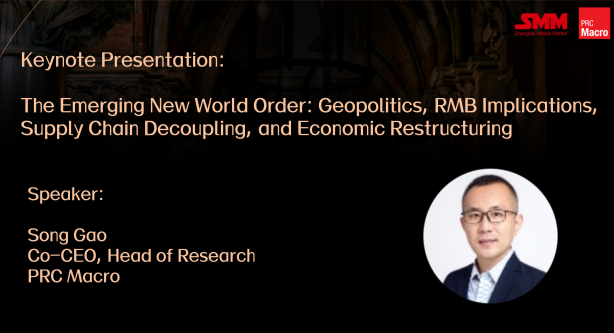
At the "SMMLMELONDONEVENT" held during LMEWEEK, Song Gao, co-CEO and research director of PRC Macro, expressed his views on "The New Order of Emerging Markets: Geopolitics, RMB Impact, Supply Chain Decoupling and Economic Restructuring."
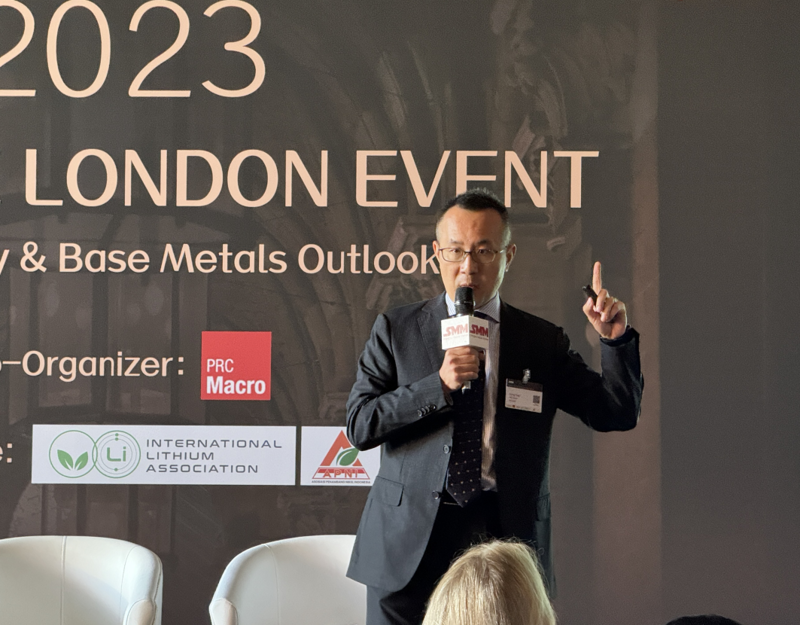
He said that China’s overseas investment is the key to the commodity super cycle, and China’s overseas investment has just begun! Catching up with larger economies is good for metals demand.
The proportion of China's cumulative overseas direct investment (ODI) in nominal GDP is less than half of the average level of major economies. We predict that China's ODI will reach $18 trillion by 2045, increasing from approximately $180 billion currently to $1.3 trillion in 2045.
Ease the pain of deleveraging and manufacturing replenishment
Reducing the pain of deleveraging means:
1) Conventional debt conversion, interest rate cuts and debt relief; 2) Unconventional asset purchases, bank recapitalization and fiscal capital injection.
We expect manufacturing replenishment driven by housing completions, energy transition and ODI to begin in the fourth quarter.
Historically, cyclical shifts in manufacturing restocking have been consistent with rebounds in A-share prices, the yuan, and commodity and energy prices.
Energy and manufacturing upgrade
Energy transition: Energy is the new asset
The composition of China's exports reflects a shift toward high value-added, energy-intensive products.
The energy transition supports strong growth in infrastructure such as power grids and power generation.
Policy support for shantytown renovations and real estate completions supported demand for durable goods. It expects copper to have room for a 10%-15% increase.
Geopolitical de-risking and "going south"
China's official direct investment, financed by state-owned banks, rebounded sharply, partially offsetting the impact of lower exports and lower foreign direct investment risks due to the global manufacturing downturn and shrinking external demand.
China's ODI is mainly concentrated in ASEAN and BRICS countries, rather than developed markets.
Benefits of global urbanization and industrialization
Domestic and foreign factors driving China's ODI support metal demand through industrialization and urbanization in recipient countries. For example, China ODI funds the growth of steel demand in China.
Demand from the domestic energy transition and ODI offset weaker-than-expected performance of domestic real estate.
We expect China to increase its ODI efforts, focusing on manufacturing, infrastructure and mining. China's ODI will accelerate urbanization and industrialization in the global south.
The new role of RMB and the new world order
Lower RMB interest rates and de-dollarization of policies have provided support for China's ODI. Japan's experience shows that if a currency can fund carry trades, sustained ODI flows will follow. In the past, China's ODI was based on the US dollar and was greatly affected by external factors.
Currently, the RMB plays a new role in the "dual circulation".
The New World Order: The Energy-Defence-Infrastructure Axis
Southern rail and infrastructure connections
The Trans-Asian Railway network connects ASEAN.
Recipient of RMB-financed infrastructure and excess manufacturing capacity.
Capacity migration provides a new way for China to enter the DM market.
Local urbanization and industrialization drive demand for resources and increase purchasing power.
China’s manufacturing capabilities reduce the costs of the local energy transition.
Multilateral and bilateral treaties, trade areas.
Northern Energy Transport Network
Financing infrastructure and affordable, stable Russian energy supplies in RMB.
RMB finances high-value asset manufacturing projects.
High-quality and low-cost energy has subsidized China's manufacturing upgrade and energy transformation, increasing the added value and competitiveness of exports.
Higher value-added manufacturing promotes productivity growth.
This is protected by multilateral trade and investment treaties.
China drives another commodities supercycle
China ODI, RMB and Commodities Super Cycle
China will drive metals demand through urbanization and industrialization in recipient countries (ASEAN and the Belt and Road Initiative). This means that by 2040, demand for steel will reach 200 million mt, copper demand will reach 12 million mt, and aluminum demand will reach 38 million mt. Demand in the next 17 years will increase by 11%, 46%, and 55% respectively.