

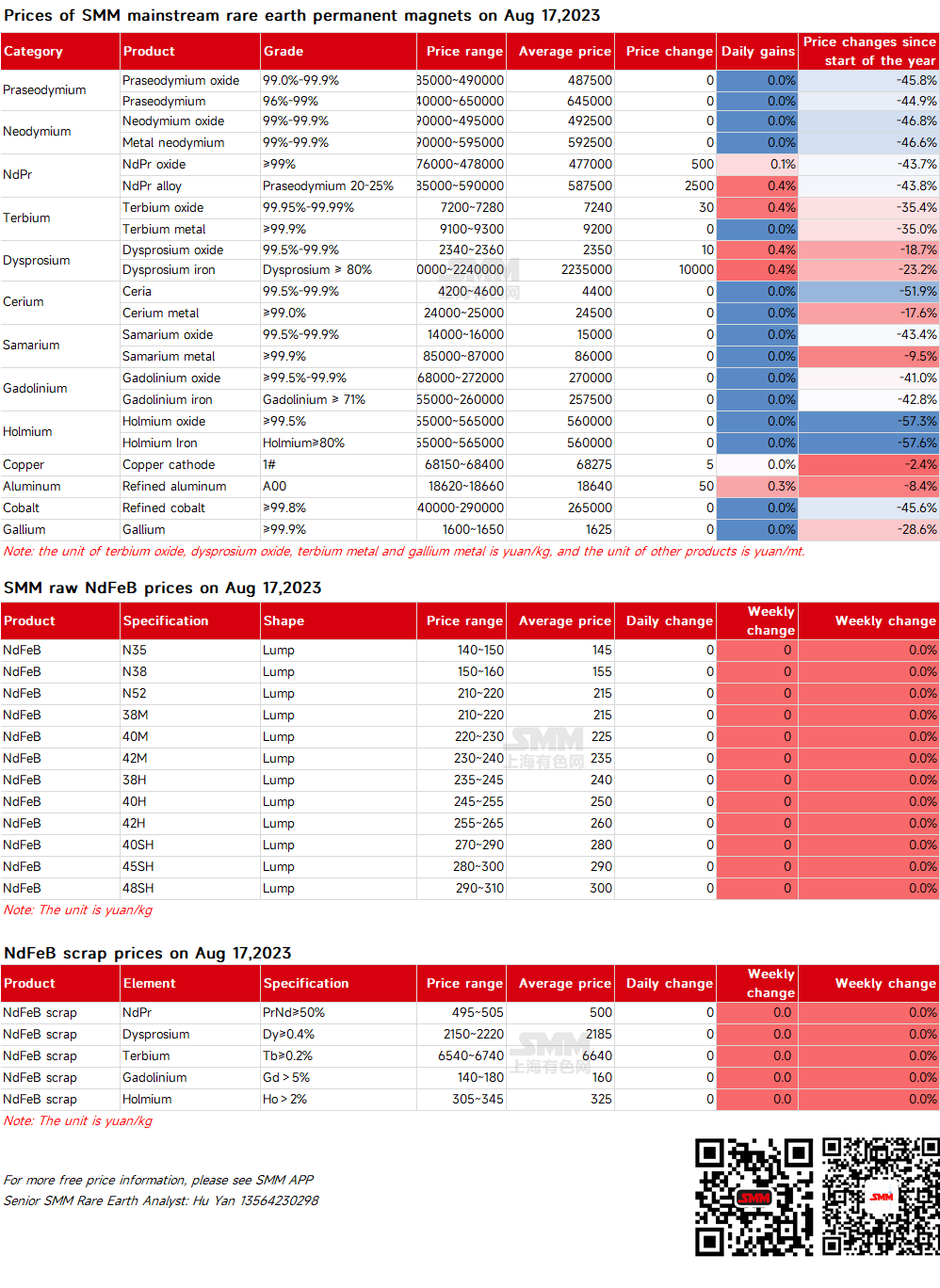
Prices of SMM mainstream rare earth permanent magnets
Prices of SMM mainstream rare earth permanent magnets
Data Source Statement: Except for publicly available information, all other data are processed by SMM based on publicly available information, market communication, and relying on SMM's internal database model. They are for reference only and do not constitute decision-making recommendations.
For any inquiries or for more information, please contact: lemonzhao@smm.cn
For more information on how to access our research reports, please contact:service.en@smm.cn
Related News

Oct 30, 2026 20:14 (GMT+8)
September–October Momentum Fell Short; Q4 Recovery Still on Track【SMM Analysis】
Read More
September–October Momentum Fell Short; Q4 Recovery Still on Track【SMM Analysis】
Oct 30, 2026 20:14 (GMT+8)

Oct 30, 2026 19:39 (GMT+8)
Pr-Nd in Retreat: NdFeB's Consumer-Market Crossroads in 2027【SMM Analysis】
Read More
Pr-Nd in Retreat: NdFeB's Consumer-Market Crossroads in 2027【SMM Analysis】
Pr-Nd softens as 2027 NdFeB demand stays positive but underwhelming: air-conditioner magnet use rises 3.9% on efficiency gains, while washing machines (-3.13%), computing devices (-12.76%) and power tools (-10.89%) fall on thinner per-unit content. Consumer markets offer support, not a price rally.
Oct 30, 2026 19:39 (GMT+8)
Oct 30, 2026 19:29 (GMT+8)
Pr-Nd Price Decline Underway: Where Is NdFeB Demand Headed in 2027? — A 2026 Consumption Review and 2027 Outlook Based on Q4 2026 Forecasts [SMM Analysis]
Read More
Pr-Nd Price Decline Underway: Where Is NdFeB Demand Headed in 2027? — A 2026 Consumption Review and 2027 Outlook Based on Q4 2026 Forecasts [SMM Analysis]
In the previous article, we focused on new energy vehicles, internal combustion engine vehicles, and wind power as the main threads, mapping out the demand framework for the transportation and new energy sectors, and arrived at a judgment that runs throughout the entire piece: NdFeB demand in 2027 will not contract, but demand growth will systematically lag downstream output growth. New energy vehicles represent a case of "more vehicles, less magnet per unit," wind power is a "big installation year with diluted routes," and internal combustion engine vehicles are the exception where "production declines while magnet usage rises."
This article shifts focus to the consumer side. Compared with the transportation sector, the consumer side carries an additional constraint: it must bear the weakness of durable goods demand itself while also facing the countervailing force of energy efficiency upgrades that push certain products back toward magnetic material routes. The former suppresses volume, while the latter boosts magnet usage; whether the net result is up or down depends on which side weighs more heavily. We will examine air conditioners, washing machines, consumer electronics, as well as elevators and power tools, which are closely tied to the real estate sector, in turn.
Oct 30, 2026 19:29 (GMT+8)
Related News
September–October Momentum Fell Short; Q4 Recovery Still on Track【SMM Analysis】
Oct 30, 2026 20:14 (GMT+8)
Pr-Nd in Retreat: NdFeB's Consumer-Market Crossroads in 2027【SMM Analysis】
Oct 30, 2026 19:39 (GMT+8)
Pr-Nd Price Decline Underway: Where Is NdFeB Demand Headed in 2027? — A 2026 Consumption Review and 2027 Outlook Based on Q4 2026 Forecasts [SMM Analysis]
Oct 30, 2026 19:29 (GMT+8)
Rare Earth Oxide Production Rises in Oct 2026, Driven by Recycling Sector Growth
Oct 30, 2026 18:03 (GMT+8)