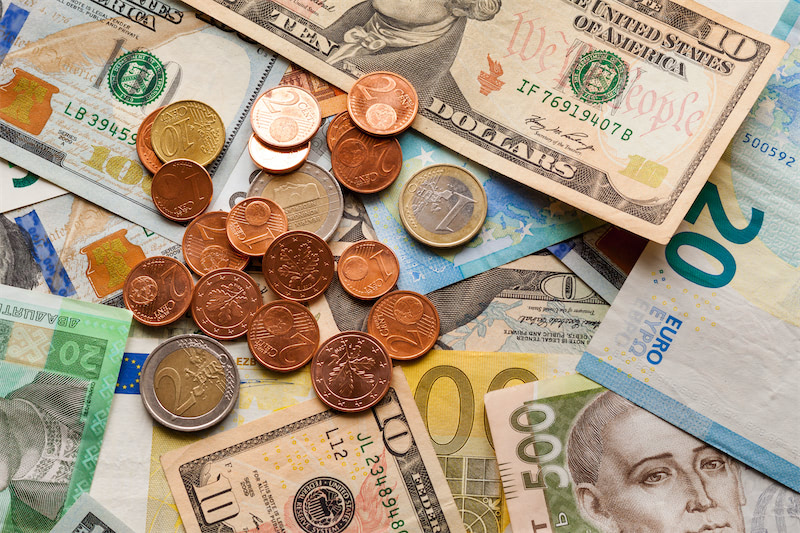
“Cash Is King” in US and Europe in Digital Age. Does Rebound in paper note Point to Recession?

Đã xuất bản: May 4, 2023 09:59
Over the past few years, the world has been searching for ways to deepen digital transactions in the hope that they can be conducted more quickly and cheaply.

Over the past few years, the world has been searching for ways to deepen digital transactions in the hope that they can be conducted more quickly and cheaply. According to statistics, nearly 90% of the world's central banks are developing central bank digital currency, and 60% have entered the proof-of-concept stage.

However, in a survey conducted in March, 53 per cent of US and 46 per cent of UK respondents said they used cash more often now than they did a year ago. Overall, 60% of respondents in both countries said using physical currency would reduce their spending.

That, in turn, has much to do with inflation in both countries, particularly in Britain, which is still running at around 10%, further amplifying the pain. The Bank of England's chief economist also put his cards on the table this week by saying that Britons need to accept being poorer.

Courtney Alev, associate director of product management at Credit Karma, which conducted the poll, said that while the world is returning to normal after the pandemic, prices have risen dramatically, and holding cash is one way to manage money to make wealth last longer.

Some respondents also said digital channels, from Apple Pay to contactless credit cards, could easily lead them to blow their budgets. Two-thirds of people in the poll said digital payments made them spend more than they had budgeted.

The smell of cash

Natalie Ceeney, chair of Cash Access UK, a non-profit organisation, said many of the theories about digital payments were designed to remove frictions from the market, but in reality many now wanted to bring them back.

She added that studies have shown that when digital payments are used in some instances, sales increase significantly. One reason is that people don't see it as a significant expense when they pay.

On the other hand, Kenneth Rogoff, an economist at Harvard University, points out that the rebound in cash use also hints at increased demand in the "underground economy". For example, he said, paying some fees in cash to avoid paying taxes.

He added that the underground economy should have grown during the pandemic and that the increased use of cash would reflect this. Rogoff also estimates that the underground economy accounts for about 10 percent of GDP in the United States and much higher in Europe.

The Bank of England revealed in October that the use of cash in the UK had continued to rise since the pandemic, with notes in circulation at record levels. Nationwide Building Society, a British bank, responded in January that British depositors had made more than 32 million withdrawals last year, a 19 percent increase on 2021.

This is clearly not very friendly to some fintech companies, especially in the payments sector. Some payment companies have introduced new features that help customers set limits to stay in the digital world. But how long cash recovers will probably depend on when inflation in the economy falls back to its target range.

Lisa Spantig, assistant professor of experimental economics at the University of Aachen in Germany, points out that while frictionless payments are generally good for society, consumers need some help, such as regulation. And digital payment providers typically benefit from higher spending, which, in times of high inflation, affects ordinary consumers.

And historically, cash is king is a constant lesson. During the Lehman crisis in 2008, eurozone paper currency use rose to an all-time high within three months. Cash use typically rises during major financial shocks or global catastrophes similar to COVID-19.

It may also be worth pondering whether the US and UK polls point to something more serious, such as a recession.

Tuyên bố về Nguồn Dữ liệu: Ngoại trừ thông tin công khai, tất cả dữ liệu khác được SMM xử lý dựa trên thông tin công khai, giao tiếp thị trường và dựa trên mô hình cơ sở dữ liệu nội bộ của SMM. Chúng chỉ mang tính chất tham khảo và không cấu thành khuyến nghị ra quyết định.

Để biết thêm thông tin hoặc có thắc mắc gì, vui lòng liên hệ: lemonzhao@smm.cn
Để biết thêm thông tin về cách truy cập báo cáo nghiên cứu, vui lòng liên hệ:service.en@smm.cn
Tin Liên Quan
SMM: Số ngày tồn kho đồng anode tại các nhà máy luyện kim Trung Quốc giảm trong tháng 8 năm 2026
8 phút trước
SMM: Số ngày tồn kho đồng anode tại các nhà máy luyện kim Trung Quốc giảm trong tháng 8 năm 2026
Đọc thêm
SMM: Số ngày tồn kho đồng anode tại các nhà máy luyện kim Trung Quốc giảm trong tháng 8 năm 2026
[SMM Tin nhanh Đồng anode] Do nguồn cung đồng anode tái chế tại Trung Quốc liên tục thắt chặt, số ngày tồn kho đồng anode của các nhà máy luyện kim Trung Quốc theo SMM đạt 6,13 ngày vào tháng 8 năm 2026, giảm 0,16 ngày so với tháng trước, đánh dấu tám tháng giảm liên tiếp kể từ tháng 1 năm 2026.
8 phút trước
Nga khởi động sản xuất cathode tại Udokan, đặt mục tiêu tổng sản lượng đồng 150.000 tấn/năm
19 phút trước
Nga khởi động sản xuất cathode tại Udokan, đặt mục tiêu tổng sản lượng đồng 150.000 tấn/năm
Đọc thêm
Nga khởi động sản xuất cathode tại Udokan, đặt mục tiêu tổng sản lượng đồng 150.000 tấn/năm
Theo truyền thông nước ngoài đưa tin, Công ty Đồng Udokan của Nga đã bắt đầu sản xuất cathode đồng tại nhà máy thủy luyện ở vùng Zabaykalsky, Viễn Đông Nga vào ngày 2 tháng 9 năm 2026. Các cathode có độ tinh khiết đồng đạt 99,99%. Dự án bắt đầu sản xuất tinh quặng đồng vào tháng 9 năm 2023, và việc đưa vào vận hành sản xuất cathode đã hoàn thiện chuỗi giá trị tích hợp từ khai thác quặng đến đồng tinh luyện. Sản xuất cathode ban đầu dự kiến bắt đầu vào quý 2 năm 2024. Tuy nhiên, một vụ hỏa hoạn vào tháng 12 năm 2023 đã làm hư hại một phần cơ sở sản xuất cathode, trong khi các lệnh trừng phạt của phương Tây khiến việc thay thế thiết bị bị ảnh hưởng trở nên phức tạp. Giai đoạn đầu của dự án được thiết kế để sản xuất tới 150.000 tấn đồng chứa mỗi năm dưới dạng tinh quặng đồng và cathode, chủ yếu phục vụ thị trường nội địa Nga và các thị trường châu Á khác. Con số 150.000 tấn thể hiện tổng sản lượng đồng chứa kết hợp và không nên được hiểu là công suất cathode độc lập. Sản lượng cathode mới của Udokan sẽ làm tăng nguồn cung đồng tinh luyện từ Viễn Đông Nga, mặc dù khối lượng trong ngắn hạn sẽ phụ thuộc vào tốc độ tăng công suất, hậu cần và các hạn chế liên quan đến lệnh trừng phạt. Công ty trước đây đã lên kế hoạch nâng tổng sản lượng đồng lên khoảng 550.000 tấn mỗi năm sau khi giai đoạn hai đi vào hoạt động, nhưng tiến độ dự án vẫn cần được theo dõi.
19 phút trước
Tỷ lệ vận hành của các nhà sản xuất anode đồng thứ cấp Trung Quốc phục hồi
23 phút trước
Tỷ lệ vận hành của các nhà sản xuất anode đồng thứ cấp Trung Quốc phục hồi
Đọc thêm
Tỷ lệ vận hành của các nhà sản xuất anode đồng thứ cấp Trung Quốc phục hồi
[SMM Thị trường đồng anode] Trong tuần, một số nhà sản xuất đồng anode bị ảnh hưởng bởi cơn bão trước đó đã khôi phục sản xuất. Từ ngày 28 tháng 8 đến ngày 3 tháng 9, tỷ lệ vận hành hàng tuần của các nhà sản xuất tấm đồng anode thứ cấp tại Trung Quốc theo SMM đã tăng 5,75 điểm phần trăm so với tuần trước lên 50,40%. Dự kiến tuần tới sẽ tăng 3,69 điểm phần trăm so với tuần trước lên 54,09%.
23 phút trước