SHANGHAI, Feb 17 (SMM) - Target requirements:
In July 2022, the Ministry of Industry and Information Technology, the National Development and Reform Commission, and the Ministry of Ecology and Environment issued the Industrial Carbon Peaking Implementation Plan, which mentioned that in 2025, the annual processing capacity of steel scrap will exceed 180 million mt, with EAF steelmaking accounting for more than 15%. By 2030, breakthroughs will be made in technologies such as hydrogen-rich carbon cycle blast furnace smelting, hydrogen-based shaft furnace for direct reduced iron, carbon capture, utilisation and storage. And EAF steel mills will produce more than 20% of steel products. The early "cornerstone plan" proposed that by 2025, the consumption of steel scrap would be 300 million mt.
Plans of various provinces
Recently, various provinces have successively issued documents to strongly support the development of the EAF steelmaking and promote the all-scrap EAF process. Henan recently issued the Notice on Management Catalogue of "high energy consumption and high pollution” (“two highs”) Projects (Revised in 2023), taking the lead in removing EAF steelmaking from the "two highs" catalogue. This means that the financing and construction of EAF steelmaking projects are no longer restricted like other steel projects.
So far, 14 provinces have announced their future targets for EAF steelmaking, and a small number of provinces have announced their scrap ratio plans.
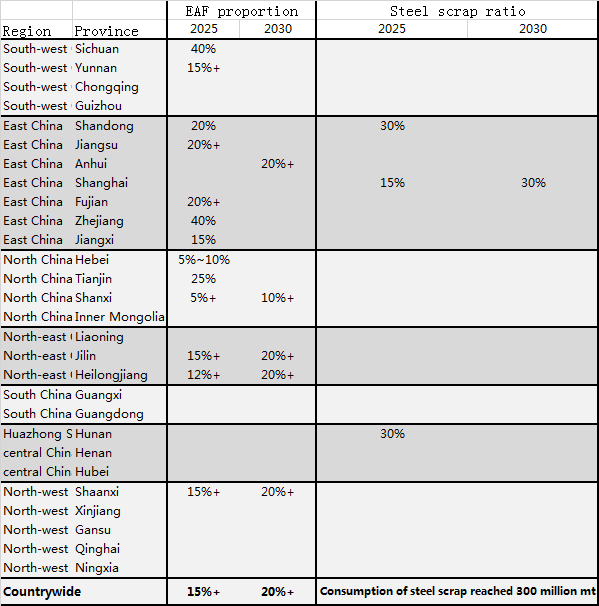
The data above is compiled and obtained by SMM according to the carbon peak implementation plan announced by each province, the implementation opinions on the high-quality development of the iron and steel industry, and the implementation plan for synergistic efficiency of pollution reduction and carbon reduction. Data in some provinces have not been announced yet, and SMM will continue to follow up.
SMM new EAF capacity: nearly 100 million mt
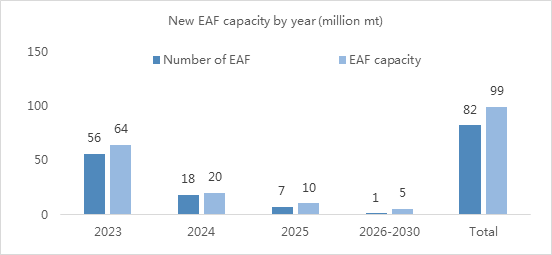
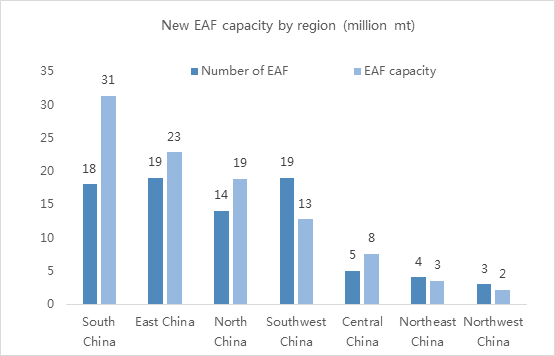
The data above is sorted and obtained by SMM according to the capacity replacement information of each steel mill.
Conclusion:
- New electric arc furnaces will be put into production intensively in 2023. It is expected that many projects affected by pandemic and losses in 2022 will also be put into production in 2023. According to SMM survey and steel mills disclosure, the new production capacity may be relatively few after 2025. But many steel mills have not yet had detailed plans after 2025.
- 55% of the new capacity is concentrated in south and east China, mainly due to lower electricity prices and ample steel scrap supply. The proportion of EAF steel in east and south-west China also exceeded the national average. Although Guangdong and Guangxi have not announced the specific ratio of EAF and steel scrap, they mentioned that the recycled volume of 9 major renewable resources including iron and steel scrap, copper scrap, aluminium scrap, lead scrap, zinc scrap, paper scrap, plastics scrap, rubber scrap, and glass scrap will reach 55 million mt in Guangdong and 14 million mt in Guangxi by 2025 and 60 million mt in Guangdong and 20 million mt in Guangxi by 2030 mt.
- The proportion of large-sized EAF steel mills will increase during the "15th Five-Year Plan" period. The high proportion of large-sized BF steel mills is unlikely to change in the short term, but the proportion of EAF steel mills may increase in 2026-2030. For example, Baosteel, according to its plan, will promote its conversion of converter capacity to electric arc furnaces during the "15th Five-Year Plan" period, and increase the steel scrap ratio to 30% by 2030.
- EAF capacity is developing in large scale with average new capacity of 1.2 million mt. The total capacity of 82 equipment is close to 100 million mt, with about 1.2 million mt capacity for a single equipment.
![Before the holiday, the black chain is unlikely to see a trend-driven market [SMM Steel Industry Chain Weekly Report].](https://imgqn.smm.cn/usercenter/zUFfM20251217171748.jpg)
![[SMM Chromium Daily Review] Inquiries and Transactions Weakened, Chromium Market Showed Mediocre Performance Before the Holiday](https://imgqn.smm.cn/usercenter/ENDOs20251217171718.jpg)