[SMM Annual Report] Global Nickel Likely to be Oversupplied in 2023-2026E

Published: Jan 10, 2023 17:33 (GMT+8)
In 2023, in addition to the impact of the aforementioned delays in the commissioning of some capacity, the demand from the new energy industry will stimulate the production and ramp-up of the upstream producers.

SHANGHAI, Jan 10 (SMM) - 2022 is another year that has witnesses the nickel price turmoil. In March 2022, nickel prices soared to a record high. In the second quarter, the prices were on a downward trend and returned to the fundamentals due to COVID-19 outbreak and the macro factors. In the middle and late third quarter, steel mills were expected to resume their production owing to the sharp drop in stainless steel supply earlier, pushing up the short-term stainless steel output and the nickel demand. In addition, the new energy industry mushroomed in the third quarter. The operating rates of battery companies grew amid the improvement of orders, the low inventory of precursor companies, the rapid expansion of the leading battery producers, etc. Nickel demand gained strong support from the new energy industry. As a result, the prices rallied from lows.

In terms of the fundamentals in 2022, the US Fed continued to raise the interest rates to temper inflation. The global economy showed signs of recession from time to time, and overseas consumption, especially in European countries, slumped, while nickel consumption performed relatively well. The two major downstream markets, the stainless steel and new energy industries both maintained positive growth, and the nickel demand in the latter burgeoned by more than 30% year-on-year. Nickel demand from the military alloy sector grew apace, while that from the electroplating sector performed poorly during the year.

In 2023, the market may witness a significant supply surplus of primary nickel, especially the NPI.  Besides, the refined nickel supply will also be in surplus. Nonetheless, the same scenario is unlikely happen to nickel sulphate in 2023 because of its capacity mismatch. The Indonesian government’s potential export tax hike on nickel products may, on the other hand, affect the rhythm of NPI production and cause oversupply. The global economy will not be optimistic in 2023. Under the influence of factors on the fundamentals and macro front, nickel prices will fluctuate wildly with a high probability and will trend lower amid the expected supply surplus.
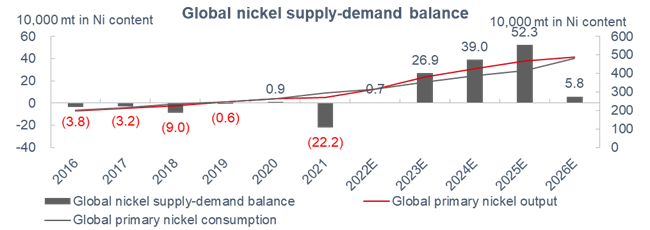
In 2022, the global primary nickel consumption is expected to be 3.14 million mt in Ni content, up 6.9% YoY. The supply will add 15.9% YoY to 3.148 million mt in Ni content. The global primary nickel surplus will reach 8,000 mt in Ni content. The market should see no supply surplus if the downstream restocking demand had been taken into account. In 2022, nickel supply has been relatively tight, which is mainly caused by the lower-than-expected growth of supply.  The commissioning of Indonesia NPI slowed down, and some production lines were switched to produce high-grade nickel matte, reducing the expectations of NPI oversupply to some extent. Meanwhile, the nickel salt output, restricted by the mismatch between converted battery-grade nickel sulphate capacity and the raw material types, failed to surge, thus the market supply was in deficit for most of the year.

In 2023, the surplus is expected to expand further. In addition to the impact of the aforementioned delays in the commissioning of some capacity, the demand from the new energy industry will stimulate the production and ramp-up of the upstream producers. In 2023, the total supply will reach 3.808 million mt in Ni content while the demand will be 3.54 million mt in Ni content, resulting in a supply surplus of 269,000 mt in Ni content, which is mainly contributed by NPI supply since there will be multiple new NPI production lines put into production. SMM predicts that SMM #1 refined nickel prices will move between 143,000-178,000 yuan/mt, with an average of 160,500 yuan/mt.
Data Source Statement: Except for publicly available information, all other data are processed by SMM based on publicly available information, market communication, and relying on SMM's internal database model. They are for reference only and do not constitute decision-making recommendations.

For any inquiries or for more information, please contact: lemonzhao@smm.cn
For more information on how to access our research reports, please contact:service.en@smm.cn
Related News
【Flash | Tubacex October Mo-Bearing Tube Surcharges Are Mixed】
Oct 02, 2026 10:52 (GMT+8)
【Flash | Tubacex October Mo-Bearing Tube Surcharges Are Mixed】
Read More
【Flash | Tubacex October Mo-Bearing Tube Surcharges Are Mixed】
Tubacex issued its October tube alloy surcharges. In euros, hot-/cold-finished 316/316L fell from €5.07/€5.59 per kg (€5,070/€5,590 per tonne) to €5.05/€5.56 per kg (€5,050/€5,560 per tonne). High Mo content materials, with Mo above 2.5%, declined from €5.26/€5.79 to €5.23/€5.76 per kg. Surcharges for 2205 and 2507 were unchanged, while 254 SMO rose from €9.64/€10.62 to €9.67/€10.65 per kg. SMM analysis: most Mo-bearing tube grades were flat or slightly lower, while 254 SMO moved higher, indicating differentiated cost transmission across grades.
Oct 02, 2026 10:52 (GMT+8)
[SMM Stainless Steel Flash] India stainless scrap prices diverge as 304 eases with nickel and tight 316 holds firm
Oct 02, 2026 10:50 (GMT+8)
[SMM Stainless Steel Flash] India stainless scrap prices diverge as 304 eases with nickel and tight 316 holds firm
Read More
[SMM Stainless Steel Flash] India stainless scrap prices diverge as 304 eases with nickel and tight 316 holds firm
[SMM Stainless Steel Flash] India stainless scrap prices diverge as 304 eases with nickel and tight 316 holds firm
India's stainless steel scrap market moved in different directions in the week ended 1 October. Domestic 304 scrap prices edged lower and import offers followed, while 316 prices held steady in both the domestic and import markets. Weaker LME nickel prices weighed on 304 sentiment, and buyers stuck to immediate requirements as trading slowed over the festive period. Tight availability limited downside for 316. On procurement, short processing windows following the government's relaxation of Pre-Shipment Inspection Certificate (PSIC) requirements, along with additional import costs, continued to limit mills' flexibility. Some mills are evaluating billets, slabs and nickel pig iron (NPI) as alternatives to scrap to manage input costs. Looking further out, the EU's proposal to restrict metal waste exports to India under its new Waste Shipment Regulation (WSR) would, if adopted, further narrow India's scrap import options. In the near term, 304 scrap faces mild downward pressure if nickel stays weak, while 316 is expected to remain firm as long as supply stays tight. PSIC developments and the relative economics of billets and NPI will be key factors to watch.
Oct 02, 2026 10:50 (GMT+8)
【Flash | Metallus Raises October Molybdenum Surcharge Component for 300M Steel】
Oct 02, 2026 10:47 (GMT+8)
【Flash | Metallus Raises October Molybdenum Surcharge Component for 300M Steel】
Read More
【Flash | Metallus Raises October Molybdenum Surcharge Component for 300M Steel】
Metallus set its October raw-material surcharges for Oct 1–30. The Mo component for 300M steel rose 0.52% to $15.176/cwt, about $334.57/t of steel, from $15.098/cwt, or $332.85/t. The listed total surcharge increased 1.03% to $45.054/cwt. Scrap rose to $17.750/cwt, while the separate energy surcharge for bars and tubes fell from $1.296/cwt, about $28.57/t, to $0.050/cwt, or $1.10/t.
Oct 02, 2026 10:47 (GMT+8)