SHANGHAI, Jan 6 (SMM) - According to the data of SNE Research, the global power battery installed capacity finally recovered in November 2022 in the wake of the steep fall in October. It is shown that the global power battery installed capacity reached 57.2 Gwh in November, a year-on-year increase of 65.7% and a substantial increase of 19% month-on-month. The combined NEV power battery installed capacity worldwide in the first 11 months of 2022 totalled 446 Gwh, a year-on-year increase of 75% compared with the 255.3 Gwh in 2021.
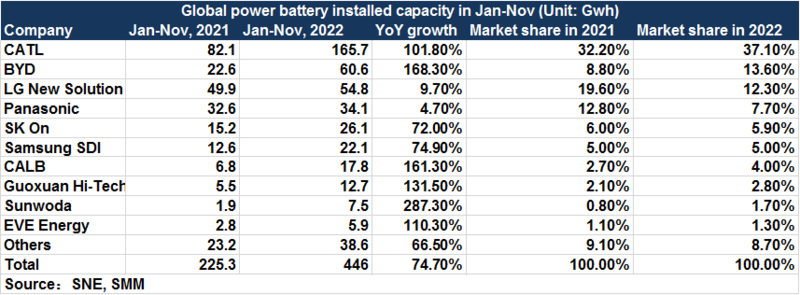
In terms of countries, the list of the top ten power battery companies in the world indicated that the growth rates of companies in China, Japan and South Korea were quite differentiated. Among them, the installed capacity of Chinese power battery companies more than doubled thanks to the rapid growth of its domestic new energy vehicle market demand. Six of the top ten companies are from China, accounting for 61% of the total global market share. The growth rate of Japanese and Korean battery cell companies, which once had a strong upward momentum in 2021, slowed down in 2022, and some of these companies' market share were swallowed by Chinese companies. Specifically, the market share of Korean companies slide by 7.4% to 23.1%, which was owed in good part to the slowdown in LG Energy Solution's growth. The market share of Panasonic also dropped from the previous 13% to about 8%. The reason behind the underperformance of Japanese and Korean enterprises was down to the poor demand in overseas market in 2022 under the influence of energy crisis, inflation, etc.
In terms of individual companyies, the two Chinese giants CATL and BYD achieved installed capacity of 165.7 Gwh and 60.6 Gwh respectively in the first 11 months of 2022, a year-on-year increase of 102% and 168%, respectively. They were the top companies in the world. It is worth noting that the growth rate of BYD's installed capacity reached 168% in 2022, second only to Sunwoda's, who enjoyed a year-on-year growth rate of 287%. Moreover, BYD's market share ranked second in the world, taking the long-held place of LG Energy Solution. BYD's sales of new energy vehicles skyrocketed in 2022. According to relevant data, BYD's total deliveries of new energy vehicles in 2022, with the popularity of its main models such as Qin Plus and Song Plus, stood at 1.86 million units, a year-on-year surge of 208%, ranking first in the world. Since BYD relied on its self-produced batteries for its new energy vehicles, the spike in its car sales naturally gave a boost to its power battery installed capacity. Fudi Battery started to supply batteries to companies other than BYD since March 2022, including Hongqi, Ford and Dongfeng. As such, its installed capacity was also boosted.
Compared with rapid growth of CATL and BYD, LG New Solution performed poorly in 2022. From January to November 2022, it will only achieved installed capacity of 54.8 Gwh, a slight year-on-year increase of 9.7%, which was far below the industry's average growth rate of 75%. The slowdown of LG New Solution's installed capacity in 2022 was mainly due to the internal failures of LG batteries that forced the company to recall its products multiple times. Besides, the growth rate of new energy vehicle sales in overseas markets gradually slowed down in 2022 due to the rising prices of lithium battery raw materials and inflation. The fact that the growth rate of demand for ternary batteries was slower than that for LFP batteries also weighed down the growth of LG New Solution's installed capacity. The performance of other two Korean power battery manufacturers, SK on and Samsung SDI, was slightly better, with each achieving installed capacity of 26 Gwh and 22.1 Gwh, an increase of 74% and 75% respectively. They took the 5th and 6th places among the top 10.
Panasonic, the only Japanese manufacturer on the top ten list, also performed weakly in 2022. Its installed capacity in the first 11 months of 2022 was only 34.1 Gwh, up slightly by 4.7% on the year, and its share dropped to 7.7% from the 12.8% in 2021.
CALB, the third largest power battery company in China, achieved 17.8 Gwh in its installed capacity in the first 11 months of 2022, a year-on-year surge of 161%. Its growth rate ranked third, second only to Sunwoda and BYD. At the same time, its market share in 2022 also rose rapidly from 2.7% in 2021 to 4%, closely following Panasonic, SK on and Samsung SDI.
Guoxuan Hi-Tech, Sunwoda and EVE Energy achieved installed capacity of 12.7 Gwh, 7.5 Gwh and 5.9 Gwh in the first 11 months of 2022, respectively, up 131%, 287% and 110% on a yearly basis.
![[SMM News] Solis starts lithium drilling at Campo Grande](https://imgqn.smm.cn/usercenter/KnMyT20251217171727.jpg)
![[SMM News] Charger re-commences drilling at Medcalf lithium deposit](https://imgqn.smm.cn/usercenter/QxQbN20251217171727.jpg)
![[SMM News] Savannah raised over $40 million to develop the Portuguese lithium project](https://imgqn.smm.cn/usercenter/OjVzX20251217171727.jpg)